




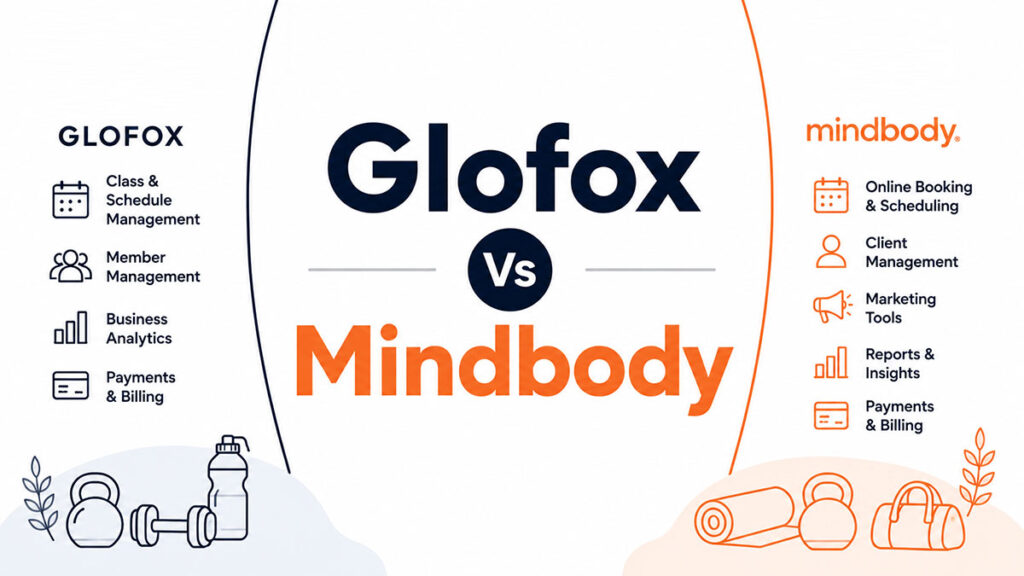
Picking the wrong gym management platform costs you time, money, and members. This comparison covers the Glofox vs Mindbody question from every angle: features, pricing, integrations, reviews, and support.
The core question: do you need a focused boutique fitness tool, or a broad wellness platform with consumer marketplace reach?
Both handle class scheduling, membership management, and payment processing. But that's roughly where the similarities end.
Their target users, pricing, and feature depth point in pretty different directions.
What Is Glofox?
Glofox is a gym and fitness studio management platform founded in 2014 in Dublin, Ireland, by Conor O'Loughlin, Finn Hegarty, and Anthony Kelly.
The original problem they were solving: fitness studios were running separate tools for scheduling, payments, member tracking, and communication. Four tools where one should do. Glofox was built to fix that.
Before the acquisition it had grown to serve customers across 80+ countries in 17 languages, with 220 people working almost entirely on the boutique fitness and gym market. Not wellness broadly. Fitness specifically.
In August 2022, ABC Fitness Solutions acquired Glofox for approximately €200 million (Preqin, 2022). It now runs as ABC Glofox, a business unit inside ABC's fitness tech portfolio.
Post-acquisition: 4,863 active locations across 80+ countries, 1.25 million studio members (ABC Glofox, 2024).
What Glofox Actually Does
Class scheduling, membership management, automated billing, and a white-label mobile app under your brand. That's the core of it.
Feature list:
- Class and appointment scheduling, including recurring bookings
- Member management and CRM with attendance tracking
- Automated billing via Stripe
- Branded mobile app (mid-tier plans and above)
- Staff management, digital waivers, basic reporting
One thing worth knowing: Glofox doesn't try to serve spas or salons. It's not a general wellness platform. If your business is purely fitness, that focus actually works in your favor. The product isn't cluttered with features you'll never use.
Who Actually Runs It Now
The co-founders stayed on after the deal, keeping leadership roles inside the combined business. ABC Fitness Solutions is a Thoma Bravo portfolio company (private equity, software-focused).
At acquisition, the combined entity covered 31 million members across 24,000+ fitness locations globally (ABC Fitness, 2022). So the platform didn't shrink after the deal. It got a lot bigger.
What Is Mindbody?
Mindbody started as Hardbody Software in 1998, founded by Rick Stollmeyer and Blake Beltram out of San Luis Obispo, California. Rebranded as Mindbody in 2001. Originally just a scheduling tool for small wellness businesses.
It grew into one of the larger fitness and wellness SaaS companies around.
The company went public on Nasdaq in June 2015 under ticker MB, raising over $100 million at $14 per share (PYMNTS, 2022). Vista Equity Partners took it private again in February 2019 for $1.9 billion.
In October 2021, Mindbody acquired ClassPass, which created what they describe as the world's largest fitness and wellness marketplace (Mindbody, 2021). Combined valuation at the time was around $3 billion.
Then in June 2025, a parent brand called Playlist was created to bring Mindbody, ClassPass, and Booker under one identity.
The Mindbody Product Suite
Mindbody operates as both a software platform and a consumer marketplace. That dual structure is what separates it from almost every other fitness management tool.
| Product Layer | What It Does | Who Uses It |
|---|---|---|
| Mindbody Business Software | Scheduling, POS, CRM, marketing automation | Studio and wellness business owners |
| Mindbody Consumer App | Discovery, booking, and payments marketplace | Fitness and wellness consumers |
| ClassPass Integration | Subscription-based class access across studios | Multi-studio fitness consumers |
| Branded App (add-on) | White-label app with your studio's branding | Studio owners on higher-tier plans |
The consumer marketplace currently has over 3 million active users searching, booking, and buying on the Mindbody app, with over 22,000 first-time purchases made from Mindbody-discovered businesses every month (Mindbody, 2025).
Mindbody's Scale in Numbers
Mindbody powers over 40,000 businesses globally, from independent studios to large franchise groups.
- 600 million+ classes and appointments booked annually on the platform
- Mindbody app downloaded over 6 times per minute in 2025
- Over 1,400 industry decision-makers surveyed for its 2025 State of the Industry Report
Mindbody projected $500 million in revenue for 2024, representing 20% year-over-year growth (Athletech News, 2024).
Who Is Each Platform Built For?
Glofox Ideal User Profile

Glofox works best for boutique fitness studios and gyms with 1 to 10 locations that run a class-based model.
- CrossFit boxes, HIIT studios, cycling studios, and yoga gyms
- Studios that want a branded app without paying enterprise-level prices
- Operators who prioritize simplicity and clean member experience over feature depth
- Businesses running recurring memberships, drop-in passes, and class packs
The global boutique fitness studio market was valued at $46.85 billion in 2024 and is growing at 8.23% annually (ResearchAndMarkets, 2024). Glofox is built specifically for the operators driving that growth.
It is not a strong fit for appointment-based wellness businesses, spas, salons, or multi-service operators. Those businesses need Mindbody's broader service model.
Mindbody Ideal User Profile
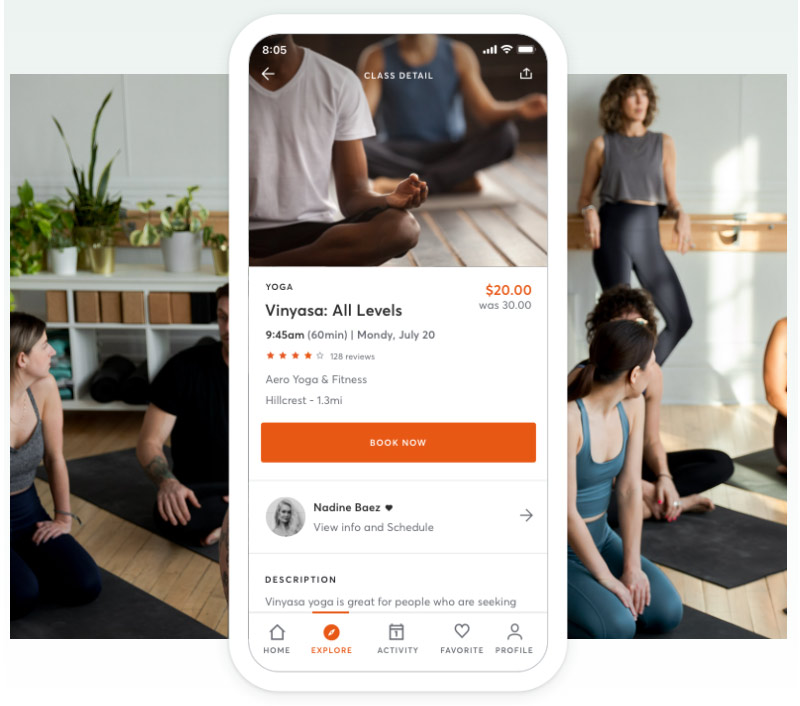
Mindbody serves a wider range of wellness businesses including yoga studios, Pilates, spas, salons, massage therapy, physical therapy, and dance studios.
The key differentiator is the consumer marketplace. If client discovery through a platform with 3 million+ active users matters to your business, that changes the value calculation entirely.
| Business Type | Better Fit | Primary Reason |
|---|---|---|
| Boutique fitness studio (1–3 locations) | Glofox | Simpler setup, branded app included at lower cost |
| Spa or salon with appointment booking | Mindbody | Appointment-first booking logic, salon CRM depth |
| Multi-service wellness center | Mindbody | Broader service category support |
| New studio needing client discovery | Mindbody | Consumer marketplace drives organic bookings |
| Established gym focused on retention | Glofox | Member engagement tools, recurring billing focus |
Mindbody has 2,990 reviews on Capterra. Glofox has 354.
But Glofox sits at 4.5/5 on G2. Mindbody is at 3.7/5 (G2, 2026).
Review count favors Mindbody, obviously. It's been around longer and runs at a much bigger scale. That's not a meaningful advantage when you're trying to figure out whether the software is actually good to use day-to-day.
A 3.7 at Mindbody's price point is a problem.
How Do Glofox and Mindbody Compare on Core Features?
Scheduling and Booking
Glofox handles recurring class schedules cleanly. Setup is fast and the member-facing booking flow is straightforward.
Mindbody's appointment booking is more capable. If your business mixes classes with personal training, spa treatments, or therapy appointments, that actually matters. Room assignments, practitioner calendars, intake forms. Glofox doesn't handle that combination well.
For a pure class-based studio, Glofox's scheduling is more than enough. For a multi-service business, Mindbody's depth earns its complexity.
Member Management and CRM
Ease of use score: Glofox 8.8/10 vs Mindbody 7.6/10 on G2 (2026).
Glofox offers a streamlined CRM focused on member retention, automated communications, and attendance tracking. Most studios find it covers 90% of what they need without digging through nested menus.
Mindbody's client management goes deeper. It includes detailed client history, health intake forms, SOAP notes for wellness practitioners, and more granular profile data. The trade-off is setup time and a steeper learning curve.
Branded Mobile App
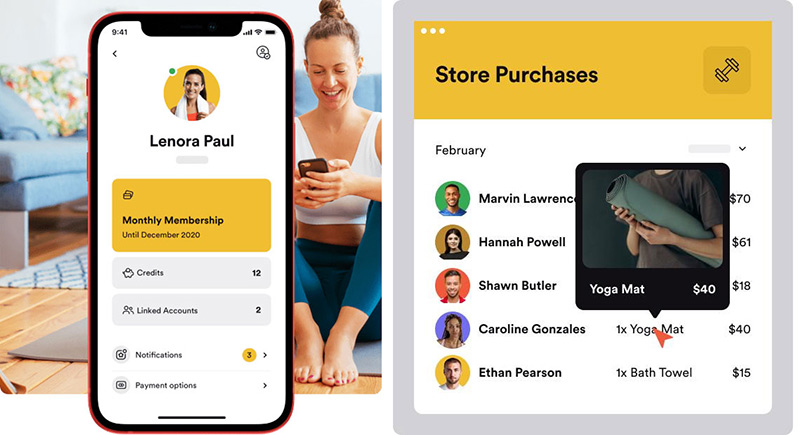
This is one area where Glofox has a real pricing advantage over Mindbody.
- Glofox: White-label branded app included in mid-tier plans, starting around $110/month
- Mindbody: Branded app requires the Ultimate plan, which starts at significantly higher monthly pricing
For studios that want members booking and managing their accounts from a branded app, this is one of Glofox's strongest arguments.
Marketing and Retention Tools
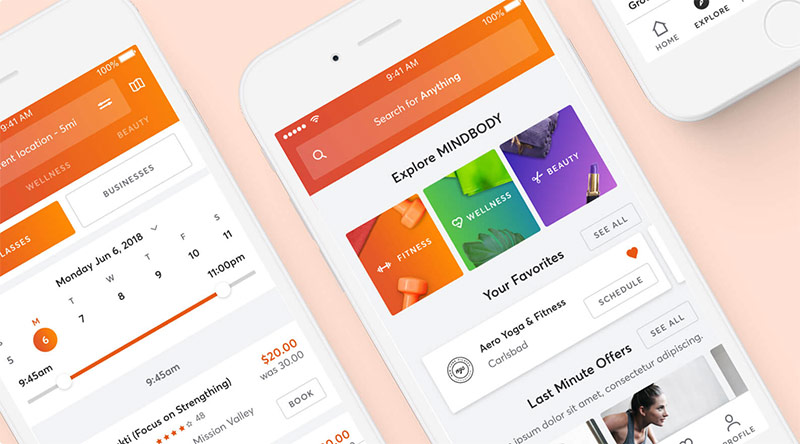
Mindbody's marketing suite includes built-in email campaign builders, automated client re-engagement flows, intro offer promotions inside its consumer app, and dynamic pricing for off-peak class slots.
Glofox offers basic automated communications and push notifications through the member app. It handles the essentials but does not match Mindbody's depth on marketing automation.
For studios that actively run campaigns, Mindbody's tools are more complete. Mindbody reports that businesses increase client bookings by 26% on average within 6 months of joining the platform (Mindbody, 2025).
Reporting and Analytics
Mindbody provides more granular business intelligence, covering revenue breakdowns, class performance, retention rates, and staff productivity from a central dashboard.
Glofox's reporting covers the basics. Multiple user reviews on G2 and Capterra flag limited reporting depth as one of the platform's clearest weaknesses, especially for studios tracking detailed financial KPIs.
One verified G2 user noted: the reporting becomes a limit at scale once a studio passes 3 locations (vibefam.com, 2026).
How Do Glofox and Mindbody Compare on Pricing?
Pricing is tricky to compare here because neither platform is fully transparent. Both require some level of contact with sales before you know your actual cost.
Glofox Pricing Structure
Glofox does not publish full pricing publicly. Plans are quote-based, with reported starting prices around $110/month for the base tier (SaaS Battle, 2026).
- Essential: Basic features, limited member volume
- Boost: Branded mobile app, automation, and more member capacity
- Elite: Full feature set, multi-location support, enterprise customization
- Enterprise: Custom pricing
Beyond the monthly subscription, Glofox charges Stripe transaction fees on top of plan costs. Multiple Capterra and G2 reviewers have flagged unexpected pricing increases of up to 70% with little notice, particularly following the ABC Fitness acquisition (vibefam.com, 2026). Annual contracts are common and cancellation can be difficult.
Mindbody Pricing Structure
Mindbody publishes its entry-level tier but keeps exact pricing for higher plans less transparent. The Starter plan begins at $99/month per location.
| Plan | Starting Price | Key Differentiator |
|---|---|---|
| Starter | $99/month | Basic scheduling and payments |
| Accelerate | Contact sales | Marketing suite, email campaigns |
| Ultimate | Contact sales | Branded app, advanced reporting |
| Ultimate Plus | Custom pricing | Multi-location, enterprise features |
Mindbody scores only 3.6/5 on value for money across Software Advice, Capterra, and G2, the lowest secondary rating of any major fitness platform in 2026 reviews (vibefam.com, 2026).
Total Cost of Ownership
The monthly subscription is rarely the full picture. Both platforms add costs in places that aren't obvious at signup.
Glofox hidden costs to account for: Stripe transaction fees, annual contract lock-in, onboarding fees on some plans, and potential mid-contract price increases.
Mindbody hidden costs to account for: Payment processing fees through Mindbody Payments, add-on charges for marketing tools on lower plans, and the annual contract structure that reviewers frequently cite as a frustration.
Mindbody has publicly positioned a "zero-cost software" model where marketplace revenue offsets subscription costs. Studios using both ClassPass and Mindbody saw average bookings climb 9.9% year-over-year in January 2025, while studios not on ClassPass experienced an average decline of 1.6% (Athletech News, 2026).
How Do Glofox and Mindbody Handle Payment Processing?
Glofox Payment Processing
Glofox runs on Stripe. Card-present, card-not-present, recurring billing, one-time class purchases. All of it goes through Stripe.
Payouts follow Stripe's standard 2-business-day schedule. Transaction fees stack on top of your monthly subscription, and the exact rates depend on your plan tier and where you're based.
Recurring memberships, drop-in passes, class packs, direct debit in supported regions. That covers most use cases. One thing worth knowing: you can't bring your own payment processor without workarounds. If you're already set up with a different provider, that's a real consideration before committing.
Mindbody Payments
Mindbody runs its own proprietary payment system called Mindbody Payments, available to US and Canada customers.
- Supports recurring billing, retail point-of-sale, and appointment deposits
- Next-day deposit option available for Mindbody Payments users
- Dynamic pricing tools let studios charge more for peak-hour bookings and less for off-peak slots
- Integrated with the consumer marketplace so purchases flow directly through the platform
For international customers outside the US and Canada, Mindbody Payments is not available. Those studios use third-party processor integrations instead, which adds a layer of complexity to setup.
Neither platform makes it easy to swap in your own preferred processor—worth checking before you commit to either, especially if you have existing payment infrastructure you want to keep.
How Do Glofox and Mindbody Compare on Integrations?
The size of each platform's integration library reflects how they see their role. Mindbody wants to be the hub of a broader business tech stack. Glofox wants to be a focused, self-contained tool.
Mindbody's Integration Ecosystem
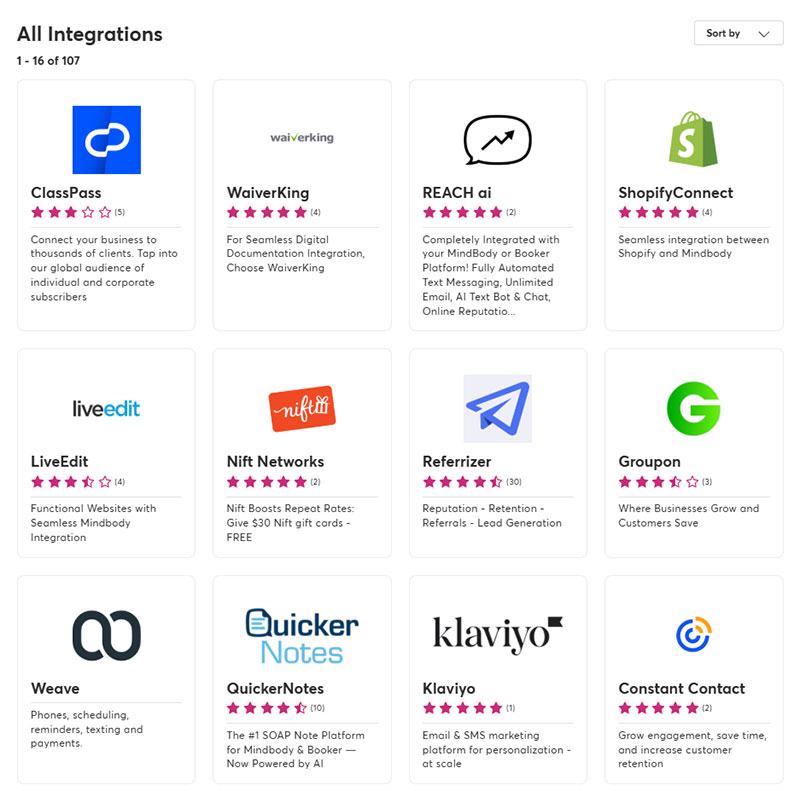
Mindbody has a large partner ecosystem with 700+ solutions across marketing, access control, wearables, and business tools (Mindbody, 2025).
Zapier, QuickBooks, Google Analytics, Perkville, MyFitnessPal. The API is publicly documented, so third-party developers have been building on top of it for 20 years. That history shows.
ClassPass integration is native. For studios trying to fill empty class slots through subscription-based discovery, that's actually useful. Over 22,000 first-time purchases happen monthly from Mindbody-discovered businesses (Mindbody, 2025).
Glofox's Integration Library
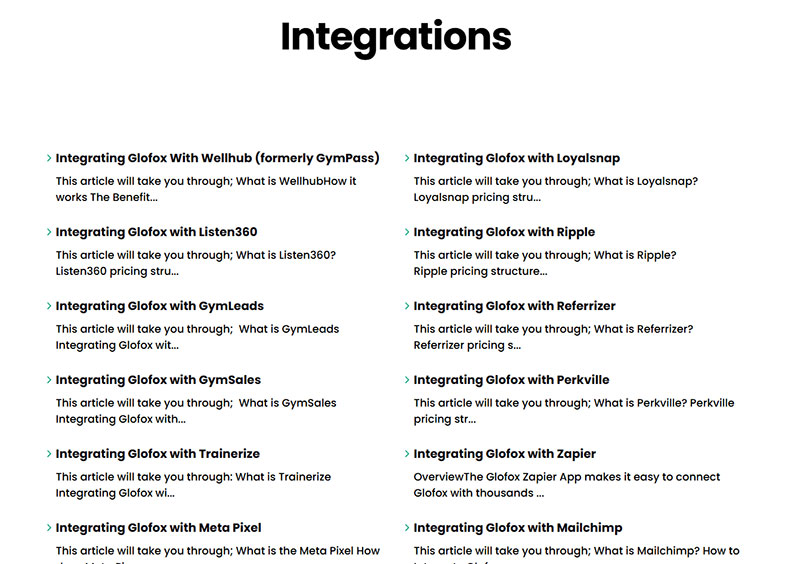
Glofox has a smaller but functional integration set. The most commonly used connections include Zapier, Zoom (for virtual classes), and Kisi (for keyless gym access control).
Glofox's API is available but less publicly documented than Mindbody's. Custom API builds are primarily used for enterprise-scale operators rather than everyday integrations.
For most boutique studios, Glofox's native feature set covers enough that the smaller integration library is not a daily problem. But if you rely on specific third-party tools for marketing, accounting, or access control, run a compatibility check before switching.
One practical note: Glofox is not a native ClassPass partner the way Mindbody is. Mindbody's ownership of ClassPass gives it a structural distribution advantage that Glofox's partner network does not currently match.
What Do Users Say About Glofox vs Mindbody?
Review platform data tells a consistent story: Glofox scores higher on satisfaction, Mindbody scores higher on volume.
Glofox User Feedback Summary
Glofox holds a 4.5/5 on G2 and 4.4/5 on Capterra, based on 137 and 354 reviews respectively (G2 and Capterra, 2026).
Top praise clusters around three themes:
- Clean, easy-to-learn interface for both staff and members
- Branded mobile app quality and reliability
- Onboarding support and tutorial resources
The recurring negatives are harder to ignore. Multiple G2 and Software Advice users in 2025 and 2026 reported pricing increases of up to 70% with little advance notice, particularly following the ABC Fitness acquisition (vibefam.com, 2026). Annual contract lock-in and difficult cancellation processes are the two most common complaints by a wide margin.
Mindbody User Feedback Summary
Mindbody leads on raw review count: 2,990 reviews on Capterra and 517 on G2, far more than any comparable fitness platform (Capterra and G2, 2026).
Overall ratings: 4.0/5 on Capterra, 3.7/5 on G2. Both are meaningfully lower than Glofox.
The positive themes center on feature breadth and marketplace visibility. Negative themes are consistent and specific:
- Scheduling interface described as unnecessarily complex for daily use (Capterra, April 2026)
- Value-for-money score of 3.6/5 on Software Advice, the lowest of any major fitness platform (vibefam.com, 2026)
- Annual contract structure cited repeatedly as a frustration
Head-to-Head Rating Comparison
| Metric | Glofox | Mindbody |
|---|---|---|
| G2 overall rating | 4.5/5 | 3.7/5 |
| Capterra overall rating | 4.4/5 | 4.0/5 |
| Ease of use (G2, out of 10) | 8.8 | 7.6 |
| Ease of setup (G2, out of 10) | 8.6 | 6.8 corrected |
| Value for money (Software Advice) | 4.2/5 | 3.6/5 |
Mindbody's ease of setup score of 6.8/10 on G2 is the most telling number in that table. Setup friction costs real time, and for a small studio owner without a dedicated IT person, that matters.
How Do Glofox and Mindbody Compare on Customer Support?
Glofox Support Structure
Ease of support score on G2: 8.7/10, versus Mindbody's 7.6/10 (G2, 2026).
Glofox offers live chat, email, and phone support with a dedicated onboarding specialist for new accounts. The Capterra score for customer service is 4.4/5.
The post-onboarding experience is where reviews split. Positive reviewers consistently cite responsive early support. Negative reviews, particularly from 2025 and 2026, describe support latency after the initial onboarding period ends, with some users reporting months of unresolved issues (vibefam.com, 2026).
Mindbody Support Structure
Mindbody provides phone, live chat, and email support across all plans. Higher-tier plans get priority access.
Support inconsistency is the dominant complaint across verified review platforms. Multiple Capterra users in 2025 described receiving templated email responses, being passed between agents, and finding that different support staff gave different answers to the same question.
The knowledge base and tutorial library are extensive, which helps for self-service questions. Orange Theory Fitness, which uses Mindbody's enterprise tier, has access to dedicated account management—a level of support not available on standard plans.
Which Platform Is Better for Multi-Location Businesses?
Mindbody Multi-Location Features
Mindbody supports multi-location management natively across all paid tiers above Starter.
- Corporate dashboard with network-wide visibility across all regions and locations
- Cross-location reporting on sales, client visits, and year-over-year revenue
- Location-level user permissions with centralized admin controls
- Shared client profiles for studios where members move between locations
Orange Theory Fitness and Solidcore both use Mindbody's enterprise tier for multi-location management (Active Blueprint, 2021). That track record carries weight for franchise operators evaluating the platform.
Many gym owners report using only about 40% of Mindbody's total feature set, with the rest feeling unnecessary for their scale (wellyx.com, 2026). That ratio may flip as location count grows.
Glofox Multi-Location Features
Glofox supports multi-location management, but it requires enterprise-level plans with custom pricing. Documentation on specific capabilities is thinner than Mindbody's.
Post-ABC Fitness acquisition, Glofox added multi-location insights, scheduled report delivery, and cross-location performance visibility. These features are stronger than they were pre-2022, but have less public documentation than Mindbody's equivalent setup.
For studios with 1 to 3 locations, Glofox handles the operational load without issue. For chains running 5 or more locations with complex permission structures, Mindbody's longer track record is worth factoring in.
Jazzercise selected ABC Glofox as its first external member management solution—powering 1,668 locations in 20 countries—a signal that the platform is credible for franchise-scale operators (ABC Fitness, LinkedIn, 2024).
What Are the Key Differences Between Glofox and Mindbody?
Glofox vs. Mindbody
Sources: G2, Capterra, Software Advice, Glofox.com (2025-2026)
Focus vs Breadth
Glofox is a fitness-first platform. Every feature is built around the class-based, membership-driven model that boutique studios run on. That focus makes the product cleaner and faster to learn.
Mindbody serves fitness, spas, salons, physical therapy, and integrative health. Broader coverage creates more configuration overhead, and that overhead shows up in its 6.8/10 ease-of-setup score (G2, 2026).
Consumer Discovery
This is Mindbody's structural advantage. No other fitness platform has a consumer marketplace with 3 million+ active monthly users searching for local fitness and wellness businesses (Mindbody, 2025).
Glofox does not have an equivalent discovery network. Studios on Glofox rely on their own marketing to bring in new clients. Studios on Mindbody get passive exposure inside a platform where consumers are actively searching.
Pricing Transparency
Mindbody: Publishes its Starter plan at $99/month. Higher plans require a sales call but have documented tiers.
Glofox: No public pricing at any tier. Every quote comes through a sales conversation, which makes cost comparisons harder before you engage.
Ownership Complexity
Both platforms now sit inside larger corporate structures. Glofox is owned by ABC Fitness Solutions (a Thoma Bravo portfolio company). Mindbody is owned by Playlist, the parent brand created in June 2025 to unite Mindbody, ClassPass, and Booker under one identity. In January 2026, Playlist announced a merger with EGYM, valued at $7.5 billion.
That complexity is not necessarily a problem, but it does mean product roadmap decisions are made at a parent-company level rather than by a founding team focused on your specific use case.
Which Platform Should You Choose?
Choose Glofox If…
Glofox is the right pick when your business fits this profile:
- Boutique fitness studio or gym with 1 to 3 locations
- Class-based model with recurring memberships and drop-in passes
- You want a branded mobile app without paying for a high-tier plan
- Ease of use and fast onboarding are more valuable than feature depth
The G2 ease-of-setup score of 8.6/10 reflects a real difference in how quickly staff can learn the platform. For small operators without dedicated admin teams, that matters more than advanced reporting. Read the contract terms carefully before signing—the pricing-increase complaints are real, and annual lock-in without an exit clause is a risk worth understanding upfront.
Choose Mindbody If…
Mindbody earns its complexity when the business model demands it.
Best fit scenarios:
- Multi-service wellness business mixing classes with appointments
- New studio that needs organic client discovery through a consumer marketplace
- Multi-location operator needing centralized reporting and permission controls
The consumer marketplace is the clearest differentiator. Over 22,000 first-time purchases are made monthly from businesses discovered on the Mindbody app (Mindbody, 2025). If you are opening a new location in a competitive market, that distribution channel has real dollar value.
Decision Framework
| Your Priority | Choose |
|---|---|
| Ease of use, fast setup | Glofox |
| Consumer marketplace exposure | Mindbody |
| Branded app at lower cost | Glofox |
| Multi-service wellness business | Mindbody |
| Franchise or 5+ locations | Mindbody |
| Boutique gym, 1–3 locations | Glofox |
Neither platform is a universal winner. The boutique fitness market grew from $43.13 billion in 2023 to $46.85 billion in 2024 at 8.23% annually (ResearchAndMarkets, 2024). Both tools are built for a growing industry. The question is which one is built for your slice of it.
FAQ on Glofox vs Mindbody
Is Glofox better than Mindbody?
For boutique fitness studios, Glofox scores higher on ease of use and setup. Mindbody wins on feature breadth and consumer marketplace reach. The better platform depends on your business model, not a universal ranking.
What is the main difference between Glofox and Mindbody?
Glofox is built exclusively for gyms and fitness studios. Mindbody serves a broader wellness market including spas, salons, and physical therapy. Glofox prioritizes simplicity; Mindbody prioritizes coverage.
How much does Glofox cost per month?
Glofox does not publish pricing publicly. Reported starting costs are around $110/month for base plans, based on user-reported data. Exact quotes require a sales call, and annual contracts are standard.
How much does Mindbody cost per month?
Mindbody's Starter plan begins at $99/month per location. Higher tiers require a sales call. Multi-location businesses pay per location, which increases total cost significantly at scale.
Does Glofox include a branded mobile app?
Yes. Glofox includes a white-label branded app in its mid-tier plans. Mindbody only offers a branded app on its Ultimate plan, which starts at significantly higher monthly pricing.
Does Mindbody have a consumer marketplace?
Yes. The Mindbody app has over 3 million active users searching for local fitness and wellness businesses monthly. No equivalent consumer discovery network exists within the Glofox platform.
Which platform is easier to set up?
Glofox scores 8.6/10 on ease of setup on G2, compared to Mindbody's 6.8/10. Most boutique studio owners report Glofox as faster to configure and easier for staff to learn from day one.
Can Glofox handle multiple locations?
Glofox supports multi-location management on enterprise plans. Mindbody has a longer track record with multi-location and franchise operations. For 5 or more locations, Mindbody's centralized reporting tools are more thoroughly documented.
What payment processor does Glofox use?
Glofox uses Stripe for payment processing. Mindbody runs its own proprietary system called Mindbody Payments, available to US and Canada customers. Both support recurring billing and membership management.
Are there alternatives to both Glofox and Mindbody?
Yes. Platforms like Zen Planner, Pike13, Wodify, and Mariana Tek serve similar markets. Each has different strengths across scheduling, pricing, and member management for fitness studio and gym operators.
Conclusion
This conclusion is for an article presenting the Glofox vs Mindbody decision as one that comes down to operational fit, not brand reputation.
Glofox delivers a cleaner member management system and faster onboarding for boutique gym operators who run class-based models with recurring billing.
Mindbody brings consumer marketplace reach, deeper appointment-booking logic, and a proven track record with multi-location wellness businesses and fitness franchises.
Neither platform is cheap. Both carry contract risks that warrant careful reading before you sign.
Match the tool to your studio's revenue model, location count, and whether client discovery or member retention is your bigger growth challenge right now.
Get that right, and the software decision follows naturally.