




The wrong scheduling tool quietly drains your week. Missed bookings, double-booked slots, clients who give up because the page was confusing. None of that shows up on an invoice, but you feel it.
So you're weighing Appointlet against Calendly. Fair. They're the two names that keep coming up whenever a service business, a solo consultant, or a small sales team goes looking for something better than emailing back and forth about times.
Here's the thing though. On paper they look almost identical. Calendar sync, automated reminders, team routing, the works. The real difference is who each one was built for, and that's where the price gap starts to make sense (or not).
Below I've gone through features, pricing, integrations, the team stuff, what actual users say, and compliance. Enough to pick one without second-guessing it later.
What Are Appointlet and Calendly?
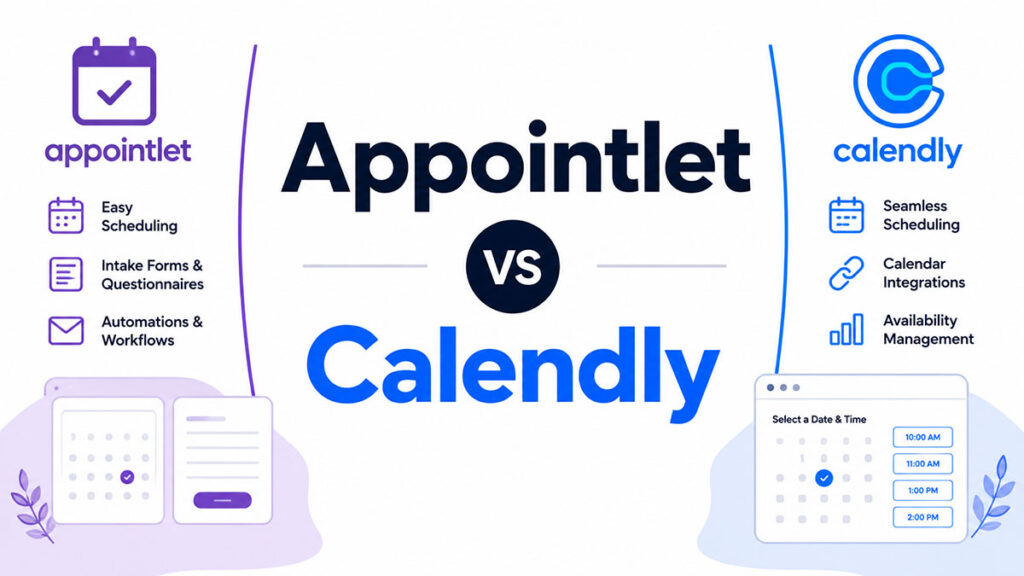
Appointlet is a scheduling tool built mostly for client work and team booking. Calendly is built around the shareable meeting link, the kind you drop in your email signature.
Both work the same way from the visitor's side: they land on a page, see your open slots, pick one. Where they part ways is who they're trying to please.
Appointlet has handled bookings for more than 120,000 organizations and crossed 7 million bookings since it launched (TechRadar). Calendly is the heavyweight, with roughly 57.6% of the scheduling market and over 170,000 companies on it, per Enlyft.
Calendly chases sales, recruiting, and SaaS hard. Appointlet goes after the people Calendly tends to overcharge: service businesses and client-heavy teams who want a branded booking page and don't want to pay enterprise rates to put their whole team on it.
| Attribute | Appointlet | Calendly |
|---|---|---|
| Primary market | Service businesses, SMBs | Sales, recruiting, SaaS, enterprise |
| User base | 120,000+ organizations | 20M+ users, 170,000+ companies |
| Pricing model | Free + Premium per seat | Free + 3 paid tiers |
| Market position | Budget-friendly team scheduler | Category leader, 57.6% market share |
What Is Appointlet
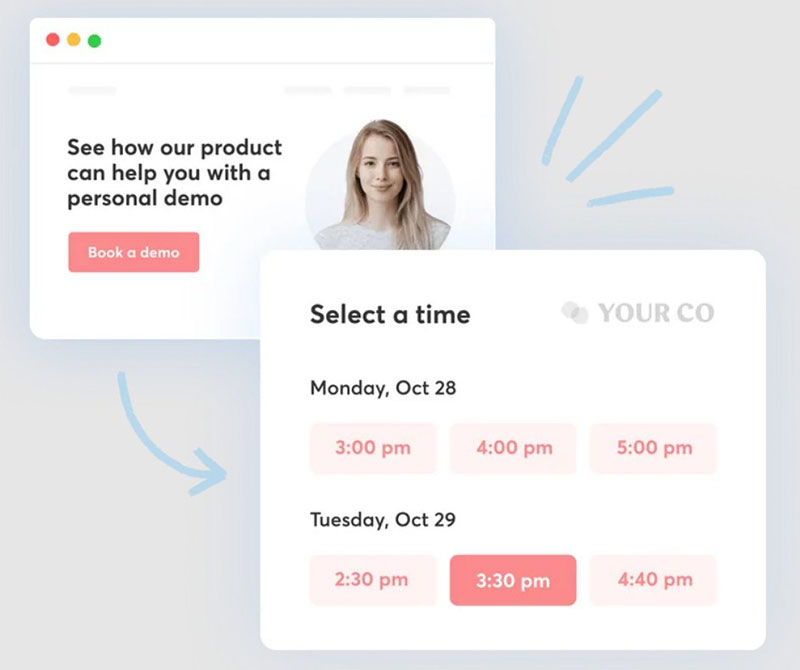
It began life as booking software for salons. Somewhere along the way it outgrew that and turned into a general-purpose tool you'll now find running schedules for consultants, tutors, healthcare-adjacent practices, and corporate customer success teams.
It hooks into Google Calendar and Microsoft Office 365 with a two-way sync. This keeps you from getting double-booked.
You set your recurring hours, add buffer time between meetings, block off the days you're out, then hand people a booking link or drop a widget straight onto your site.
- Branded booking pages with custom logos, colors, and welcome messages
- Intake forms for collecting info before the meeting
- Pooled availability and round-robin assignment for teams
- Manual booking approval as an option
- Redirect URLs after confirmed appointments
What Is Calendly
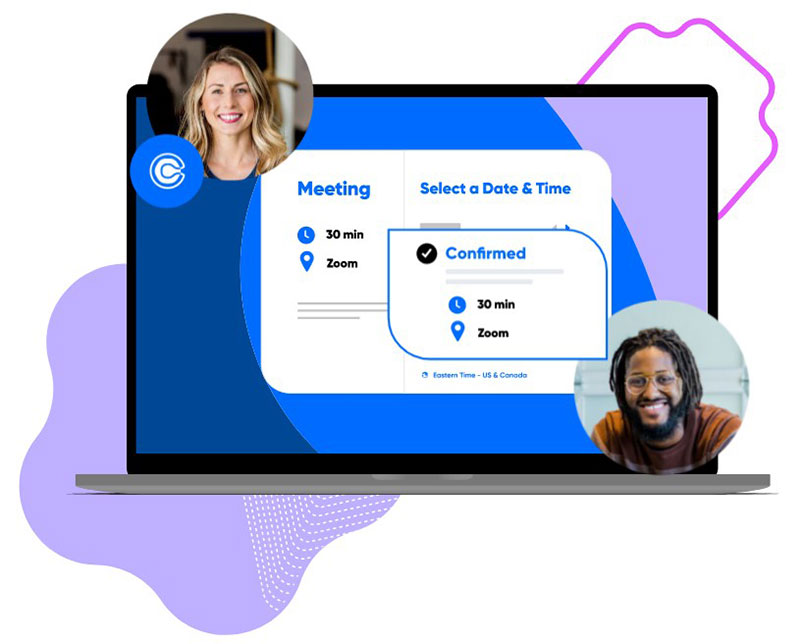
Calendly launched in 2013. Within a few years it had basically turned into a verb. If someone says "send me your Calendly," nobody asks what that means anymore. Roughly 35% of its users sit in sales and business development, and recruiting and HR account for another 25% or so, according to business model research from 2025.
Its numbers climbed fast. The company went from 4 million users in 2019 to over 20 million by 2023. What's interesting is where the revenue shifted. By 2024-2025 the bulk of new money was coming from enterprise contracts, more than 80% of the growth riding on team plans instead of individual sign-ups.
Plans run Free, Standard, Teams, and Enterprise. A freelancer can live on the link alone, while a bigger company gets the SAML SSO and admin controls it needs to say yes. Wide coverage, sure. But that's also exactly the spot where costs balloon once you start putting a whole team on paid seats.
How Do Appointlet and Calendly Compare on Core Features?
Both platforms handle the basics of online appointment booking: shareable scheduling links, calendar sync, invitee-facing booking pages, and automated confirmation emails. Where they split is in depth, flexibility, and which user type each feature set actually serves.
| Feature | Appointlet | Calendly |
|---|---|---|
| Meeting types | One-on-one, group, round-robin, collective | One-on-one, group, round-robin, collective |
| Intake forms | All plans including free | Standard and above |
| Custom branding | Logo, colors, welcome message | Limited on free, more on paid plans |
| Buffer times | Yes | Yes |
| Timezone detection | Automatic | Automatic |
Appointlet Core Features
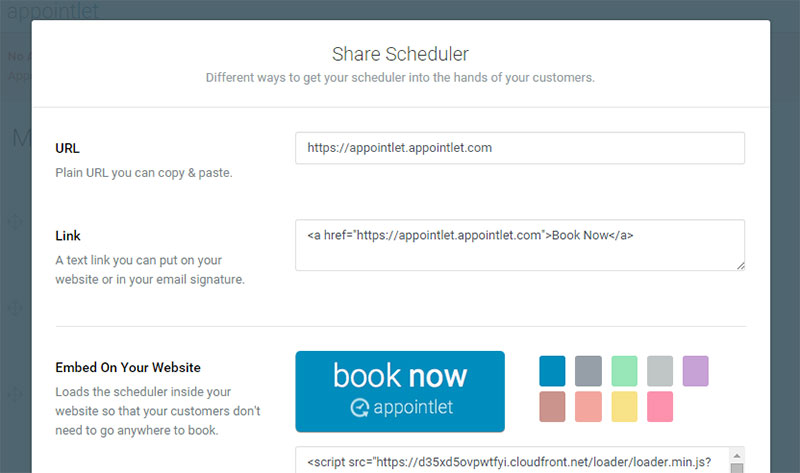
Booking page customization is where Appointlet punches above its weight. Logo, brand colors, custom welcome messages, and intake questions are all available on the free plan, not locked behind a paywall. That's actually rare at this price point.
Appointlet automatically detects and converts time zones for invitees, which matters for teams scheduling across regions. Buffer times between appointments, daily scheduling limits, and availability rules by day of week are all configurable.
- Unlimited meetings and team members on the free plan
- Custom intake forms on all tiers
- Manual approval option for bookings
- Booking page embed as inline widget or popup
Calendly Core Features
Calendly's free plan is limited to 1 active event type. That's a real constraint for anyone running more than one type of meeting. The Standard plan at $10/user/month (billed annually) unlocks unlimited event types and calendar connections.
Where Calendly leads is routing. Routing Forms let teams qualify leads through marketing forms in Marketo, HubSpot, or Pardot, then direct them to the right booking page automatically. Appointlet has no native equivalent to this feature.
- Routing Forms on Teams and Enterprise plans
- Calendly Workflows for multi-step automated sequences (reminders, follow-ups)
- Payment collection via Stripe and PayPal on Standard and above
- Chrome extension for scheduling directly from Gmail
How Do Appointlet and Calendly Differ on Calendar Integrations?
Calendar integration depth affects whether a scheduling tool actually works in your team's existing stack. A booking that doesn't sync reliably with connected calendars creates double bookings, which defeats the whole point.
Both tools handle the two dominant calendar platforms. The differences show up in how many calendars each platform checks, which video conferencing tools connect natively, and how far the CRM integrations actually go.
Calendar Sync Support
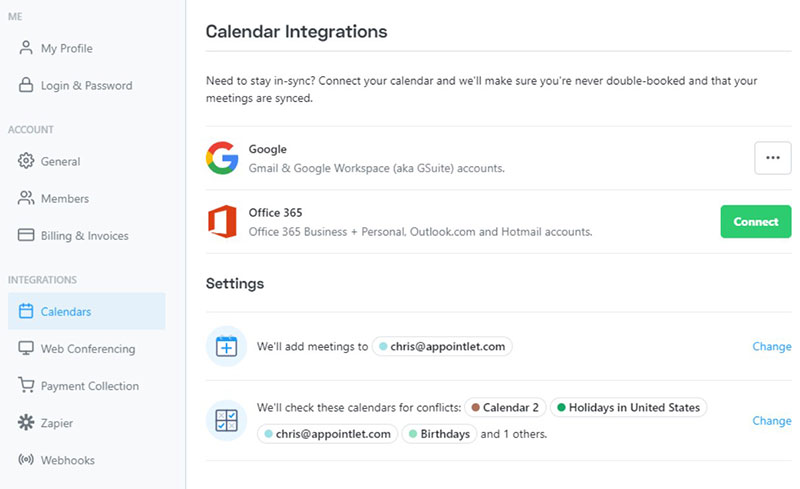
Calendly checks up to 6 connected calendars per user for conflict detection. Appointlet syncs with Google Calendar and Microsoft Office 365 through two-way integration, checking connected calendars per member.
Calendly also supports iCloud Calendar. Appointlet does not have native iCloud support, which matters for teams with heavy Apple ecosystem usage.
- Google Calendar: both platforms
- Microsoft Outlook / Office 365: both platforms
- iCloud: Calendly only
- Multi-calendar conflict checking: Calendly (up to 6), Appointlet (connected calendars per member)
Video Conferencing Integrations
Appointlet connects with Zoom, Google Meet, GoToMeeting, and Join.me natively. Calendly connects with Zoom, Google Meet, and Microsoft Teams, adding its Zoom link to every event automatically once the integration is configured.
For teams running entirely on Microsoft Teams, Calendly's native integration is cleaner. Appointlet users on Teams typically route through Zapier.
CRM and Third-Party Integrations
If you want to see the real difference between these two, watch what happens after a meeting gets booked. This is where it shows up.
Calendly does its CRM work natively. Salesforce on the Teams plan and up, HubSpot from Standard onward. Book a meeting and it can spin up a new contact or update an existing one, drop the meeting onto the CRM timeline, even kick off a HubSpot workflow without you touching anything.
That matters more than it sounds. HubSpot found that sales reps spend just 28% of their time actually selling (HubSpot, 2024). The rest? Scheduling, data entry, updating records. The stuff nobody got into sales to do. Calendly's direct sync is aimed squarely at clawing some of that time back.
Appointlet gets to the same CRMs, just by a different road. Salesforce, Zoho, Mailchimp, all reachable through Zapier and webhooks. The connections hold up fine. But you're routing them through Zapier as a middle layer instead of plugging in directly, and if your team isn't already paying for Zapier, that's another subscription plus the time it takes to wire everything up.
How Do Appointlet and Calendly Handle Team Scheduling?
Team scheduling is where the two platforms diverge most clearly in philosophy. Appointlet was built with managed team pages in mind from early on. Calendly started as an individual-first tool and bolted team functionality on top as the product scaled toward enterprise.
Both platforms support round-robin assignment, collective scheduling, and group events. The mechanics differ, and so do the plan requirements.
Round-Robin Scheduling
Calendly handles round-robin with priority stars. When two or more people are open for the same slot, the stars decide who lands the meeting. Behind that, it's counting. The system keeps a running tally of how many meetings each person has taken, and once someone gets 3 ahead of the pack, Calendly quietly pulls them off the booking page until everyone else catches up (Calendly Help, 2025). Nobody ends up buried while a teammate coasts.
You get two ways to run it. One mode crams in as many meetings as possible by booking whoever's free. The other spreads the load evenly, even if that means showing fewer open slots to the person booking. Worth knowing though: round-robin only lives on the Teams and Enterprise plans. Standard doesn't get it.
Appointlet's version covers the same ground and then some. You've got the automatic rotation, sure, plus pooled availability and the option to assign a host by hand when you want to override the machine. And it's on every paid plan, not gated behind the priciest tier.
Collective and Group Meetings
Collective scheduling shows only time slots where all selected hosts are free simultaneously. Both platforms support this. On Calendly, it is available from the Standard plan upward. On Appointlet, it is included in the Premium plan.
Group events let a single host meet multiple invitees in the same time slot, useful for webinars, onboarding sessions, or workshops. Both platforms support this format.
Team Admin and Management
Appointlet displays all team members' availability on a single booking page, letting invitees select any available member. Each member also has their own individual scheduling page.
Calendly's team admin controls include:
- Admin-managed team event types with custom links
- User provisioning on Enterprise (SCIM)
- Activity logs and audit trails on Enterprise
- Routing to specific team members based on lead qualification
For teams under 20 seats without complex routing requirements, Appointlet's team management is comparable. For teams with Salesforce routing, SAML SSO requirements, or inbound lead qualification workflows, Calendly's architecture handles it better.
What Are the Pricing Differences Between Appointlet and Calendly?
Pricing is the most straightforward area where Appointlet has a clear advantage for small and mid-size teams. The gap is real and it compounds as team size grows.
Both tools offer free plans. Both offer annual billing discounts. The structure of what you get at each tier is where they split.
Appointlet Pricing
The free plan gives you unlimited meetings and unlimited team members. Read that again, because it's the headline. Calendly's free tier caps you at one active event type and starts charging the moment a second person needs real access to the team features. Appointlet just... doesn't.
- Free: Unlimited meetings, unlimited members, intake forms, basic booking pages
- Premium: $10/user/month, or $9/user/month if you pay yearly. Adds white-labeling, payment collection, Zapier, and the advanced team controls
- Enterprise: Custom pricing for the security, reporting, and priority support stuff
Calendly Pricing
Calendly's free plan boxes you into one active event type and a single calendar connection. Most people blow past that in about a week.
- Standard: $10/user/month (annual). Unlimited event types, Stripe and PayPal payments, the basic integrations
- Teams: $16/user/month (annual). This is where round-robin, Salesforce, routing forms, and admin controls show up
- Enterprise: Starts at $15,000/year. SAML SSO, SCIM, audit logs, Microsoft Dynamics, a dedicated CSM
Cost at Scale
Put ten people on annual billing and the math gets loud. Appointlet Premium comes to $90 a month. Calendly Teams comes to $160. That's $840 a year for the exact same headcount, and it only gets worse as you climb to 20 or 30 seats.
Part of why is that Calendly starts billing the second you drop a second user into a shared workspace. Appointlet lets you stack multiple members on the free plan and never nudges you toward an upgrade you didn't ask for.
So who actually wins here? If you're running a service business or a small team that's never going to touch Calendly's heavy routing and CRM machinery, Appointlet Premium does basically the same scheduling job for roughly half the cost per seat. The fancier features are real. You just might not need a single one of them.
How Do Appointlet and Calendly Handle Embedding and Booking Page Customization?
Embedding a booking widget into a website or landing page is standard practice for service businesses and sales teams. How each platform handles embed options, visual branding, and custom domain support determines how professional the booking experience looks to the invitee.
Embed Options
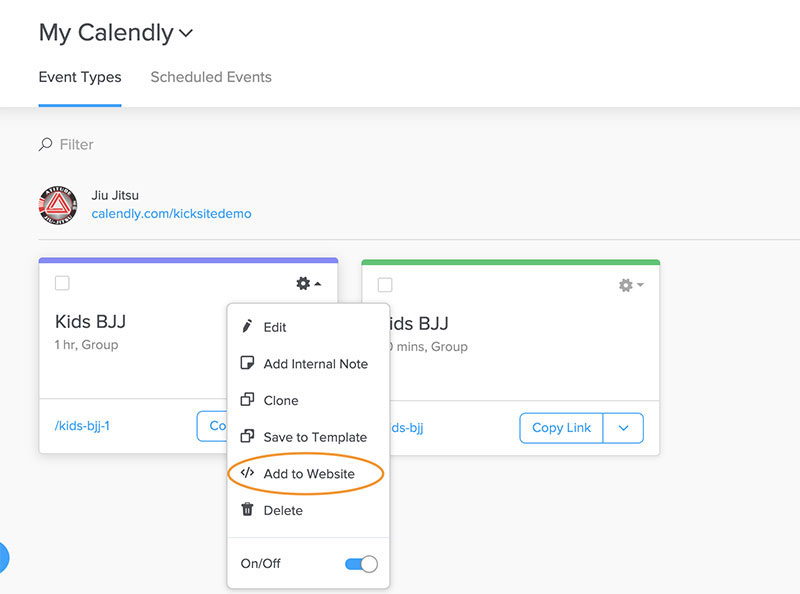
Both Appointlet and Calendly support 3 main embed formats: inline embed (the booking calendar appears inside a page section), popup widget (triggered by a button click), and a floating button that stays persistent as users scroll.
Appointlet's embed code drops into any HTML page or website builder. Calendly offers the same, plus a Chrome extension that lets users insert their scheduling link directly from Gmail without visiting the Calendly dashboard.
Branding and Visual Customization
Appointlet allows logo upload, custom brand colors, and welcome messages on all plans including free. Removing Appointlet branding from the booking page requires the Premium plan.
Calendly's branding customization is more restricted on lower tiers. The Standard plan adds some customization options, but removing the Calendly logo requires higher plan access. For service businesses where the booking page is an extension of the client-facing brand, Appointlet's free-tier branding options are a genuine advantage.
Custom domain support, which lets users host booking pages at their own URL rather than a calendly.com or appointlet.com subdomain, is available on Calendly's higher plans. Appointlet's custom domain availability depends on the plan tier.
Impact on Conversion
A fully branded booking page reduces friction for new clients who haven't interacted with the scheduling tool before. They see the company's logo and colors rather than a third-party interface. For service businesses running high-volume client booking, this detail matters for conversion on landing pages and email campaigns.
Calendly's popup and inline embeds are well-documented and used by companies like HackerOne, which connected with 88% more customers year over year after implementing Calendly's scheduling workflow (Calendly, 2021). That result reflects the platform's broader integration depth more than embed format alone.
How Do Appointlet and Calendly Perform on Workflow Automation?
Scheduling automation goes beyond the booking itself. Reminders reduce no-shows. Follow-up sequences keep leads warm. Webhook triggers push booking data into CRMs and email tools. The depth of these capabilities separates a basic booking tool from a proper scheduling automation platform.
Scheduling software with automated reminders reduces missed appointments by 50–80% compared to manual confirmation processes, based on aggregate data from over 10,000 businesses (Scheduling Kit, 2024–2025).
Reminders and Confirmation Sequences
Both platforms send automated booking confirmations and reminders. Appointlet handles email reminders and confirmation messages with customizable templates. Calendly's Workflows feature goes further, offering multi-step automated sequences that trigger before and after meetings.
Calendly Workflows, available on Standard and above, allows users to:
- Send SMS reminders (on Teams and Enterprise)
- Trigger follow-up emails after a meeting completes
- Send pre-meeting instructions or preparation materials automatically
- Set custom timing for each step in the sequence
Appointlet's reminder and confirmation setup is simpler. It covers the core use case but lacks the multi-step sequence builder that Calendly's Workflows provides.
Zapier, Webhooks, and Native Automation
Appointlet supports Zapier and native webhooks on the Premium plan, which opens connections to thousands of third-party tools including Salesforce, Zoho CRM, Mailchimp, and Slack. Post-booking redirects to custom thank-you pages are also configurable.
Calendly's automation stack includes native webhook support and a full API, with access expanding based on plan tier. The API is available to Standard users for basic triggers; Enterprise plans get expanded API access for custom workflow development.
For teams using workflow automation software already, both platforms connect into existing stacks reasonably well. The difference is that Calendly's native integrations with HubSpot and Salesforce handle the data mapping automatically, while Appointlet's connections through Zapier require manual field mapping setup.
Post-Booking Redirect and Thank-You Pages
Both platforms support custom redirect URLs after a booking is confirmed. This lets teams send confirmed invitees to a branded confirmation page, a content resource, or an onboarding flow rather than leaving them on the default booking confirmation screen.
For teams tracking workflow automation benefits like reduced admin overhead and faster lead response times, the redirect plus CRM sync combination in Calendly is more turnkey. Appointlet's equivalent requires more configuration through Zapier but achieves the same end result.
What Do Users Report About Appointlet and Calendly?
Calendly scores 4.7 out of 5 on G2 (approximately 2,558 reviews) and 4.7 on Capterra (over 4,000 reviews). Appointlet holds a 4.8 out of 5 on Capterra across 105 reviews. Review volume alone tells part of the story: Calendly has category dominance, Appointlet has a smaller but consistently positive base (G2, Capterra, 2025–2026).
Both tools earn strong marks for ease of setup and ease of use. Where the feedback diverges is on pricing and feature depth.
What Users Like About Calendly
The most common praise: clean interface, reliable calendar sync, and time zone detection that works without configuration.
- Workflow automations: reminders, prep questions, and pre-meeting qualification praised consistently
- Integration quality with Zoom, Google Calendar, and Slack cited frequently
- Widely recognized among clients and prospects, reducing friction on the invitee side
Sales and business development users specifically highlight reduced admin load. One Capterra reviewer noted the platform "significantly reduced administrative work and made scheduling discovery calls much more efficient" (Capterra, June 2026).
What Users Like About Appointlet
Appointlet reviewers consistently highlight 3 things: support quality, pricing fairness, and ease of onboarding.
One G2 reviewer called it "the best solution for automated scheduling" that "reduces absences through automatic reminders" (G2, 2022). Another on Capterra noted the interface was the most intuitive of the 20+ tools tested, with customer support that is "super quick and understands everything" (Capterra, December 2024).
SMB Guide scored Appointlet 8.6 out of 10 across features, pricing, and usability (SMB Guide, 2024).
Common Complaints: Both Platforms
Calendly's free tier draws the most consistent criticism. Reviewers on Capterra call it "overly restrictive," noting that any use case beyond a single meeting type hits a paywall quickly. Customization is limited at lower tiers, and customer support quality drops for non-enterprise accounts.
Appointlet's complaints are different. Users flag the smaller native integration library compared to Calendly, and the .ics file format for calendar invites (vs. a Google Calendar link) has caused friction for some invitees. One reviewer noted a client canceled a meeting over the .ics attachment (Capterra, December 2024).
| Metric | Appointlet | Calendly |
|---|---|---|
| G2 rating | 4.4 / 5 (15 reviews) | 4.7 / 5 (2,558 reviews) |
| Capterra rating | 4.8 / 5 (105 reviews) | 4.7 / 5 (4,000+ reviews) |
| Top praise | Support, pricing, onboarding | Interface, integrations, reliability |
| Top complaint | .ics invites, smaller integrations | Restrictive free plan, paywall for branding |
Which Use Cases Fit Appointlet vs Calendly?
CALENDLY
| Category | Appointlet | Calendly | Edge |
|---|---|---|---|
|
Free Plan
|
Up to 5 meeting types and 5 team members with no credit card required. Teams can validate the tool fully before committing to paid. | 1 event type and 1 user only. A second seat triggers paid billing immediately, making it hard for teams to test collaboratively before buying. | APPOINTLET |
|
Paid Pricing
|
Premium plan at $12/member/month (or $9/month billed annually). Includes round robin, collective hosting, payment collection, and white-label branding at this tier. | Standard at $12/member/month ($10 annually). Round robin, collective hosting, white-label branding, and payment processing require the Teams tier ($20/month) or higher. | APPOINTLET |
|
Team Scheduling
|
Round robin (pooled availability) and collective hosting (multiple hosts, one booking) are both available on the base Premium plan. User permission management is also included. | Round robin and collective scheduling exist but sit behind the Teams plan. Calendly's team routing is more mature, with lead routing logic and CRM hand-off automation. | Depends on budget |
|
Integrations
|
Google Calendar, Outlook, Zoom, MS Teams, Google Meet, GoToMeeting, WebEx, Stripe, and Zapier (700+ apps). Webhooks for custom integrations are included at the Premium tier. | Over 100 native integrations including Salesforce, HubSpot, LinkedIn, Slack, Stripe, and Zapier. The breadth of CRM and sales-tool depth is wider than Appointlet's. | CALENDLY |
|
Calendar Connections
|
Unlimited calendar connections per person on the Premium plan. Useful for professionals juggling personal and multiple client calendars simultaneously. | Capped at 2 calendar connections on the Standard plan. Higher limits require moving to Teams or Enterprise, adding cost for users who manage several calendars. | APPOINTLET |
|
White-Label Branding
|
Branding removal, custom page colors, and post-booking redirect to your own URL are all unlocked at the $12 Premium tier. No Appointlet logo on client-facing pages. | Custom branding and logo removal are available on Standard, but full white-labeling (custom domain, complete Calendly logo removal) requires the Teams or Enterprise plan. | APPOINTLET |
|
Scale and Market Presence
|
Serves over 220,000 organizations and has processed more than 15 million bookings. Smaller footprint, but purpose-built for teams that want more features per dollar. | One of the most widely recognized scheduling platforms globally. Used by solo professionals through enterprise sales teams. Widely supported and documented across the SaaS ecosystem. | CALENDLY |
|
Payment Collection
|
Stripe payment collection is available on the $12 Premium plan. Paid consultants and service providers can charge for bookings without upgrading beyond the base paid tier. | Stripe payments are supported, but are locked to the Teams plan ($20/member/month). Solo consultants wanting payment-gated bookings must pay a premium to unlock it. | APPOINTLET |
|
Bottom Line
|
The stronger choice for budget-conscious teams that need round robin routing, payment collection, and white-label booking pages without moving past the first paid tier. | The stronger choice for sales-driven organizations that need deep CRM integrations, enterprise routing logic, or the brand recognition that makes clients feel at ease clicking the link. | Context dependent |
Corporate buyers account for 60% of the global appointment scheduling software market in 2024 (Fact.MR, 2024). But within that broad category, the split between individual-focused tools and team-focused scheduling systems is significant, and Appointlet and Calendly land on different sides depending on the use case.
Choosing between them comes down to 3 factors: team size, integration requirements, and whether the booking workflow is client-facing or internally driven.
Where Appointlet Fits Best
Service businesses, consultants, and small teams running client-facing booking workflows without needing deep CRM automation.
- Consulting firms where clients book directly from a branded landing page
- Education and tutoring services needing intake forms on all plans
- Customer success teams managing appointment-based onboarding
- Solo operators or teams under 10 seats who want scheduling without a per-seat paywall
Appointlet's free plan with unlimited members and intake forms works well for early-stage teams that need professional booking pages without committing to monthly software costs. For context, 94% of customers are more likely to book when online scheduling is available (HouseCallPro research, via NextPhone, 2024), and Appointlet delivers that at zero cost for basic setups.
Where Calendly Fits Best
Calendly is the clear choice when routing, CRM integration, or enterprise security are non-negotiable.
Sales teams using HubSpot or Salesforce benefit from native integrations that push meeting data directly into the CRM without Zapier. Recruiting teams handling high-volume candidate scheduling use round-robin with equal-distribution logic across large interviewer pools. Enterprise buyers on the $15,000+/year plan get SAML SSO, SCIM user provisioning, audit logs, and a dedicated customer success manager.
- Inbound sales with lead qualification through Routing Forms
- Recruiting pipelines with Greenhouse or Marketo integration
- SaaS companies with existing Salesforce or HubSpot stacks
Use Case Decision Framework
| Scenario | Better Fit |
|---|---|
| Small service team, budget-conscious | Appointlet |
| Solo consultant needing branded pages | Appointlet |
| Sales team with Salesforce routing | Calendly |
| Enterprise with SSO and audit requirements | Calendly |
| Recruiter with Greenhouse integration | Calendly |
Teams using a free meeting scheduler as their entry point often outgrow it when team size or CRM requirements expand. That's the point where the Appointlet-vs-Calendly decision becomes most relevant, since both serve the post-free-tool upgrade path differently.
What Are the Main Limitations of Each Tool?
Every scheduling platform has real tradeoffs. The ones that matter depend on your setup.
Appointlet Limitations
The integration library is smaller. Appointlet connects with Zoom, Google Meet, GoToMeeting, and Join.me for video, and reaches Salesforce, Zoho CRM, and Mailchimp through Zapier. Native direct integrations with HubSpot, Marketo, or Microsoft Dynamics are not available without the Zapier middle layer.
Analytics and reporting are limited on lower plans. Teams that need detailed booking-pattern data or conversion metrics across team members need the Enterprise tier.
- No native HubSpot or Marketo integration
- No iCloud Calendar support
- .ics file format for calendar invites (not a Google Calendar link) causes occasional friction
- Smaller review volume means fewer third-party comparisons and community resources
Calendly Limitations
Calendly's cost structure is the most cited pain point. The free plan is limited to 1 active event type, which is genuinely restrictive for anyone running more than one meeting format. The Teams plan at $16/user/month (billed annually) is required for round-robin, Salesforce integration, and routing forms, and pricing scales per seat with no team-wide flat rate below 30 seats.
Booking page customization at lower tiers is constrained. Removing Calendly branding, adding custom domains, and accessing full white-label options requires higher-tier access. Reviewers on Capterra consistently flag "limited customization for lower tiers" as a drawback (Capterra, 2024–2025).
Neither platform offers HIPAA compliance out of the box. Calendly holds SOC 2 Type 2 certification and ISO 27001 certification, but does not execute a Business Associate Agreement (BAA) for workflows involving Protected Health Information (Accountable HQ, 2025). Healthcare-adjacent scheduling requires a separate HIPAA-compliant tool or confirmation of BAA scope directly with Calendly.
Shared Limitations
Neither Appointlet nor Calendly provides native payment processing at the free tier. Both require Stripe or PayPal connections on paid plans to collect booking fees. Teams running paid appointments need to factor in the additional payment processor fees on top of the scheduling subscription.
For teams exploring a Calendly alternative specifically because of cost or feature gaps, the tradeoffs between Appointlet, Acuity Scheduling, and Setmore depend heavily on whether CRM routing or branded booking pages are the top priority.
How Do Appointlet and Calendly Compare to Each Other on Security and Compliance?
Security and compliance requirements increasingly drive scheduling tool selection, especially for teams in finance, healthcare-adjacent services, and legal. Both platforms handle standard business security well. The differences show up at the enterprise layer.
GDPR and Data Privacy
Calendly has designed its data privacy program to be compliant with GDPR and has incorporated a Data Processing Addendum into its Terms of Use. Accepting Calendly's Terms of Use puts the DPA in place automatically, with no additional agreement required (Calendly Help, 2022).
Appointlet's GDPR compliance documentation is less prominently published but covers standard data processing requirements for EU-based users. Teams with strict EU data transfer requirements should verify current DPA terms directly with both vendors before committing.
SOC 2 and Enterprise Certifications
Calendly holds SOC 2 Type 2 certification and ISO 27001 certification, both of which are documented through its security portal (Calendly, 2025). These are relevant for enterprise procurement reviews and vendor risk assessments.
- SOC 2 Type 2: Calendly confirmed, Appointlet not publicly confirmed
- ISO 27001: Calendly confirmed
- SAML SSO: Calendly Enterprise only
- SCIM provisioning: Calendly Enterprise only
- Audit logs: Calendly Enterprise only
HIPAA Considerations
Neither tool is suitable for workflows involving Protected Health Information without specific verification.
Calendly is not designed to collect PHI and does not execute a BAA as part of its standard agreements. Its own FAQ states that users should consult legal counsel before using it in healthcare scheduling workflows (ComplySaaS, 2025). GDPR fines can reach 4% of annual revenue, and HIPAA fines range from $100 to $50,000 per record, so the compliance decision carries real financial weight (Phala, 2025).
For healthcare-adjacent scheduling, teams using either platform should implement it only for non-PHI workflows and verify BAA availability directly with each vendor before any regulated use. Teams building a broader online booking system in a regulated industry need to treat the scheduling tool as one component in a larger compliance architecture, not a standalone solution.
FAQ on Appointlet vs Calendly
Is Appointlet cheaper than Calendly?
Yes. Appointlet's Premium plan runs $9/user/month annually. Calendly's Teams plan, which unlocks comparable team features like round-robin scheduling and Salesforce integration, costs $12/user/month. The gap widens at 10+ seats.
Which tool has a better free plan?
Appointlet's free plan includes unlimited meetings, unlimited team members, and intake forms. Calendly's free tier limits users to one active event type. For teams, Appointlet's free plan is meaningfully more generous.
Does Appointlet integrate with HubSpot?
Not natively. Appointlet connects to HubSpot through Zapier, which requires a separate subscription. Calendly integrates with HubSpot directly, syncing meeting data to contact timelines and triggering workflows automatically on Standard plans and above.
Which is better for sales teams?
Calendly. Its Routing Forms qualify leads through HubSpot, Marketo, or Pardot forms before routing them to the right rep's booking page. That inbound lead qualification workflow has no direct equivalent in Appointlet's feature set.
Can both tools handle round-robin scheduling?
Yes. Both platforms support round-robin meeting distribution across team members. Calendly's round-robin is available on Teams and Enterprise plans only. Appointlet includes it on the Premium plan with pooled availability and manual host designation options.
Is Calendly HIPAA compliant?
No. Calendly holds SOC 2 Type 2 and ISO 27001 certifications but does not execute a Business Associate Agreement for Protected Health Information workflows. Neither Appointlet nor Calendly should be used for PHI scheduling without direct BAA verification.
Which platform has better booking page customization?
Appointlet. Custom logos, brand colors, and welcome messages are available on the free plan. Calendly restricts branding options to higher tiers and charges extra for custom domain support and full white-label booking pages.
Does Calendly support iCloud Calendar?
Yes. Calendly syncs with Google Calendar, Microsoft Outlook, and iCloud. Appointlet supports Google Calendar and Office 365 only. Teams running Apple-heavy workflows should factor in this gap when comparing calendar integration depth.
Which tool is easier to set up?
Both are fast to configure. Reviewers on Capterra and G2 consistently rate Appointlet's onboarding as highly intuitive, with responsive live support. Calendly's setup is equally straightforward, though team-level features like routing and CRM sync add configuration complexity.
When should I choose Appointlet over Calendly?
Choose Appointlet when you need a branded client-facing booking page, manage a small-to-mid team, and don't require native Salesforce or HubSpot routing. It delivers comparable scheduling automation at roughly half the per-seat cost of Calendly Teams.
Conclusion
This conclusion is for an article presenting the core differences between Appointlet vs Calendly across pricing, team scheduling, integrations, and compliance.
Neither tool is universally better. It depends entirely on what your team actually needs.
Appointlet wins on cost, free-plan generosity, and branded booking page flexibility for service businesses and small teams. Calendly wins on native CRM integrations, lead routing automation, and enterprise-grade security controls for sales and recruiting teams.
If round-robin distribution, Salesforce sync, or SAML SSO are on your requirements list, Calendly is the right call. If they aren't, Appointlet delivers comparable scheduling automation at a significantly lower per-seat cost.
Match the tool to the workflow, not the brand name.