




The Vagaro versus Acuity decision isn't really a feature contest. It's a question of how much software you want your business running on. One of these tools wants to be the whole operation. The other wants to be one clean piece of it and stay out of your way.
Get that part wrong and the cost shows up everywhere: hours of setup you didn't need, staff fighting a tool that's too heavy or too light, clients drifting off because the booking flow felt clunky.
Both serve service businesses well. They're just built for different operations, different team sizes, and different daily rhythms. What follows breaks down the pricing, the scheduling, payments, client management, integrations, and what real users actually report, so you can pick without guessing.
What Is the Core Difference Between Vagaro and Acuity Scheduling?
Vagaro is a full business management platform built specifically for salons, spas, barbershops, gyms, and fitness studios. Acuity Scheduling (now running as Squarespace Scheduling since the 2019 acquisition) is a focused online booking tool aimed at coaches, consultants, therapists, photographers, and solo service providers.
The gap between them isn't really about feature count. It's about scope.
Vagaro hands you a POS system, payroll, inventory management, email marketing, and a public-facing marketplace, all bundled into one subscription. Acuity hands you a clean, reliable scheduling layer and leaves everything else to third-party integrations.
Vagaro serves over 100,000 businesses worldwide (Vagaro, 2025). Acuity has been the go-to client self-scheduling tool for solo practitioners and small service teams since long before Squarespace bought it.
Acuity is software you plug in. Vagaro is software you build your operation around. That one distinction matters more than any single feature comparison.
Vagaro's Identity as a Business Suite
Vagaro was built with one kind of customer in mind: the appointment-based business that also sells products, employs staff, and needs all of it tracked in one place.
What you get inside the platform runs wide. Online booking from the Vagaro Marketplace, Instagram, Facebook, and Apple Maps. A built-in POS with retail inventory tracking and product sales. Staff payroll through the Gusto integration or native Vagaro Payroll. Email and SMS marketing, with 1,000 free email messages a month on the base plan. And the ability to show up to 25 employee calendars at once on a single screen.
The Marketplace feature alone sets Vagaro apart from nearly every scheduling competitor. Clients can search Vagaro's public directory for nearby salons and spas and book directly. Acuity has nothing equivalent to that built-in client acquisition channel.
Acuity's Identity as a Scheduling Tool
Acuity does one thing exceptionally well: it makes client self-scheduling clean, fast, and reliable.
G2 reviewers rate Acuity's confirmation and reminder system at 9.5 out of 10, pointing to how effectively it cuts no-show rates for coaches and consultants.
Every Acuity plan gives you unlimited appointments on a customizable booking page, automatic time zone detection (which is critical for remote providers), custom intake forms to collect client information before each session, and payment collection through Stripe, Square, or PayPal at the moment of booking.
Acuity deliberately doesn't try to be an all-in-one system. For service providers who already have tools they like for accounting, marketing, and client management, that's a feature, not a shortfall.
How Do Vagaro and Acuity Scheduling Compare on Pricing?
Vagaro starts at $30/month for one bookable calendar and adds $10/month for every extra staff calendar. A 5-person salon is looking at a minimum of $70/month just for the base subscription, before any add-ons.
Acuity runs three tiers with no per-calendar upsell at entry level: Starter at $20/month, Standard at $34/month, and Premium at $61/month on monthly billing. Annual billing drops those to $16, $27, and $49.
| Plan | Vagaro | Acuity Scheduling |
|---|---|---|
| Entry price (monthly) | $30/mo 1 calendar |
$20/mo Starter, 1 calendar |
| Mid-tier (monthly) | $50/mo 3 calendars |
$34/mo Standard, up to 6 calendars |
| Upper tier (monthly) | $90+/mo 7+ calendars |
$61/mo Premium, up to 36 calendars |
| Free plan | No (30-day trial) | No (7-day trial) |
Neither one has a permanent free plan. Acuity's 7-day trial is shorter than Vagaro's 30-day trial, which is a real factor if you're still in the evaluation stage and want time to actually test it.
Vagaro's Add-On Cost Structure
Vagaro's base subscription covers the scheduling calendar, basic online booking, and core client management. Almost everything else costs extra.
The common add-ons stack up fast, roughly: text marketing at $20/month, custom forms at $10/month, the MySite website builder at $20/month, an online store or cart at $10/month, and the Data Lake advanced analytics at $40/month.
A 3-person salon running text marketing, forms, and a booking website realistically lands at $120 to $150/month before processing fees. Those fees run from 2.2% to 3.5% per card transaction depending on payment type and monthly volume (Pabau, 2025).
Smaller merchants processing under $4,000/month get charged higher in-person rates (2.75% + $0.15 per transaction). That stings for new businesses still ramping up their volume.
Acuity's True Cost Beyond the Subscription
Acuity's pricing looks cleaner upfront, but the real cost rides on which tier your business actually needs.
SMS reminders are locked behind the Standard plan ($34/month). If you need text-based appointment reminders to cut no-shows, and you do, the Starter plan at $20/month won't get you there.
HIPAA compliance for healthcare providers requires the Premium plan at $61/month. Payment processing fees come straight from Stripe, Square, or PayPal, since Acuity doesn't process payments itself, and those typically run 2.7% to 2.9% per transaction for card-present payments through Square or Stripe.
Video conferencing isn't built in either. If you run virtual sessions, add Zoom Pro at around $13 to $17/month on top of your Acuity subscription.
Which Platform Has Stronger Appointment Scheduling Features?
Acuity takes scheduling automation and the client self-booking experience. Vagaro takes calendar management depth for multi-staff operations. Which one wins for you depends entirely on whether you run a team or work solo.
The appointment scheduling software market was worth $332.8 million in 2024 and is projected to hit $891 million by 2032 at a 13.1% CAGR (Verified Market Research, 2024). Both platforms are fighting inside a space that's growing fast and getting crowded.
Acuity Scheduling's Self-Booking and Automation Tools
Automatic time zone detection is the feature that keeps surfacing in Acuity reviews from coaches and consultants. Clients book in their own time zone and the system adjusts on its own. That sounds minor right up until you've got clients scattered across four time zones and you start fielding confused confirmation emails.
The booking workflow goes deeper than that, though. There are conditional intake forms that show different fields based on the service selected. A "minimize gaps" feature that steers new bookings into slots right next to existing appointments, killing dead time in your schedule. Recurring appointment setup with flexible intervals. And package and membership sales tied straight into the booking flow on the Standard plan and above.
G2 reviewers rate Acuity's onboarding as exceptionally fast, consistently reporting they went from signup to a live booking page in under an hour. Vagaro can't claim anything close in that space.
Vagaro's Multi-Staff and Multi-Location Calendar Management
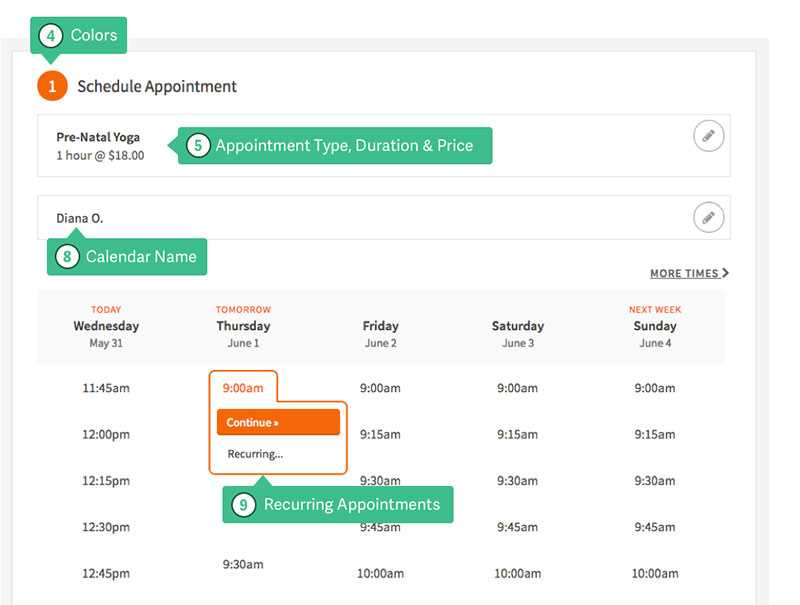
Vagaro's calendar depth is genuinely impressive for team operations. It lets you display up to 25 employee calendars at once on a single screen, which Acuity can't match at any price point.
The scheduling controls go well beyond that. Resource management, so you can book specific rooms, chairs, or equipment alongside staff. Gap processing time, which lets a provider take additional clients during the waiting stretches inside a service, say between a hair color application and the rinse. An automated waitlist with notifications when a slot opens. Buffer and lead time controls on every service type. And acceptance/denial controls for online booking requests from clients with cancellation histories.
That gap processing feature is the kind of thing you only find in software written by people who actually understand how beauty and wellness services run. Vagaro gets it right.
How Do Vagaro and Acuity Handle Payment Processing?
Vagaro has a fully built-in POS with native card reader hardware support. Acuity collects payments through three external processors: Stripe, Square, or PayPal.
This isn't a minor difference. If you run a business where clients pay on-site after a service, Vagaro's integrated POS is a real operational edge. If you run a remote or virtual service business, Acuity's third-party payment integration is perfectly fine.
Vagaro's Built-In POS and Payment Ecosystem
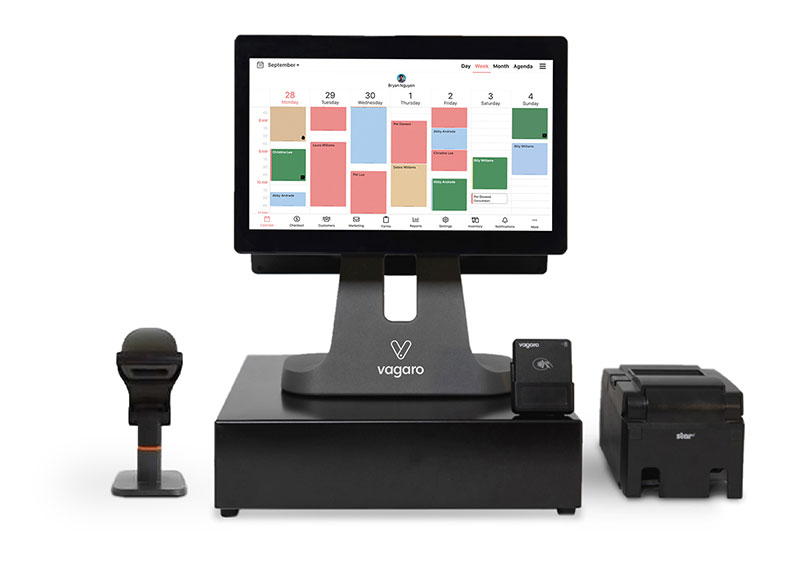
G2 users rate Vagaro's payment gateway integration at 9.5 out of 10 for versatility.
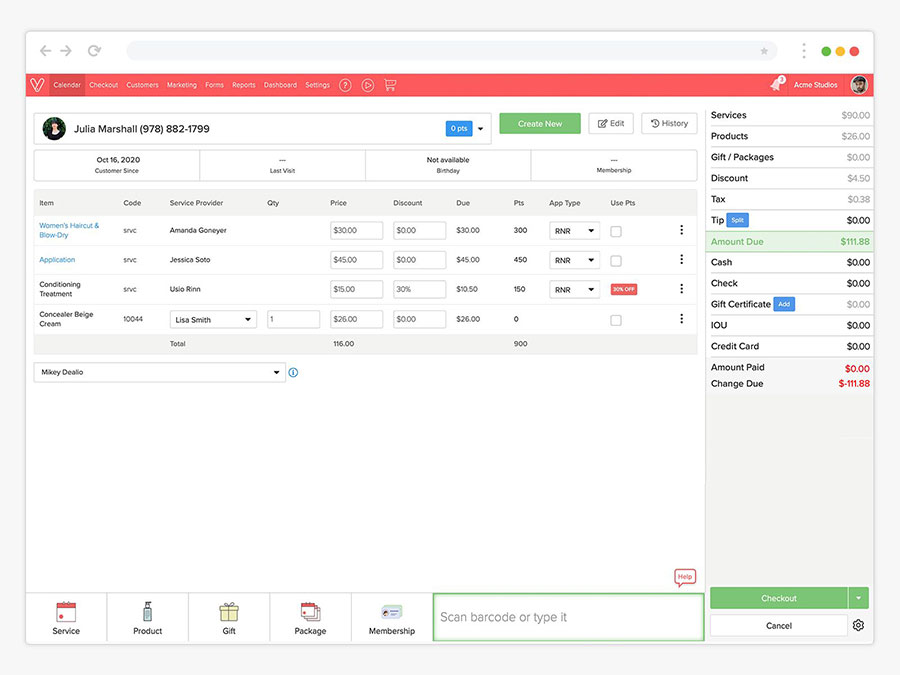
The POS system covers a lot of ground. In-person card processing with physical card readers (extra hardware cost: $100 to $380). Contactless payments including Apple Pay and Google Pay. Gift card creation and redemption. Membership billing and package sales with automatic recurring charges. And inventory sales tracked right at checkout with stock-level updates.
Processing fees vary by volume. Merchants over $4,000/month pay 2.2% + $0.19 per transaction. Merchants under that threshold pay 2.75% + $0.15 for in-person card payments. That lower-volume rate is noticeably higher, which matters a lot to independent stylists or newer businesses that haven't built up their monthly revenue yet.
Acuity's Payment Collection Workflow
Acuity doesn't charge transaction fees on top of your subscription. You pay only what your chosen processor charges.
For collecting payment, you've got a deposit or full payment taken at the time of booking, tip collection through automated follow-up emails after appointments, coupon codes and discount management inside the booking flow, contactless payment links sent to clients' phones, and invoices with payment links for post-appointment billing.
The main limitation is that there's no built-in in-person POS. If a client walks in and you need to process a payment, you're doing it through a separate Square terminal or Stripe reader that isn't natively wired to your Acuity calendar the way Vagaro's system is. Workable, but less integrated.
What Client Management Tools Does Each Platform Offer?
Vagaro's client profiles are built for service businesses tracking detailed histories across visits, purchases, and treatments. Acuity's client database is built for professionals who need session history, intake responses, and notes, without the retail and service-specific depth.
No-shows cost small and medium-sized businesses an average of $26,000 a year in lost revenue (10to8 research). Both platforms fight that with automated reminders, but the implementation and the depth differ significantly.
Vagaro's Client Profiles and CRM Depth
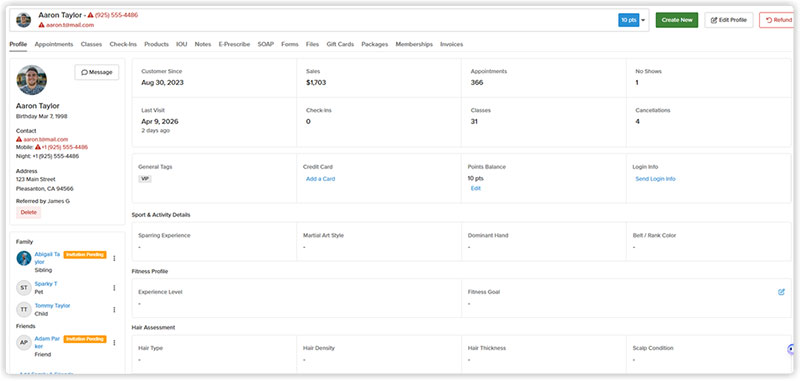
A Vagaro client profile holds a lot more than booking history. You get the full visit history with services received and which staff performed them, purchase history covering both services and retail products, custom formula notes (especially handy for salon color work), photos stored per appointment through Vagaro Drive (a paid add-on), and the client's loyalty points balance and membership status.
Two-way texting with clients runs through Vagaro's messaging feature, which is particularly valuable for salons and spas where quick back-and-forth on appointment changes is routine.
Vagaro also has a dedicated client-facing app that clients use to manage their own bookings, view their history, and receive promotional messages.
Acuity's Client Database and Intake System
Acuity's client management centers on the intake form system. Every form response is stored against the client's profile and sits there visible before their next appointment.
Alongside that you get a full appointment history per client with notes, intake form responses saved and searchable per client, automated email follow-up sequences after appointments, and vaulted credit cards on file for repeat billing on the Standard plan and above.
The booking page itself is customizable with your brand colors and logo, though the visual customization has limits. Acuity users on review platforms frequently mention that deep brand styling requires either a Premium plan for CSS access or working inside Acuity's fairly restricted template options. A photographer running a boutique studio, for instance, might find that frustrating compared to how tightly branded they can make everything else in their workflow.
How Do Vagaro and Acuity Scheduling Handle Forms and Intake?
Both support custom intake forms. Vagaro goes further with industry-specific form types. Acuity takes the win on conditional logic flexibility and HIPAA compliance clarity.
Acuity's Intake Form System and Conditional Logic
Acuity's forms handle a range of field types, single-line text, paragraph text, checkboxes, dropdowns, file uploads. The conditional logic lets you show or hide specific fields based on answers the client has already given.
That conditional piece earns its keep for providers who offer multiple session types. A coach running both individual coaching and group workshops can show entirely different intake questions depending on which option the client picks, all inside a single form.
HIPAA compliance is available on the Premium plan through a signed Business Associate Agreement (BAA), which is a real consideration for therapists, health coaches, and wellness professionals handling protected health information. Acuity recommends confirming the BAA details with them directly before purchasing, since the documentation on their public pricing page isn't fully detailed on this point.
Form delivery in Acuity is tied to the booking moment. Clients complete intake forms during the scheduling process, so you turn up to every appointment with their information already filled in.
Vagaro's Form Types and Clinical Documentation
Vagaro supports three distinct form categories that go past general intake: consent forms, SOAP notes, and pre-appointment questionnaires.
SOAP notes (Subjective, Objective, Assessment, Plan) are what massage therapists, physical therapists, and medical spa practitioners use to document session details in a clinical format. Vagaro's native support for that format is a meaningful differentiator for wellness businesses operating in or near clinical territory.
Digital signatures are supported inside Vagaro's form system, which matters for consent forms in medical spa and tattoo studio contexts where a signed waiver carries real legal weight.
Form delivery can be triggered at booking, before an appointment, or at check-in through the Vagaro Check-In App. That check-in trigger is useful for walk-in clients who never completed any digital paperwork in advance.
Vagaro is also HIPAA and EMR-compliant for medspas when it's configured correctly, which puts it level with Acuity for healthcare-adjacent businesses, with the added advantage of the full business management suite sitting alongside it.
Which Platform Offers Better Marketing and Retention Tools?
Vagaro has significantly more native marketing functionality. Acuity leans almost entirely on integrations with platforms like Mailchimp for anything beyond basic booking confirmations.
Businesses using online booking systems see an average revenue increase of 27%, with some local businesses reporting gains of up to 120% (Signpost, 2024). Marketing tools that drive repeat bookings aren't a nice-to-have. They're part of the growth equation.
Vagaro's Native Marketing and Loyalty Tools
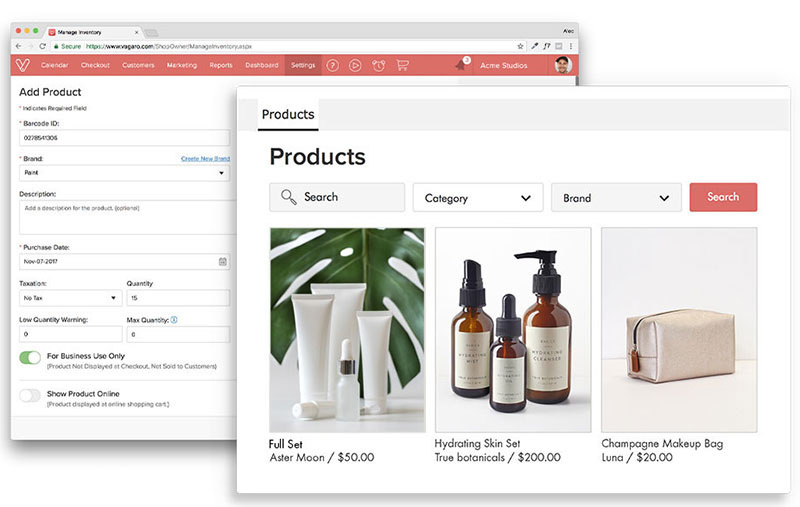
Vagaro's marketing suite is one of the features that most clearly separates it from pure scheduling tools.
It covers email marketing campaigns with 1,000 free messages a month on the base plan, SMS marketing campaigns to segmented client lists (a paid add-on at $20/month), a loyalty program with points tracking and redemption built into checkout, daily deals and promotional offers listed right on the Vagaro Marketplace, and review collection prompts sent automatically after appointments.
The Vagaro Marketplace works as a built-in discovery channel. Potential clients in a given area can search the platform for salons or spas and book directly, without ever visiting your website. For new businesses still building clientele, that's a meaningful edge, and Acuity has nothing equivalent.
Acuity's Marketing Approach and Squarespace Integration
Acuity's native marketing tools come down to discount coupons, package sales, and gift certificates inside the booking flow. That's about it for built-in marketing.
Where Acuity shines instead is its integration ecosystem. Because Squarespace acquired it in 2019, users who build their website on Squarespace get a tightly connected booking-plus-website-plus-email experience through the Squarespace platform. Mailchimp integration is available too, for email marketing automation, through Zapier or a native connection.
For a solo photographer or independent consultant whose marketing is mostly content-driven and handled through separate tools, Acuity's lean approach isn't a weakness. It's by design. The problem only shows up for growing service businesses that want everything in one place, because Acuity's "bring your own marketing tools" model piles on cost and complexity over time.
Vagaro's loyalty program deserves a separate mention. For salons trying to build repeat business, an integrated point-based rewards system that fires automatically at checkout is a retention tool with real impact on booking frequency. Acuity has no equivalent.
What Integrations Does Each Platform Support?
Acuity connects to more third-party tools out of the box. Vagaro has deeper native functionality, which cuts down how many outside tools you actually need.
Acquiring a new client costs 5 to 7 times more than keeping an existing one, according to Harvard Business Review (2024). That figure matters here because integrations with email marketing platforms are how both tools handle the retention side of the equation.
| Integration category | Acuity Scheduling | Vagaro |
|---|---|---|
| Calendar sync | Google Calendar Outlook iCal |
Google Calendar Apple Maps |
| Video conferencing | Zoom Google Meet GoToMeeting |
Zoom (via Zapier) |
| Accounting | QuickBooks FreshBooks (via Zapier) |
QuickBooks Xero (paid add-on) |
| Marketing automation | Mailchimp ActiveCampaign Constant Contact |
Mailchimp (via Zapier) Built-in email / SMS |
Acuity's Native Integration Ecosystem
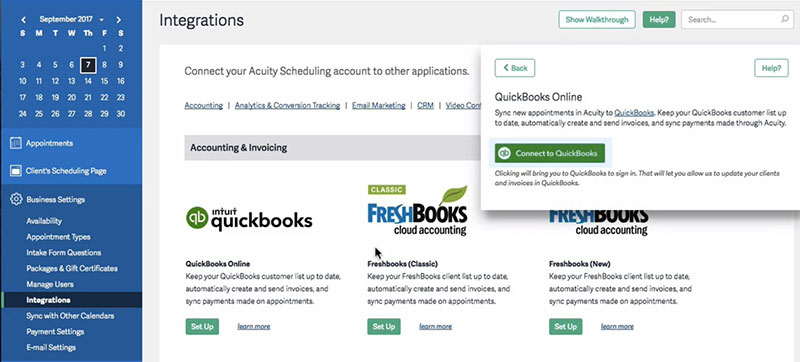
Acuity connects directly to Zoom, Google Meet, and GoToMeeting for virtual appointments. The video conferencing links generate automatically when a client books a session, with no manual steps from you or them.
Other native connections include ClassPass (bidirectional sync for class availability), Salesforce via Zapier (client data flows into the CRM on booking), Google Analytics for conversion tracking on the scheduling page, and Facebook and Instagram booking buttons.
Acuity supports up to 25 Zapier connections per contributor on the account, which opens access to thousands of additional apps without touching any code.
Vagaro's Integration Approach
API access costs $10/month extra and includes 5,000 webhook calls a month. Native integrations like Google Business Profile and QuickBooks don't need the webhook add-on.
The integrations reviewers cite most are Instagram (rated 4.6/5 for integration quality), Google Calendar (4.7/5), and Meta for Business (4.3/5).
The QuickBooks integration has a known limitation that several Vagaro users flag in reviews. It groups all sales into a single deposit line rather than separating service sales from product sales, which creates reconciliation friction for businesses with detailed financial reporting needs.
How Do Vagaro and Acuity Scheduling Perform for Group and Class Bookings?
Vagaro is the stronger option for businesses running group fitness classes, workshops, and recurring session series. Acuity handles group bookings, but it requires a higher-tier plan and lacks the operational depth class-heavy businesses need.
60% of salons and spas can reach an online booking rate of up to 60% when they use booking software (Signpost, 2024). For fitness and wellness studios where classes are the core product, that conversion rate leans heavily on how well the booking interface handles group session complexity.
Vagaro's Class and Group Session Management
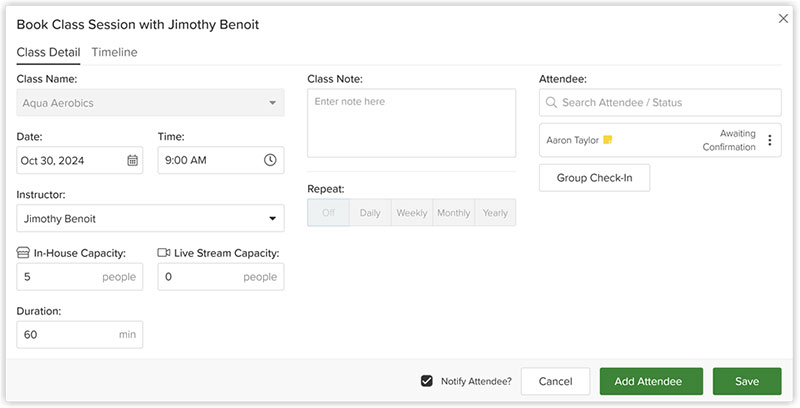
Vagaro was built with multi-instructor, multi-class operations in mind.
Its class management covers capacity limits per class with automatic booking cutoff once seats fill, an automated waitlist that notifies clients when a cancellation opens a spot, recurring class series on consistent weekly or monthly schedules, QR code check-in at the door synced directly to attendance records, class packs and unlimited membership plans tied to attendance tracking, and built-in live streaming for virtual classes with no third-party video account needed.
A yoga studio running 20 weekly classes across four instructors is exactly the scenario Vagaro handles cleanly. Each instructor gets a separate calendar. Classes appear on the public booking page with available spots shown in real time. A client can buy a 10-class pack and the system deducts automatically on each check-in.
Acuity's Group Class Functionality
Group classes require the Standard plan ($34/month) or above. They're not available at the Starter tier.
What Acuity gives you for group bookings is the ability to set maximum participant limits per class or session, accept payment per seat at the time of booking, and send unified reminders to all registered participants.
What it doesn't have is native live streaming, built-in check-in tools, or the class pack and membership depth Vagaro carries. For a coach or consultant running the occasional group workshop, Acuity's group booking is plenty. For a fitness studio or yoga school where group classes are the primary revenue driver, Vagaro is the more practical choice.
Which Platform Is Easier to Set Up and Use Daily?
Acuity wins on speed of initial setup. Vagaro wins on daily operational depth once you're past the learning curve.
G2 reviewers consistently report Acuity's onboarding as fast, going from signup to a live, bookable page in under an hour. Vagaro's setup takes longer because more modules need configuring: staff calendars, service menus, POS settings, cancellation policies, and marketing tools all have to be set up one by one.
Acuity's Setup Experience and Daily Workflow
Solo service providers make up the bulk of Acuity's user base, and the platform reflects that.
The setup advantages are clear. No credit card required for the 7-day trial. A booking page live in under an hour for most users. And intake forms, availability rules, and payment connection all configurable from one settings area.
Daily use is clean. Most providers check their calendar, glance at upcoming intake form responses, and occasionally adjust availability. The mobile admin app handles all of it on iOS and Android.
The most consistent complaint in Acuity reviews is that session logging on the Squarespace side forces frequent re-authentication. Some users report being logged out roughly every 30 minutes (Capterra, 2025). Frustrating for daily use.
Vagaro's Setup Process and Daily Operations
Vagaro's depth is also its initial obstacle. Plenty of users across G2, Capterra, and TrustRadius describe it as "not beginner-friendly at first," with a setup process that takes real time to configure properly.
Once it's configured, though, the daily workflow is well-regarded. Staff can view up to 25 employee calendars at once. The mobile app handles scheduling, payments, and client communication in one place. Vagaro also rolled out AI tools in December 2024, adding automated chat responses and content creation for service descriptions and marketing copy (Vagaro, 2024).
On support, Vagaro offers live phone support, live chat, and Vagaro University (video tutorials and webinars). Acuity offers email and chat support with no phone option. That gap matters when you're stuck during a busy day and need a real answer fast.
What Do Real Users Report About Vagaro and Acuity Scheduling?
Acuity Scheduling holds a 4.8 out of 5 from over 5,747 verified reviews on Capterra. Vagaro holds a 4.7 out of 5 from over 3,400 reviews there. Both are strong, but the patterns in what users praise and criticize diverge significantly (Capterra, 2025–2026).
What Vagaro Users Consistently Say
GetApp's analysis of verified Vagaro reviews shows a clear split in sentiment.
The praise tends to land on the same things: the appointment scheduling convenience and 24/7 booking, the mobile app's usability for managing schedules on the go, the automated reminders cutting no-show rates, and the value for money at entry level compared to competitors like Mindbody.
The recurring complaints across G2, Capterra, and TrustRadius are just as consistent. Software glitches and the occasional crash during busy periods. An add-on pricing structure that catches users off guard after the initial subscription. The QuickBooks integration grouping all sales into one line with no service-versus-product separation. And customer support described as inconsistent, with long wait times reported.
One pattern worth noting: Vagaro picked up Best Value badges on Capterra in the barbershop category in 2023, and its value-for-money rating of 4.7 beats the 4.5 category average. Users who need a full business suite find strong value. Users who expected a simpler tool feel the complexity wasn't worth the price.
What Acuity Scheduling Users Consistently Say
G2 reviewers give Acuity a higher overall satisfaction score than Vagaro, particularly on ease of use and quality of support.
The standout positive is the confirmation and reminder system, which earns 9.5 out of 10 on G2. Users from coaches and consultants to university scheduling teams report it reliably cuts no-shows. The intake form system gets consistent praise too, for making every appointment feel prepared.
The complaints are narrower but worth knowing. No phone support option, only email and chat. Frequent re-authentication since the Squarespace acquisition. Acuity client data not syncing with Squarespace Contacts, which creates duplicate records for businesses using both products. And limited visual customization on the booking page below the Premium tier.
For small service teams and solo practitioners, Acuity's satisfaction scores hold up well. The complaints tend to surface more for users who pushed past basic scheduling into complex multi-staff or multi-location setups.
Who Should Use Vagaro and Who Should Use Acuity Scheduling?
These are two good tools solving different problems. The wrong choice usually comes from picking on price alone, without accounting for how much operational complexity your business actually has to manage.
| Business type | Better fit | Key reason |
|---|---|---|
| Hair salon, spa, barbershop | Vagaro | POS Inventory Staff calendars Marketplace |
| Fitness studio with classes | Vagaro | Class scheduling Memberships QR check-in |
| Solo coach or consultant | Acuity | Fast setup Clean client booking Zoom integration |
| Therapist or health practitioner | Acuity (Premium) | HIPAA compliance Intake forms No POS needed |
| Photographer or creative | Acuity | Lean interface Package sales Easy embeds |
When Vagaro Is the Right Choice
Vagaro works best when your business hits three or more of these. You've got multiple staff members who each need their own bookable calendar. You take in-person payments with product or retail sales alongside services. You run group fitness classes or recurring wellness sessions. You want local client discovery through a public marketplace. Or you're planning to scale to multiple locations.
A 4-chair hair salon running color appointments, retail product sales, and email marketing campaigns is the canonical Vagaro use case. The platform was designed around that exact business. For barbershops specifically, Vagaro is worth comparing against other dedicated options in guides on the best booking apps for barbers, especially for shops juggling multiple chairs and walk-in traffic alongside booked appointments.
When Acuity Scheduling Is the Right Choice
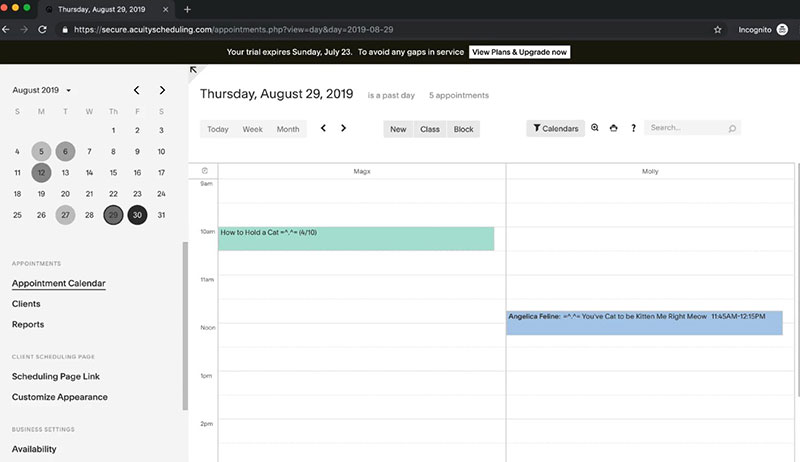
Acuity suits businesses that need clean, reliable client self-scheduling without POS hardware, inventory tracking, or a built-in marketing suite.
It's the right fit when you work solo or with a small team (1 to 6 calendars), your sessions are mostly remote or virtual, you want Zoom links to generate automatically without extra steps, you need clients to complete intake forms before each appointment, or your website is on Squarespace, where the integration is tight and native.
Coaches, photographers, and independent consultants consistently report Acuity as the fastest path from "I need a booking system" to "clients are actually booking." The learning curve is minimal next to Vagaro.
Businesses Where Neither Tool Fits Well
Large enterprise spas processing high booking volumes across dozens of staff with advanced reporting needs may find both platforms limited. Vagaro's reporting has been described by multiple users as "tricky to customize" at the analytics level.
Medical practices handling fully clinical documentation, e-prescribing, or insurance billing need a dedicated EHR system alongside or instead of either platform. Neither Vagaro nor Acuity replaces clinical practice management software for complex healthcare workflows. Businesses in that space looking at therapy scheduling software specifically should verify the HIPAA coverage details directly with the vendor before committing.
And for service businesses that have outgrown Acuity and are weighing a migration, moving to Vagaro means importing client data, rebuilding service menus, reconfiguring staff calendars, and retraining front desk staff. It's doable, but it's not a weekend project. Plan for two to four weeks of parallel running before you fully switch over.
FAQ on Vagaro vs Acuity Scheduling
Is Vagaro better than Acuity Scheduling?
It depends on your business type. Vagaro is better for salons, spas, and fitness studios needing POS and inventory. Acuity is better for solo coaches, consultants, and photographers who want clean client self-scheduling without the extra overhead.
What is the main difference between Vagaro and Acuity?
Vagaro is an all-in-one business management platform with built-in POS, payroll, and marketing. Acuity Scheduling is a focused online booking tool. It handles appointment scheduling exceptionally well but relies on third-party integrations for everything else.
Which is cheaper, Vagaro or Acuity Scheduling?
Acuity starts at $20/month against Vagaro's $30/month. But Vagaro's add-on costs for text marketing, forms, and a website builder can push the real monthly figure to $120 or more. Acuity's total cost depends on which payment processor you use.
Does Vagaro have a free plan?
No. Vagaro offers a 30-day free trial but no permanent free plan. Acuity offers a 7-day free trial only. Neither gives you ongoing free access once the trial ends.
Does Acuity Scheduling work for salons?
It can handle basic salon booking, but it lacks a built-in POS, retail inventory tracking, and a public marketplace for client discovery. Most salons with multiple staff or retail product sales will find Vagaro better suited to their day-to-day.
Can Vagaro and Acuity Scheduling integrate with Zoom?
Acuity integrates natively with Zoom, generating meeting links automatically on booking. Vagaro connects to Zoom through Zapier rather than a direct native integration. For virtual service providers, Acuity's Zoom workflow is significantly more straightforward.
Which platform is easier to set up?
Acuity. Most users have a live booking page running in under an hour. Vagaro's setup means configuring multiple modules, staff calendars, POS, service menus, and cancellation policies, which takes considerably more time to do properly.
Does Acuity Scheduling support group classes?
Yes, but only on the Standard plan ($34/month) or above. Group class functionality in Acuity is basic next to Vagaro, which builds in capacity limits, QR check-in, automated waitlists, and class pack tracking natively.
Which has better customer support, Vagaro or Acuity?
Vagaro offers live phone support, live chat, and Vagaro University tutorials. Acuity provides email and chat only, with no phone option. For businesses that need immediate help during busy hours, Vagaro's phone support is a meaningful advantage.
Can I switch from Acuity to Vagaro?
Yes, but it means importing client data, rebuilding service menus, reconfiguring staff calendars, and retraining staff. Vagaro offers free data migration assistance during onboarding. Plan for two to four weeks of parallel running before you fully switch over.
Conclusion
This conclusion is for an article presenting Vagaro vs Acuity Scheduling as two capable but fundamentally different tools for service-based businesses.
Vagaro wins for salons, spas, barbershops, and fitness studios that need built-in POS, multi-staff calendar management, retail inventory, and a public marketplace.
Acuity wins for solo practitioners, coaches, photographers, and consultants who need fast setup, reliable client self-scheduling, and clean Zoom integration without the overhead of a full business suite.
Neither platform is objectively better. The right choice depends on your staff size, session type, and how much operational complexity your business actually runs on daily.
Start with your workflow, not the feature list.