




Picking the wrong booking software costs you money every single month.
Not a little money. Think missed appointments, double-bookings, staff confusion, clients who just don't come back because the online booking experience was clunky. It adds up fast.
The Vagaro vs Mindbody debate comes up constantly among salon owners, spa managers, and fitness studio operators because both platforms look similar on paper. They're not.
Vagaro is built for small-to-mid-size beauty and wellness businesses that want an affordable, full-featured salon scheduling software without spending three weeks on setup. Mindbody targets established studios and multi-location wellness brands that need enterprise-level membership management and consumer app visibility.
Different tools for different stages of business. Choosing the wrong one at the wrong time is an expensive mistake.
This guide covers pricing, scheduling, POS, marketing, reporting, integrations, and support so you can figure out which one actually fits your operation.
What Is Vagaro?
Vagaro launched in 2009 out of Dublin, California. Started as a digital alternative to paper appointment books, now it's a full business management platform used by independent providers and small wellness studios.
Scheduling, online booking, POS, client management, payroll, email marketing, website building. All in one subscription, across web, iOS, and Android.
Pricing
Starts at $30/month for one bookable staff member (currently promoted at $23.99). Caps at $83.99/month for seven or more staff at a single location. No per-booking commissions on standard plans.
Add-ons cost extra: SMS marketing, intake forms, Vagaro Drive storage, and the website builder each have separate monthly fees. Worth knowing before you budget.
What's Actually in the Platform
Pretty complete stack for the price. You get appointment scheduling, a client-facing booking page, point of sale, basic payroll, and email marketing without touching another tool. The website builder is functional, not impressive, but it gets the job done for studios that don't want to maintain a separate site.
One thing that genuinely stands out: Vagaro is HIPAA and EMR compliant. For medspas and health-adjacent businesses, that's not a nice-to-have.
Over 5 million consumers use the Vagaro app to book services (Vagaro, 2025). That's real consumer-side distribution, which matters if you're relying on new client discovery.
Review Scores
- Capterra: 4.7/5 from 3,640+ verified reviews
- G2: 4.6/5, with 98.8% of reviewers coming from small businesses
Consistently strong, and the G2 breakdown tells you something useful about who's actually using it.
Who Vagaro Is Built For
Independent professionals and small-to-mid-size service businesses that need a capable platform without paying enterprise prices or dealing with enterprise complexity.
The typical user runs a business with 1 to 10 staff. Booth renters, solo stylists, small spa teams, boutique fitness studios running classes. A 5-staff salon pays $70/month before add-ons (GoodCall, 2025). That's a meaningfully different cost structure compared to anything competing at the same feature level.
Businesses that use Vagaro most:
- Hair salons and barbershops
- Day spas and nail salons
- Yoga and Pilates studios
- Personal training and fitness studios
- Medspas requiring EMR/HIPAA compliance
If your business is bigger than 10 staff or running multiple locations, you'll start feeling the limits.
What Is Mindbody?
Mindbody started as Hardbody Software in 1998, rebranded in 2001, and has been through a lot since then. Vista Equity Partners took it private in 2019 for around $1.9 billion. Two years later, Mindbody acquired ClassPass. The combined entity now operates under a parent brand called Playlist.
That acquisition history matters when you're evaluating it as a long-term software partner.
What It Actually Does
Appointment scheduling, class management, membership billing, staff management, marketing automation, payment processing. Standard stuff for a platform at this level.
The part that actually sets Mindbody apart from most competitors: a consumer-facing marketplace app with over 3 million active users booking wellness services every month (Mindbody, 2025). That's real built-in discovery for your business, not just a backend tool.
The numbers back it up. Mindbody powers 40,000+ businesses and processed over 600 million bookings in the past year. Businesses that join reportedly see a 26% increase in client bookings within 6 months (Mindbody, 2025).
Pricing
This is where things get complicated.
Four tiers, all billed per location:
- Starter: $99-$159/month
- Accelerate: $259-$279/month
- Ultimate: $499/month
- Ultimate Plus: $699+/month
Contracts are typically 24 months. Not month-to-month.
One Trustpilot reviewer tracked their cost going from $80/month in 2015 to $469/month by 2025 as features got moved into higher tiers over time (GoodCall, 2025). That's not an isolated complaint. It's a pattern worth knowing about before you sign anything.
Who Mindbody Is Built For
Established studios, multi-location wellness brands, fitness businesses that are already running at scale and need enterprise-level tools. The pricing alone filters out most small operators.
If you're a solo practitioner or a studio with a handful of staff, Mindbody is probably more platform than you need right now. And more cost.
Who Mindbody Is Built For
Mindbody fits established wellness businesses with consistent volume, multi-location operations, or businesses that rely on new-client discovery to grow.
The consumer app is a real acquisition channel. More than 22,000 first-time purchases happen monthly through the Mindbody app from users who found a business there (Mindbody, 2025). That is a meaningful number for a mid-size studio running paid acquisition on top of organic growth.
The platform architecture handles multi-location from its core. Cross-location client records, roll-up reporting, and centralized staff scheduling are built into the higher tiers, not bolted on. This makes Mindbody a natural fit for yoga chains, spa groups, and boutique fitness franchises.
Business types that use Mindbody most:
- Boutique fitness studios with class-based scheduling
- Multi-location yoga and Pilates chains
- Established spa groups and wellness centers
- Gyms requiring membership contract management
- Brands where consumer app discovery drives new-client revenue
Vagaro vs Mindbody: Pricing
Vagaro is cheaper. Not slightly cheaper. At every comparable usage level, the gap is real enough that it changes the conversation depending on where your business is right now.
The spa and salon software market hit $1.57 billion in 2025 and is projected to reach $3.75 billion by 2033 (Grand View Research, 2025). Both platforms are fighting for share in a space where switching software is painful and pricing actually matters.
| Plan Level | Vagaro | Mindbody |
|---|---|---|
| Entry | $30/month (1 staff) | $99-$159/month (Starter) |
| Mid | $60/month (4 staff) | $259-$279/month (Accelerate) |
| Full-featured | $85/month (7+ staff) | $499/month (Ultimate) |
| Enterprise | Custom pricing | $699+/month (Ultimate Plus) |
Vagaro's base plan includes scheduling, payment processing, email marketing (1,000 free messages), and client management. Mindbody's Starter gets you scheduling, POS, and a marketplace listing. Advanced marketing, email campaigns, lead management? Those are locked behind higher tiers (Mindbody, 2025).
Hidden Costs in Mindbody
The sticker price isn't the full number.
Payment processing runs 2.75% to 3.5% per transaction. A studio doing $10,000/month in bookings is handing Mindbody $275 to $350 every month just in processing fees (Koalendar, 2025). And Mindbody doesn't publish pricing for Accelerate or Ultimate publicly. You have to request a quote for anything above Starter.
Add-ons that cost extra on top of the base plan:
- Branded mobile app
- Advanced marketing automation (Accelerate tier minimum)
- Lead management and referral tools (Ultimate tier only)
- 24-month contract lock-in on most plans
That last one trips people up. You're not just evaluating monthly cost. You're committing.
What Vagaro Includes at Base Price
More than Mindbody's Starter, at roughly a third of the price.
Vagaro base plan includes: appointment scheduling, drag-and-drop calendar, online booking widget, client management, POS, payment processing, 1,000 email marketing messages per month, basic reporting, marketplace listing.
SMS marketing, intake forms, the advanced website builder, and Vagaro Drive storage each add $10-$20/month if you want them. That structure is actually pretty honest. You pay for what you turn on, not for a tier that bundles things you don't need.
Mindbody's model pushes you toward higher tiers the moment you need anything beyond basic scheduling. That's where the cost gap stops being theoretical.
How Do the Scheduling and Booking Features Compare?
Both platforms handle core appointment scheduling and class booking well. The differences show up in client-side booking experience, calendar flexibility, and where new bookings come from.
Appointment scheduling software accounts for the largest revenue share of the salon and spa software market at 31.9% in 2025, reflecting how central this function is to the purchase decision (Grand View Research, 2025).
Vagaro Scheduling

Calendar mechanics that work well in practice:
- Drag-and-drop rescheduling with color-coded staff views
- Day, week, month, and team view options
- Gap processing to take walk-ins while services set
- Waitlist management, both manual and automated
- Recurring appointments and class scheduling
- Embeddable booking widget for external websites
Vagaro's booking widget is one of the more flexible options in this category. You can embed it on your existing site, open it in a pop-up, or direct clients to a new browser tab. Staff can also generate individual booking links, which is practical for solo operators who want direct client access (Vagaro Support, 2025).
The consumer Vagaro app has over 5 million users, so there is marketplace exposure, though it is smaller in scale than Mindbody's dedicated discovery platform.
Mindbody Scheduling
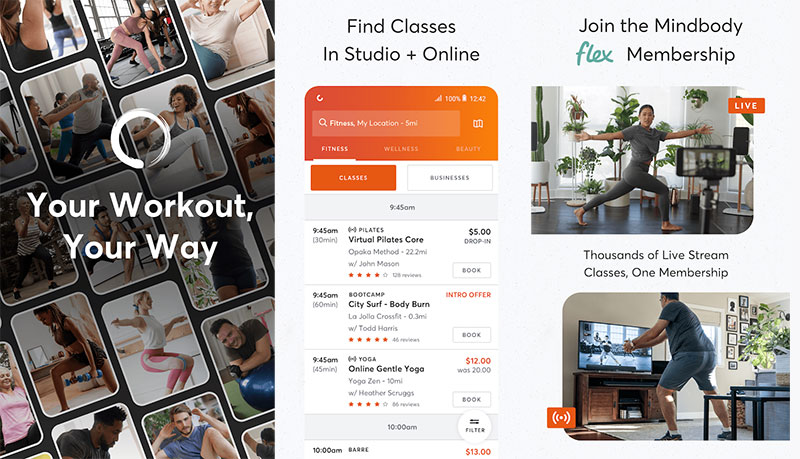
Mindbody scheduling is built around class-based workflows. Waitlists, class packs, multi-class sequences, and pick-a-spot seating come standard on mid and upper tiers. These are things Vagaro handles more basically.
The direct booking path through the Mindbody consumer app is where Mindbody scheduling has a real structural advantage. Over 3 million active users are searching for services in the app each month. A boutique fitness studio or yoga chain running on Mindbody gets passive discovery exposure Vagaro's marketplace does not replicate at that scale (Mindbody, 2025).
Multi-location scheduling on Mindbody allows clients to book across any location from a single profile. Staff scheduling across locations is also centralized. Vagaro handles multiple locations but runs them as separate accounts with their own calendars.
| Feature | Vagaro | Mindbody |
|---|---|---|
| Drag-and-drop calendar | Yes | Yes |
| Class scheduling | Yes | Yes, deeper on upper tiers |
| Pick-a-spot seating | No | Yes (Accelerate+) |
| Waitlist automation | Yes | Yes |
| Consumer marketplace app | 5M+ users | 3M+ active monthly users |
| Multi-location booking | Separate accounts | Unified client profile |
How Do the Point of Sale and Payment Processing Features Compare?
Both platforms include a built-in POS system. The differences come down to hardware options, processing fee structure, and which features are available at which pricing tier.
Vagaro POS and Payment Processing
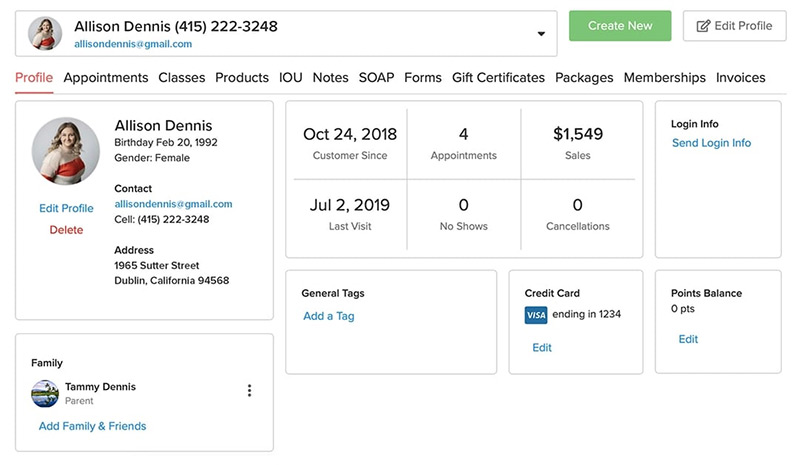
Vagaro's POS is included in the base subscription. It handles retail sales, gift cards, service checkout, tip collection, product inventory, and client purchase history. No separate POS subscription is required.
Processing rates work on a volume-based model. Businesses processing under $4,000/month are on the Small Merchant plan. Those processing over $4,000/month move to the Large Merchant plan with rates as low as 2.2% (Vagaro, 2025). That lower rate is genuinely competitive for studios with consistent volume.
Vagaro hardware options:
- PayPro terminal: full front-desk POS with customer-facing screen
- PayPro Mini: grab-and-go tablet option
- PayPro Duo: dual-screen device for multi-location use
- Card readers, barcode scanners, receipt printers available separately
Hardware ranges from roughly $100 for basic readers to $380 for full terminals. Vagaro Capital lets businesses finance hardware through daily card sales without interest (Vagaro, 2025). That is a practical option for new businesses that don't want large upfront equipment costs.
Mindbody POS and Payment Processing
Mindbody Payments handles payment processing for US and Canadian businesses. The base processing rate is 2.75% card-present on the Starter plan. Rates may decrease on higher tiers, but Mindbody does not publish tiered processing rates publicly.
The POS handles service checkout, retail sales, class packs, gift cards, and membership billing. Some advanced POS features, including certain reporting and automation integrations, are tied to Accelerate and Ultimate plan subscriptions.
Mindbody's payment setup has generated some user complaints. Capterra reviewers mention payment processing glitches, high fees, and slow resolution times from support as recurring issues (Capterra, 2025). This tracks with Mindbody's lower overall satisfaction score of 4.0/5 compared to Vagaro's 4.7/5 on the same platform.
How Do the Marketing Tools Compare?
Marketing capability is where the gap between Vagaro and Mindbody becomes most visible, and it cuts both ways depending on what type of marketing matters most to your business.
Vagaro's Marketing Tools
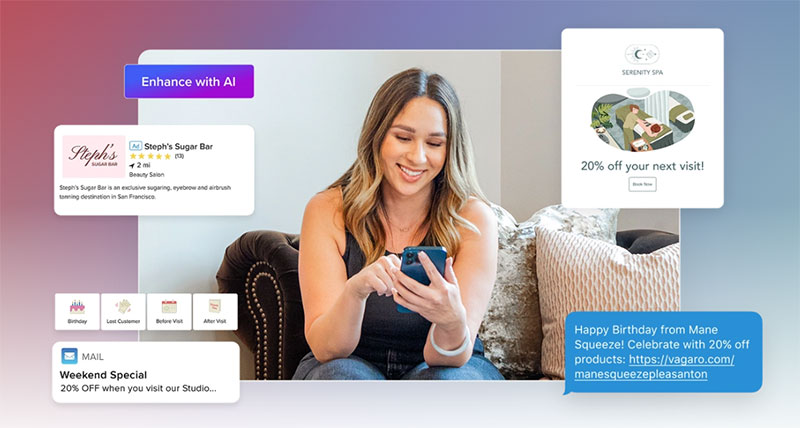
Vagaro's base plan includes 1,000 email marketing messages per month, automated appointment reminders via email, SMS, and push notification, and a Deals Marketplace where businesses can post offers to attract new local clients.
In 2024, Vagaro released AI-powered marketing tools that assist with content creation, client segmentation, and automated campaigns. The drag-and-drop email builder supports custom templates. SMS marketing plans start at $20/month for 500 messages (The Salon Business, 2026).
What's included at base price:
- 1,000 email messages/month
- Automated birthday and appointment reminders
- Smart client segmentation (inactive clients, specific services)
- Deals Marketplace for promotional offers
- AI-assisted content creation for campaigns
The tradeoff with Vagaro's marketing is that it is outbound. You are pushing to your existing client base. There is no passive discovery mechanism at Mindbody's scale.
Mindbody's Marketing Tools and Consumer App
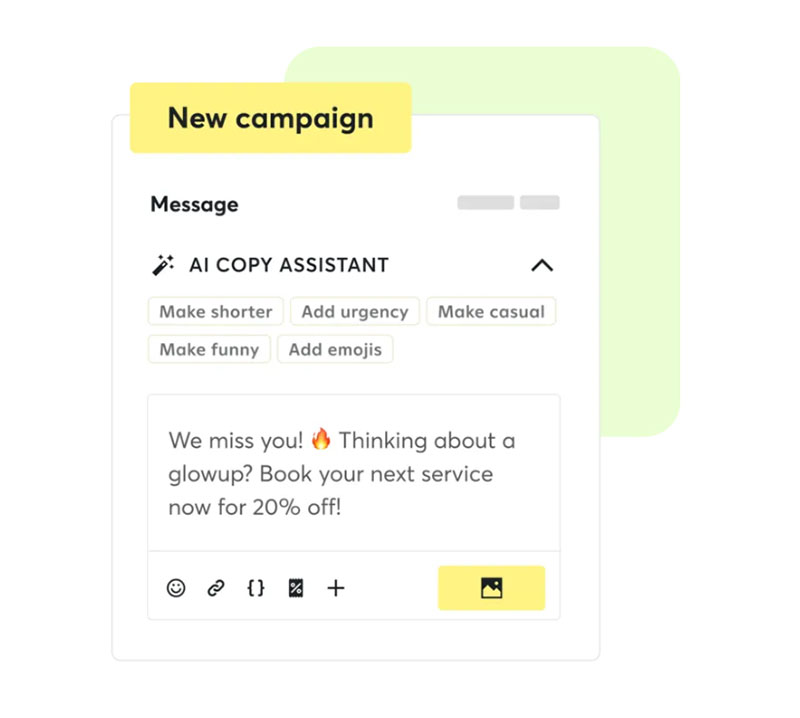
Mindbody splits its marketing into two distinct channels: outbound automation tools and inbound consumer app discovery. Both require understanding separately before comparing costs.
The email campaign builder, smart contact lists, and automated retention campaigns are locked behind Accelerate ($259-$279/month) and Ultimate ($499/month). If you are on the Starter plan, the marketing tools are limited (Mindbody, 2025).
The Mindbody consumer app is a separate channel entirely. It is downloaded over 6 times every minute, with 3 million+ active monthly users. Over 22,000 first-time purchases happen monthly through the app from new-to-business clients (Mindbody, 2025). For a yoga studio or fitness brand trying to grow its client base passively, that is a meaningful acquisition channel with no equivalent in Vagaro.
In December 2025, Mindbody announced a partnership with Attentive, integrating AI-powered SMS and email automation directly into the Mindbody platform. This gives businesses on higher tiers access to more sophisticated segmentation and behavioral triggers (Grand View Research, 2025).
| Marketing Feature | Vagaro | Mindbody |
|---|---|---|
| Email campaigns | Included (1,000/month) | Accelerate+ only |
| SMS marketing | $20/month add-on | Ultimate tier |
| Consumer marketplace | 5M+ users (Vagaro app) | 3M+ active monthly users |
| AI content tools | Yes (2024 update) | Yes (Attentive integration) |
| Win-back automation | Yes | Yes (Accelerate+) |
How Do Reporting and Business Analytics Compare?
Reporting depth is a practical dividing line between the two platforms. Vagaro covers what most single-location businesses need. Mindbody goes deeper for studios that make data-driven staffing and retention decisions.
Over 65% of service providers now use software to automate tasks like appointment bookings and payment processing, and reporting is consistently cited as one of the top reasons businesses upgrade platforms (ReAnIn, 2025).
Vagaro Reporting
Vagaro's dashboard covers revenue, staff performance, appointment history, product sales, and payroll. The Credit Card Deposits report tracks fee deductions and net earnings per transaction. Reports can be exported to CSV.
For a single-location owner without a dedicated operations team, Vagaro's reporting is readable and practical. You can see which staff members are booking well, which services are driving revenue, and how inventory is moving, without needing to build custom views.
The reporting starts to feel limited when you want deeper retention analytics, cohort analysis, or performance comparison across locations. That is where Mindbody pulls ahead.
Mindbody Reporting
Mindbody's reporting capabilities by tier:
Starter: Basic scheduling reports and simple revenue summaries.
Accelerate: Advanced reporting, resource utilization, and promo code performance tracking.
Ultimate: Full analytics suite with client lifetime value, marketing campaign performance, lead management reporting, and multi-location roll-up dashboards.
The multi-location roll-up is the specific feature that matters for growing businesses. A yoga chain running 5 studios can see total and per-location performance in a single view. Vagaro would require logging into each location's account separately and compiling data manually.
Mindbody also supports custom report builders and deeper third-party BI integrations on higher plans. Boulder Planet, a climbing gym operating across Southeast Asia, uses Mindbody specifically to manage cross-location reporting and client experience at scale (Mindbody, 2025).
How Do the Membership and Class Pack Features Compare?
Membership management is where the operational gap between these two platforms is most pronounced. Boutique fitness studios face 35-45% annual churn, and the software managing recurring billing, contract enforcement, and retention automation directly affects whether that number improves (ClubIntel Boutique Studio Benchmark, 2025).
Members who attend 3 or more times per week have 85-90% annual retention rates. Those attending once a week drop to 40-50% (Les Mills Global Fitness Report, 2025). Any platform running memberships needs to support the automations that encourage that attendance frequency.
Vagaro Membership Tools
Vagaro handles recurring billing, autopay, freeze options, and membership-based booking restrictions. Clients can manage their memberships and class packs directly through the Vagaro consumer app. Family account management is supported, letting one client handle billing for multiple family members.
What Vagaro membership includes:
- Recurring autopay with configurable billing cycles
- Membership freeze and cancellation workflows
- Class packs with expiry date settings
- Membership status checks at time of booking
The limitation is contract enforcement. Vagaro does not offer the kind of contract-level controls that prevent a client from canceling mid-term without penalty. For studios with annual or multi-month contracts, that is a gap.
Mindbody Membership and Class Pack Tools
Mindbody's membership architecture is built specifically for class-based studios running complex recurring revenue models. Contract enforcement, early cancellation fees, autopay failure workflows, and family sharing are all handled natively.
Class packs support expiry dates, rollover credits, and shared access across family accounts. Early Access Booking (released late 2024) rewards active members with priority class booking before non-members, which directly supports retention (Mindbody, 2024).
Peaches Pilates used Mindbody's membership and class booking tools to scale from one idea to 10 studios, citing the booking infrastructure and ClassPass integration as key to their growth (Mindbody, 2025).
Studios using Mindbody with ClassPass integration saw average bookings climb 9.9% year-over-year in January 2025, while studios not on ClassPass saw an average decline of 1.6% (Athletech News, 2026).
How Do Vagaro and Mindbody Handle Multi-Location Businesses?
Multi-location management is one of the clearest dividing lines between these platforms. The architecture decisions made by each company reflect their core target market.
Vagaro Multi-Location Setup
Vagaro supports multiple locations under one account with separate calendars, staff management, and reporting per location. Each location operates as its own environment. Staff can be assigned to specific locations, and you can switch between them from a single login.
The practical limitation: reporting does not roll up automatically across locations. A salon group with 3 locations needs to pull reports separately and compile the data manually. There is no native cross-location dashboard.
Pricing also scales per location as separate subscriptions, which increases the monthly cost significantly once you pass 2-3 locations.
Mindbody Multi-Location Architecture
Mindbody is built multi-location from the ground up. Client profiles are unified across all locations, meaning a client who joins at one studio can book at another without creating a new account. Staff scheduling and payroll work across locations from a centralized view.
Key multi-location features on Ultimate tier:
- Cross-location roll-up reporting in Analytics 2.0
- Unified client records across all locations
- Centralized staff and resource scheduling
- Multi-location performance comparison dashboards
Mindbody's Analytics 2.0 (released November 2024) brings sales, visits, and membership data into one configurable dashboard with location-level filtering and year-over-year trend tracking (Mindbody, 2024).
| Feature | Vagaro | Mindbody (Ultimate) |
|---|---|---|
| Unified client profile | No | Yes |
| Cross-location reporting | Manual only | Built-in (Analytics 2.0) |
| Staff scheduling across locations | Separate accounts | Centralized |
| Pricing model | Per-location subscriptions | Per-location on Ultimate |
How Do Integrations and API Access Compare?
Integrations determine how well either platform fits into an existing tech stack. Most service businesses use at least 3-4 tools alongside their booking software, from accounting to email marketing to video.
Mindbody customers who use integrations earn 10% more revenue, see 40% more bookings, and have roughly 35% more client purchases compared to those who do not use integrations (Mindbody integrations data, 2025).
Vagaro Integrations
Vagaro connects natively with QuickBooks, Google Calendar, Facebook, Instagram, Zoom, and Mailchimp. Zapier access opens connections to over 2,000 additional tools. The API is available as a paid add-on at $10/month, which includes 5,000 webhook calls per month (AgentZap, 2026).
The native QuickBooks sync runs daily at 2 AM, automatically exporting transaction data, tips, refunds, and product sales to QuickBooks Online. That covers the core accounting workflow without manual exports for most single-location businesses.
Vagaro's API is functional but has less developer documentation than Mindbody's. Businesses wanting custom integrations or complex workflow automation will hit that ceiling faster than they would on Mindbody.
Mindbody Integrations and Developer Platform
Mindbody runs an open API with a full developer ecosystem. Over 600 certified integration partners have built tools on the Mindbody platform, covering everything from performance tracking to HR to corporate wellness benefits.
Notable Mindbody integrations:
- ClassPass: fills open spots with 343M+ reservations made globally through ClassPass as of October 2025
- Perkville: loyalty program management tied directly to booking behavior
- Zapier: workflow automation without custom development
- Attentive: AI-powered SMS and email (December 2025 partnership)
The ClassPass integration specifically is something Vagaro cannot replicate. Schedules sync automatically, reservations update in real time, and ClassPass performance data is visible inside the Mindbody dashboard (Mindbody, 2025).
How Does Customer Support Compare Between Vagaro and Mindbody?
Support quality is a real differentiator in this category because booking software problems are not abstract. A broken checkout flow or a payment processing glitch affects cash flow the same day.
Vagaro Support
Vagaro offers live chat, phone, and email support 7 days a week. There is no separate onboarding fee. Setup resources are self-serve through Vagaro University, which includes videos and webinars for every feature. Support is included at all subscription levels.
Vagaro scores 4.7/5 on Capterra from over 3,400 verified reviews and 4.6/5 on G2, with ease of setup rated 8.8/5 on G2. Reviewers consistently mention responsive support and accessible onboarding as reasons for switching from other platforms (Capterra, 2025).
Acquiring a new client costs 5 to 7 times more than retaining an existing one, a widely cited figure in customer retention research. Reliable support that keeps a business running smoothly directly affects client retention, not just software satisfaction.
Mindbody Support
Support access on Mindbody varies by plan tier. Starter plan users have limited live support options. Accelerate and Ultimate plans include more direct access, and strategic accounts get a dedicated onboarding specialist and account manager.
Mindbody scores 4.0/5 on Capterra and 3.7/5 on G2 from 483 reviews, with ease of setup rated 6.7/5 (G2, 2025). The gap between Vagaro's ease-of-setup score (8.8) and Mindbody's (6.7) is significant and tracks with review content about Mindbody's onboarding complexity.
Common Mindbody support complaints across Capterra and Software Advice include: payment processing glitches, slow resolution on account errors, and tiered support that gives deeper assistance to higher-plan subscribers while leaving lower-tier users with inconsistent response times.
| Support Metric | Vagaro | Mindbody |
|---|---|---|
| Capterra rating | 4.7/5 (3,640+ reviews) | 4.0/5 (2,993+ reviews) |
| G2 rating | 4.6/5 | 3.7/5 |
| Ease of setup (G2, out of 10) | 8.8 | 6.8 |
| Support availability | 24/7, all tiers | Tiered by plan |
| Onboarding fee | None | Bundled on all plans |
Which Business Types Are Best Suited for Vagaro vs Mindbody?
The honest answer is that these platforms solve different problems at different price points. Choosing the wrong one is not just a software inconvenience. It affects your monthly cost, the features available to your team, and how new clients find you.
About half of U.S. salons still do not use digital scheduling tools. For those making the switch, the choice between a capable online booking system for salons and a more complex enterprise platform matters immediately (GoodCall, 2025).
When Vagaro Is the Better Choice
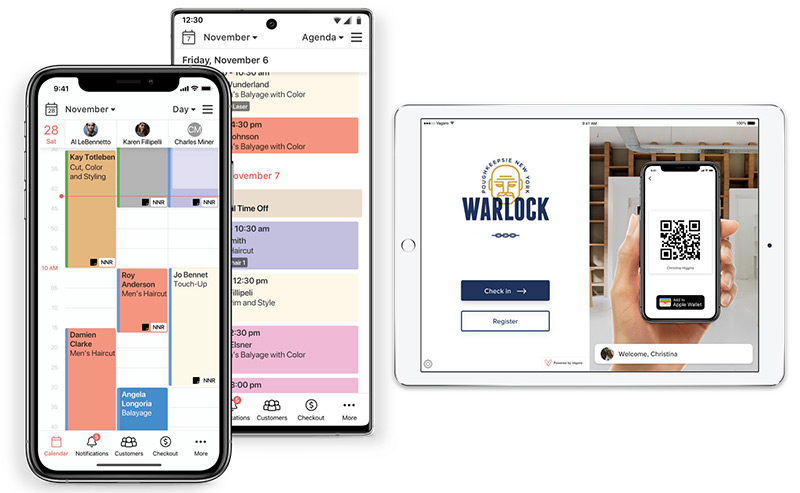
Vagaro fits businesses where cost control, fast setup, and an all-in-one base plan are the priority. It is the right call for solo operators, small salons, barbershops, and studios that do not need multi-location roll-up reporting or enterprise-level membership contracts.
The total cost difference is not trivial. A 5-staff salon pays $70/month on Vagaro versus a minimum of $99/month (Starter, single location) on Mindbody, with marketing tools requiring at least $259/month on Accelerate to match what Vagaro includes at base price.
Choose Vagaro if:
- You run 1-2 locations with 1-10 staff
- You want marketing tools included without a higher tier
- HIPAA/EMR compliance is needed (medspas)
- Setup speed and ease of use are priorities
- You need a reliable booking system built specifically for hair salons
When Mindbody Is the Better Choice
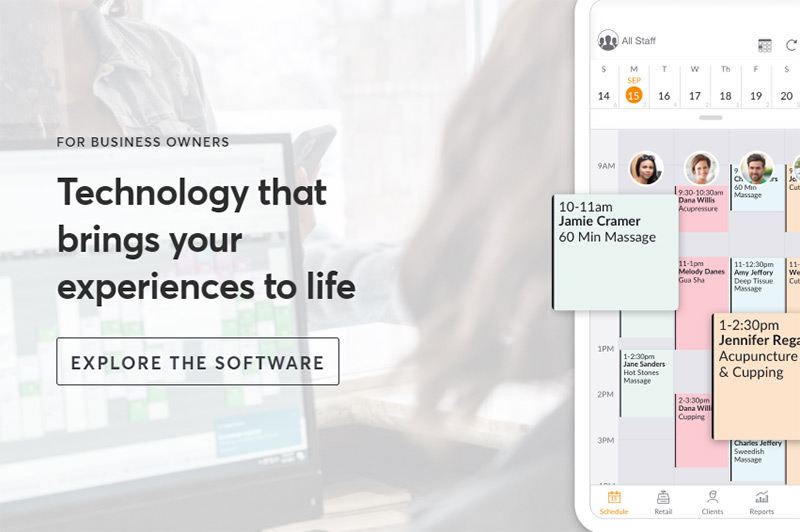
Mindbody earns its cost when the consumer app's discovery channel, ClassPass integration, or multi-location architecture are worth more than the price gap. For an established yoga chain or boutique fitness brand where new-client acquisition through the app offsets the $259-$499/month subscription, the math works.
Studios using both ClassPass and Mindbody saw 9.9% year-over-year booking growth in January 2025, while studios not on ClassPass declined 1.6% over the same period (Athletech News, 2026). If the Mindbody ecosystem drives that kind of booking lift, the platform pays for itself.
Choose Mindbody if:
- You run 3+ locations and need unified client records and roll-up reporting
- Membership contract enforcement is a core operational need
- ClassPass integration for open-spot revenue is relevant to your model
- Consumer app discovery drives meaningful new-client acquisition for your business
For a beauty salon software decision, Vagaro wins on value and usability at small-to-mid scale. For a fitness studio or multi-location wellness brand where the Mindbody ecosystem generates bookings, Mindbody justifies the cost. The mistake is paying for Mindbody's enterprise infrastructure when your business is a 3-person salon booking 40 appointments a week.
FAQ on Vagaro vs Mindbody
Is Vagaro cheaper than Mindbody?
Yes, by a significant margin. Vagaro starts at $30/month for one staff member and caps at $83.99/month for 7 or more. Mindbody's Starter plan begins at $99-$159/month per location, with full-featured plans reaching $499/month.
Which platform is better for small salons?
Vagaro. It includes scheduling, POS, email marketing, and client management at base price. Small salons with 1-10 staff get everything they need without paying for enterprise features they will never use.
Does Mindbody charge marketplace commission fees?
Yes. Mindbody charges a 20% commission on new client bookings made through its marketplace, capped at $30 per transaction. Promoted intro offers and dynamic pricing also carry a 20% fee on total purchase price.
Which is better for fitness studios?
Mindbody. Its class scheduling depth, membership contract enforcement, waitlist management, and ClassPass integration are purpose-built for fitness. Studios using both Mindbody and ClassPass saw 9.9% booking growth year-over-year in January 2025.
Can Vagaro handle multiple locations?
Yes, but with limitations. Each location runs as a separate account with its own calendar and reporting. There is no native cross-location roll-up dashboard. Mindbody handles multi-location management from a single unified architecture.
Which platform has better customer support?
Vagaro. It offers 7-day live support at all plan levels with no onboarding fee. Vagaro scores 4.7/5 on Capterra versus Mindbody's 4.0/5. Mindbody limits live support access on its Starter plan.
Does Vagaro have a consumer marketplace app?
Yes. The Vagaro consumer app has over 5 million users. Mindbody's app reaches 3 million active monthly users but functions as a dedicated discovery platform with stronger new-client acquisition tools for wellness businesses.
Is Mindbody worth the cost for a yoga studio?
It depends on volume. Mindbody reports businesses see an average 26% increase in bookings within 6 months of joining. If consumer app discovery and ClassPass fill your open class spots, the subscription cost pays for itself.
Does Vagaro support membership billing and class packs?
Yes. Vagaro handles recurring autopay, membership freezes, class packs with expiry dates, and family account billing. It lacks contract-level enforcement, so studios requiring signed membership agreements with cancellation penalties need Mindbody.
Which platform integrates with QuickBooks?
Both do. Vagaro syncs daily with QuickBooks Online automatically. Mindbody also supports QuickBooks through its integrations marketplace. Vagaro's QuickBooks connection is a paid add-on; Mindbody's availability depends on plan tier.
Conclusion
This conclusion is for an article presenting the full picture of Vagaro vs Mindbody across pricing, scheduling, POS, marketing, reporting, membership management, integrations, and support.
Vagaro wins on affordability and ease of use. It is the right salon management platform for independent professionals, small beauty businesses, and studios that want a capable system without enterprise-level costs.
Mindbody justifies its price when the consumer app drives new-client discovery, ClassPass fills open spots, or multi-location reporting is a daily operational need.
Neither platform is universally better. The right choice depends on your business size, revenue model, and growth stage.
If you are running a service-based business under 10 staff, Vagaro delivers more value per dollar. If you are scaling a wellness brand across locations, Mindbody's ecosystem earns its cost.