




Your booking data lives on somebody else's server. And the bill climbs every time you add a person to the team.
For a lot of small operations, that's just the deal with cloud schedulers. After a while you stop noticing it.
Open source scheduling software is the other road. You run the booking engine on your own server, the client data stays yours, and there's no per-user fee stacking up as you hire. No monthly-per-seat tax of the kind Calendly charges.
It's an uneven category, though, and worth saying so up front:
- Some are polished WordPress plugins you'll have live by the afternoon
- Some are developer-grade platforms that expect you to run your own stack
- One or two barely belong in the conversation
The 10 Best Open Source and Open-Core Scheduling Tools
A quick word on the title, because license type is the whole reason you're reading this. Most tools here are genuinely open source: GPL, AGPL, or MIT, code you can inspect, self-host, and fork. A couple use an open-core model, where the base is open but some deployment conveniences or features sit behind a paid license. Both belong on a self-hoster's shortlist, so both are here, and each entry states plainly which camp it falls in.
One entry, Trafft, is neither. It's included as a labeled bonus at the end, not inside the ranked ten, because it fails the open-source test its own section explains. More on why in a second.
And the disclosure that matters most on a page like this: Trafft publishes this article. On the other comparison lists we run, Trafft genuinely fits the category and ranks first. Here it doesn't fit, so we've kept it out of the ranking entirely and put it in a clearly marked bonus slot where you can judge it on its own terms.
The nine ranked tools below are the actual open-source and open-core answer to this search. We've flagged where each beats Trafft, because on this specific question, several do.
Self-hostable scheduling tools keep gaining ground for one blunt reason. You own the data, and you skip the per-seat tax.
Self-hosting a Cal-style scheduler runs roughly $600 to $1,200 a year in infrastructure. Compare that to $1,920 to $3,840 for Calendly Teams at just 20 users (OSSAlt, 2026). That gap is most of the reason interest keeps climbing.
The shortlist below is ranked by overall usefulness for real service businesses, most broadly useful first. It sits inside the wider field of the best appointment scheduling software if you want to compare beyond open source.
| Tool | License / Model | Best For | Entry Price |
|---|---|---|---|
| WPAmelia (Amelia) | GPL·WordPress | Polished WordPress booking | Free Lite |
| Cal.diy | MIT·Self-hosted | Technical teams, developers | Free self-host |
| Easy!Appointments | GPL-3.0·WordPress | Zero-budget WordPress sites | Free |
| Booknetic | Commercial·Self-hostable open-core add-ons | WordPress scheduling depth | $45/yr |
| Booked Scheduler | Open source·Self-hosted | Clubs, shared rooms | Free |
| Rallly | AGPL-3.0 open-core deployment | Group availability polls | Free self-host, single user |
| BookingPress | Freemium GPL core·WordPress | Budget solo operators | Free core |
| Salon Booking System | Freemium GPL core·WordPress | Hair and beauty salons | Free core |
| WooCommerce Bookings | Commercial GPL·WordPress | WooCommerce stores | Paid |
| Trafft (bonus, not open source) | Freemium·Closed code | All-in-one service businesses | Free plan |
Amelia - Best for WordPress sites that want a polished booking widget
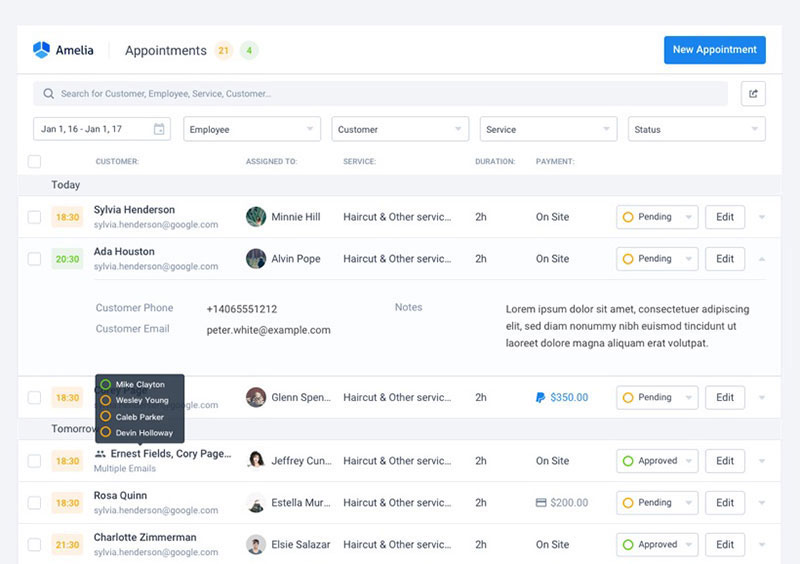
Amelia Lite is the strongest free pick for a solo WordPress operator, and it opens the ranking because it's the rare tool that's both genuinely open-source-licensed (GPL, as all WordPress plugins are) and polished enough to run in production the same afternoon. Two things earn the top spot: the booking-page polish, and a free Lite tier that ships with Square payments out of the box.
The rarer feature, though, is the events module with QR-coded e-tickets. Almost no other booking plugin bothers with it.
What you get
- Google Calendar and Outlook sync
- Automated notifications and group appointments
- Custom per-day pricing
- A clean, WordPress-native booking widget
- Free Square card payments on the Lite tier
Pricing
Lite is free (1 employee, unlimited appointment types, Square payments). Starter from about $49/yr, with annual or lifetime billing on most tiers (wpamelia.com, verified 2026).
Where it wins
- Cleanest admin and widget in the category
- 90,000+ active installs and a 4.6/5 WordPress.org rating
- Deep documentation plus video tutorials
Good to know: multi-staff, extra gateways, and calendar sync come with the paid tiers, so Lite works best as a starting point that you scale up as the business grows.
A tester walked Amelia v9.4 through a full booking on WordPress 6.9.4, committing a live deep-tissue appointment end to end, and the aggregate score sits at a strong 4.9 on Capterra.
The real story here is depth of polish, not a feature checklist. The admin, the widget, and the documentation all feel finished, which is why solo operators keep it running rather than swapping it out.
Cal.diy - Best for developers self-hosting meeting scheduling
Cal.diy is what's left after Cal.com moved its production code private in April 2026. The MIT-licensed open source edition, and the truest open-source option on this list for standalone meeting scheduling.
It suits technical teams who want unlimited event types and round-robin scheduling without per-seat fees, and who are comfortable running their own stack.
What you get:
- 1:1, group, round-robin, and collective events
- Google, Outlook, and CalDAV sync
- Routing forms and webhooks
- Stripe payments
- A full app-store framework, self-hostable with no per-user pricing
Pricing: Free to self-host under MIT. The managed Cal.com cloud starts at $12/user/mo for Teams (efficient.app, June 2026).
Where it wins:
- Closest open-source path for teams leaving Calendly
- Strong API surface for custom automations and CRM sync
- Stable, documented Docker Compose deployment
Where it falls short:
- Personal, non-production use is the official positioning, security not guaranteed
- Community Docker setup can lag the main release
- Email delivery must be configured before your first booking
- Missing paid features: Teams, Organizations, SSO, Workflows, and Insights aren't in the community edition
There's a sharp reason to take that seriously. A critical authentication-bypass flaw, CVE-2026-23478 (disclosed January 2026, CVSS 10.0), affected Cal.com versions from 3.1.6 up to 6.0.7 and let an attacker take over any account. That's the kind of security pressure Cal.com later cited when it moved its production repo private.
Almost no competing page has caught up to the split yet. The "open source Calendly" is now a stripped community edition, so treat "can run it" and "should run it in production" as two separate questions.
Easy!Appointments - Best for zero-budget WordPress sites with complex schedules
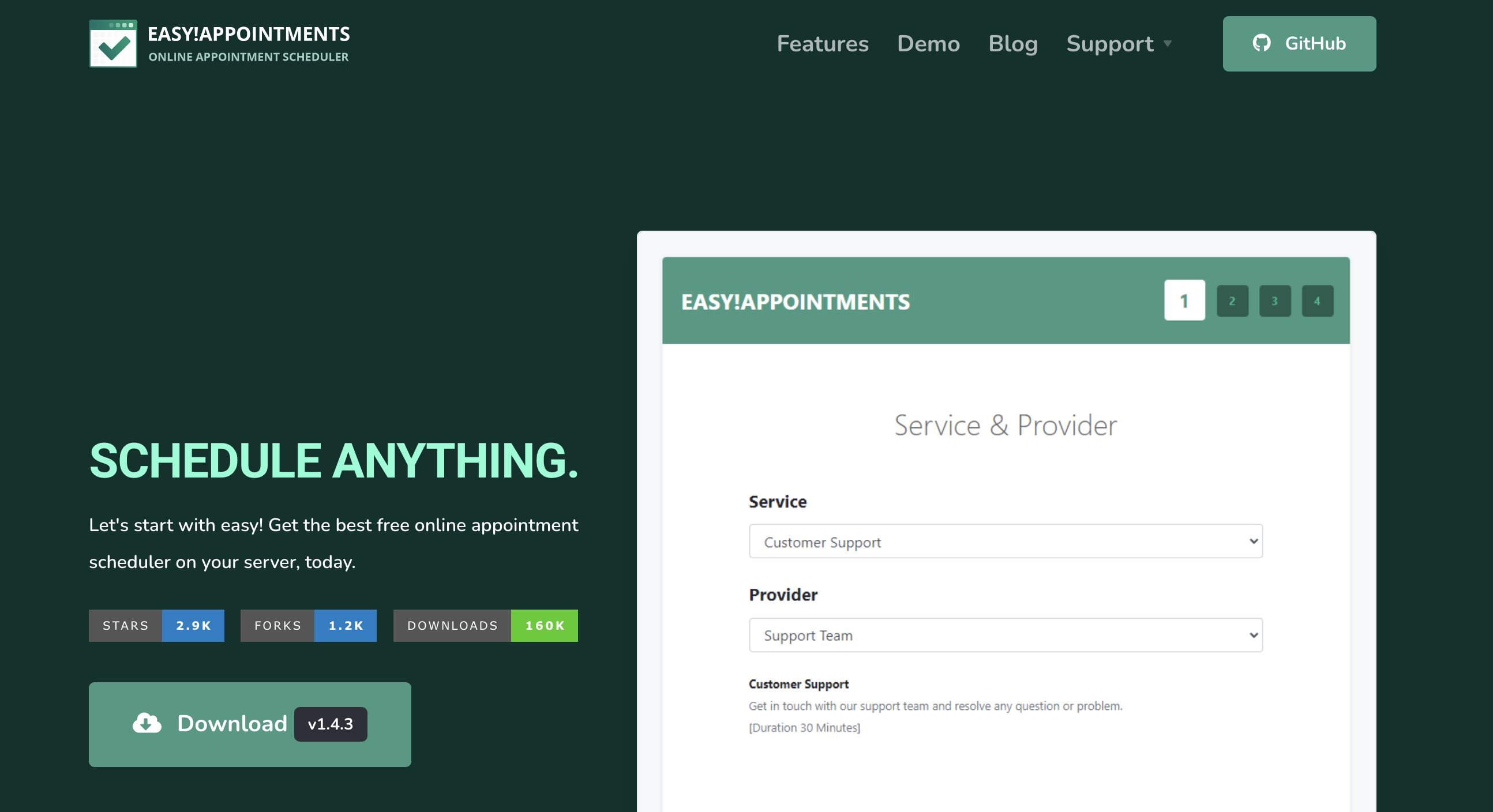
Easy!Appointments is one of the strongest genuinely free WordPress booking plugins going. GPL-3.0, fully open source, and built around a location/service/worker/connection model.
The connection model is what sets it apart. It maps staff to services and locations cleanly, and it does it without consuming WordPress user accounts, which matters more than it sounds.
What you get:
- Multi-provider scheduling and customer management
- Google Calendar sync
- Free reCAPTCHA and custom form fields
- A lightweight PHP stack
Pricing: Free WordPress.org build. A paid Pro extension unlocks calendar sync, SMS, and payments.
Where it wins:
- Adding staff doesn't eat WordPress user seats
- Shared rooms and multi-location handled without add-ons
- Genuinely free for a real multi-staff setup
Where it falls short:
- Dated front-end styling
- Most modern integrations live behind the Pro extension
- Mixed Pro support reputation, with one review citing a six-week wait
A tester configured a full salon-style setup (a $120 60-minute service) on WP 6.9.4 with the 2026 free build and confirmed the connection model as a real differentiator (Booknetic review, 2026).
After Cal.com's shift, several analysts now point to Easy!Appointments as one of the safer general self-hosted booking bets. That repositioning is barely reflected in the older roundups.
Booked Scheduler - Best for clubs and shared-resource booking
Booked Scheduler is built for a different job: reserving shared spaces rather than booking one-on-one appointments. It suits clubs, non-profits, and facilities that need to schedule rooms and equipment.
The whole design is resource-first, with permissions and approval workflows layered on top.
What you get:
- Room and resource scheduling
- Recurring reservations
- User permissions and reporting
- Self-hosted deployment on your own server
Pricing: Free open source core, self-hosted.
Where it wins:
- Purpose-built for shared spaces, not client bookings
- Granular permission controls
- Long track record with non-profit and club use
Where it falls short:
- Not designed for provider-to-client appointment flows
- Dated interface next to modern schedulers
- Technical setup
Independent roundups consistently slot it into the clubs-and-non-profits bucket rather than the appointment-booking one, which matches its resource-centric design. It sits closer to event scheduling software than personal booking, so it fills a gap the client-focused tools on this list can't touch.
Rallly - Best for group availability polls without accounts
Rallly solves the one problem the booking tools mostly ignore: finding a time that works for a whole group. Participants vote on proposed slots, the organizer picks the winner, and nobody has to create an account to take part.
That account-free voting is the standout, and it's self-hostable.
What you get:
- Availability polls with participant comments
- No login required to vote
- A clean, fast poll UI
- Self-hosted deployment
Pricing: Rallly uses an open-core model. The full codebase is open source under AGPLv3 and a single-user self-hosted instance is completely free to run. Multi-user self-hosted deployments (introduced in v4) require a paid license, and the hosted version at rallly.co offers a free Hobby tier with Pro at about $56/year.
Where it wins:
- Kills the email back-and-forth over group timing
- No signup barrier for invitees
- Lightweight and fast to deploy
Where it falls short:
- Not an appointment or payment system
- No staff scheduling or reminders
- A team wanting its own shared multi-user instance pays for the license
With 4,000+ GitHub stars, Rallly gets listed as a Doodle-style poll replacement rather than a Calendly competitor (OSSAlt, 2026). Worth being precise about the license, since this article turns on that exact question: the code stays fully AGPL and forkable, so a solo self-hoster runs it free forever. The paid piece is a deployment convenience for shared team instances, not a lock on the source.
Most "scheduling software" lists blur booking and group polling together. Rallly is the reminder that these are two different jobs, and it does the second one better than any all-in-one tool here.
BookingPress - Best for budget-minded WordPress solo operators
BookingPress gets a working appointment system live without a big upfront cost. It fits single-provider sites that need bookings, payments, and notifications on a modest budget. The core is a free GPL plugin, with paid tiers layered on, so it's freemium open-core in practice.
For its price point, the payment gateway support is unusually broad. That's the standout.
What you get:
- Service and staff setup
- Online payments across many gateways
- Email notifications
- Calendar sync on paid tiers
Pricing: Free core plugin. Paid tiers unlock gateways, add-ons, and sync.
Where it wins:
- Low barrier to a functional booking page
- Wide gateway options for the price
- Straightforward for single-provider setups
Where it falls short:
- Multi-staff and multi-location need higher tiers
- Less polished than Amelia
- Thinner automation
In category comparisons it lands as a budget alternative, useful for businesses that don't need the deeper workflows the heavier plugins offer. It covers the underserved middle between "free but bare" and "powerful but pricey," which the flagship plugins tend to skip right past.
Salon Booking System - Best for hair and beauty salons on WordPress
Salon Booking System is built specifically around the salon and spa workflow. It suits hair, beauty, and nail businesses that want service menus, staff assignment, and deposits tuned to how salons actually operate. Same shape as the other WordPress entries: free GPL core, premium unlock on top.
The booking flow itself is salon-specific, with service duration and staff assignment baked in rather than bolted on.
What you get:
- A service catalog and staff scheduling
- Deposit handling
- Notifications and Google Calendar sync
- A salon-focused booking widget
Pricing: Free core plugin. The premium version unlocks the full feature set.
Where it wins:
- Built around real salon operations, not a generic form
- Deposits help against no-shows
- Familiar setup for salon owners
Where it falls short:
- Niche focus limits use outside beauty services
- Premium tier needed for full functionality
- Smaller ecosystem than the general plugins
Because it's tuned to a single vertical, it maps more directly to a salon than a general plugin does. That's exactly why owners reach for dedicated salon scheduling software instead of adapting a generic tool. A tool that already speaks in services, stylists, and deposits saves the setup work a general scheduler forces on you.
Booking & Appointment Plugin for WooCommerce - Best for WooCommerce stores selling bookable services
This plugin turns WooCommerce products into bookable slots. So a store can sell appointments, rentals, or classes through the checkout it already runs. Licensed GPL like the WooCommerce ecosystem it plugs into, though it's a paid extension rather than a free-core one.
It fits businesses already on WooCommerce that want bookings inside the same cart and payment flow. The standout is native WooCommerce checkout, using your existing gateways and order system.
What you get:
- Bookable products with date and time availability
- Resource and quantity control
- WooCommerce order integration
- Calendar sync
Pricing: Paid plugin, priced through WooCommerce extension licensing.
Where it wins:
- Bookings live inside your existing store, no separate system
- Reuses WooCommerce payments, taxes, and reports
- Flexible for rentals and multi-day bookings
Where it falls short:
- Requires WooCommerce, so it's overkill for simple appointment needs
- Complex config for edge-case availability
- Not a standalone scheduler
For shops already invested in WooCommerce, keeping bookings in the same order pipeline avoids reconciling two systems. That's the practical win reviewers cite most. It's the only entry that treats a booking as a product, so if you already sell through WooCommerce, it removes the double-checkout problem the other tools quietly create.
Bonus - Trafft (not open source, included for context)

Straight up: Trafft doesn't meet this article's own bar. It's a commercial, closed codebase, not a GPL, AGPL, or MIT project. We're including it as a labeled bonus rather than a ranked entry because self-hosters who land here are often really asking a broader question, "how do I get off per-seat cloud pricing and keep my data close?", and for some of them a self-hostable freemium tool answers it even though the source isn't open.
Trafft pulls bookings, staff schedules, payments, and reminders into a single system, with a free plan covering up to five users and multi-location handling from one dashboard. You get Google Calendar and Outlook two-way sync, automated email, SMS, and WhatsApp reminders, employee scheduling, and an embeddable booking form.
The honest boundary: you're getting convenience and a real free tier, not the right to inspect or fork the code. If license type is a hard requirement for you, and on this search it usually is, one of the nine open-source and open-core tools above is the correct pick, not this one. If your actual goal is escaping per-seat fees with minimal setup, it's worth a look. Either way, we'd rather tell you that than quietly rank ourselves first on a list where we don't qualify.
How to pick the right one
Match the tool to your stack and your workflow first. Feature checklists come second.
| Your Situation | Start With |
|---|---|
| Already on WordPress | Amelia·asy!Appointments |
| Want data control, no per-seat fees | Cal.diy fully open source |
| Booking rooms or equipment | Booked Scheduler |
| Just need a group to agree on a time | Rallly |
What is open source scheduling software?
Strip out the jargon and it's an appointment booking system whose source code is publicly licensed. Which lets you self-host it, inspect it, and modify it.
That's the split from closed tools like Calendly. You can run it on your own server and own the booking data end to end.
The category divides mostly by license, and the license decides what you can legally do with the code:
| License | Example Tool | What It Allows |
|---|---|---|
| GPL | Easy!Appointments·WordPress plugins | Use, modify, redistribute (share-alike) |
| AGPL | Rallly | Same, plus network-use disclosure |
| MIT | Cal.diy | Broadest reuse, minimal conditions |
One more distinction worth holding onto: open-core. Tools like Rallly and the freemium WordPress plugins keep an open-licensed core but put some features or deployment conveniences behind a paid license. The code is still open and forkable; you're paying for polish, support, or a specific deployment shape, not for access to the source itself. That's different from a closed tool, where you can't see the code at all.
Demand for the self-hosted route tracks a wider shift. The 2024 State of Open Source Report from Perforce found that a large majority of organizations increased or maintained their open source use, with roughly a third increasing it significantly.
At its core, this software runs availability, self-service bookings, calendar sync, and notifications for businesses ranging from small service providers to a call center handling high volumes of appointment requests.
It's also flexible enough for organizations in software development outsourcing that need to coordinate client meetings, project check-ins, and team availability across multiple time zones. If you want the mechanics before the tooling, it helps to know how a booking system actually works under the hood.
How does self-hosted scheduling compare to cloud-based booking?
Both give you the same booking page. The real split is who runs the server and who holds the data.
| Factor | Self-Hosted | Cloud-Based |
|---|---|---|
| Data location | Your server | Vendor server |
| Pricing | Flat infra cost | Per-seat fees |
| Maintenance | Your responsibility | Vendor handles it |
Cloud still runs the wider market. Market research puts web-based SaaS at roughly two-thirds of the appointment scheduling software market. Which is exactly why open source reads as the alternative rather than the default.
Cost and per-seat pricing
The core difference is flat versus per-user. Self-hosting removes the per-seat tax that scales with your headcount.
The real numbers: running a Cal-style scheduler costs roughly $600 to $1,200 a year in infrastructure, against $1,920 to $3,840 for Calendly Teams at 20 users (OSSAlt, 2026).
What you're really doing is swapping a subscription for server time plus your own hours. That's the trade, and it's worth naming.
Data control and compliance
Self-hosting keeps booking records, client details, and payment metadata on infrastructure you control. That takes a lot of the friction out of GDPR and data-residency questions.
The control has a cost, and 2026 made it obvious. Cal.com moved its production code private in April 2026, citing AI-driven security risks, and left a stripped MIT edition called Cal.diy for self-hosters to run.
If you're weighing the jump, plan the migration the way you would when setting up an online booking system from scratch. Recreate services, reconnect calendars, then switch traffic over.
What separates a full scheduler from a basic calendar?
Automated reminders are the one feature with the clearest payback. Aggregate practice data shows they cut no-shows by 30% to 60% (Appointment Reminder, 2024-2026), and no-show rates otherwise run 15% to 30% across industries.
A real scheduler carries the pieces a plain calendar can't:
- Two-way calendar sync with Google Calendar, Outlook, and CalDAV
- Automated email, SMS, and WhatsApp reminders
- Payment and deposit capture through Stripe, PayPal, or Square
- Staff scheduling, multi-location support, and buffer times
- API access and webhooks for CRM sync
El Rio Health, a Tucson, Arizona health center, cut no-shows by 32% and added roughly $100K in monthly revenue within nine months of moving to automated voice and SMS reminders. The lesson holds. A good appointment reminder app pays for itself long before the feature list matters.
Two more that matter depending on who you are:
- Repeat clients: recurring appointments and a customer panel handle rebooking without manual entry
- Builders: webhook support and REST API access wire scheduling into the rest of your stack
Which businesses does each type of tool fit?
Match the tool to your stack first. Feature counts come second.
| Category | Tools | Best Fit |
|---|---|---|
| WordPress plugin | Amelia·Easy!Appointments | Sites already on WordPress |
| Standalone self-hosted | Cal.diy | Developers, technical teams |
| Resource booking | Booked Scheduler | Clubs, shared rooms |
| Group polls | Rallly | Finding a shared time |
The WordPress route matters because of sheer reach. W3Techs put WordPress at about 41.5% of all websites in mid-2026, easing back from a peak above 43%, and WooCommerce still powers roughly a third of online stores.
Vertical needs pull businesses toward purpose-built options. A clinic weighing HIPAA workflows leans toward dedicated medical scheduling software rather than bending a generic plugin to fit.
What upkeep does self-hosting actually require?
Self-hosting is a commitment, not a one-time install. Running your own instance shifts the maintenance burden onto you, and skipping it is where most self-hosters get burned.
Three things you can't skip:
- Updates: patch promptly, since unpatched instances are the main risk
- Backups: test your restores before you go live, not after something fails
- Email delivery: configure a transactional provider before the first booking goes out
The risk is concrete, not theoretical. CVE-2026-23478 was a critical (CVSS 10.0) authentication-bypass flaw in Cal.com versions before 6.0.7 that let an attacker take over any account. That's the kind of exposure that makes prompt patching non-negotiable, and it's part of the backdrop to Cal.com closing its repo.
Security is a top friction point across the whole field too. Perforce's 2024 State of Open Source Report flagged security policy and end-of-life software as persistent challenges, noting that a meaningful share of organizations were still running end-of-life software such as CentOS.
So the honest read: if consistent updates, tested backups, and monitoring aren't realistic for your team, managed hosting is the safer call even when the open code is free.
Frequently Asked Questions
What is open source scheduling software?
It's an appointment booking system with publicly licensed code you can self-host, inspect, and modify. Unlike Calendly, you control the server and own the booking data end to end, with no per-seat fees.
Is Trafft open source and free?
No, Trafft is not open source. It offers a free plan for up to five users and a self-hostable deployment, but its codebase is commercial rather than a GPL, AGPL, or MIT license. That's why it sits as a labeled bonus on this list rather than inside the ranked open-source tools. You get convenience and low cost, not the right to inspect or fork the code.
What makes WPAmelia different from other WordPress booking plugins?
Amelia pairs a polished booking widget with an events module that issues QR-coded e-tickets, rare in this category. The free Lite tier ships with Square payments and unlimited appointment types on one employee calendar.
Can I self-host open source scheduling software?
Yes. Tools like Cal.diy and Easy!Appointments run on your own server, usually via Docker or a PHP and MySQL stack. Self-hosting keeps client data on infrastructure you control for easier compliance.
What is the best open source Calendly alternative?
For technical teams, Cal.diy is the closest match, with round-robin scheduling and API access. Easy!Appointments suits WordPress service businesses, while Rallly handles group availability polls. Pick by workflow, not feature count.
Do these tools sync with Google Calendar?
Most do. Amelia, Easy!Appointments, and Cal.diy support two-way calendar sync with Google Calendar and Outlook, which prevents double-bookings by marking booked times as busy across systems automatically.
Can open source schedulers accept payments?
Yes, though often on paid tiers. Common gateways include Stripe, PayPal, and Square. Deposit capture at booking is the feature that fights no-shows hardest, so confirm it before you commit.
Is Cal.com still open source?
Not fully. Cal.com moved its production code private in April 2026, citing AI-driven security risks. The open source edition now lives as Cal.diy under the MIT license, positioned for personal, non-production use.
What's the difference between open source and open-core?
Open source means the whole codebase is publicly licensed and forkable. Open-core keeps an open-licensed base but puts some features or deployment options behind a paid license, as Rallly does with multi-user self-hosting. In both cases the core code is inspectable; the difference is how much of the full product is free to run.
What licenses do these tools use?
Mostly GPL for WordPress plugins, AGPL for tools like Rallly, and MIT for Cal.diy. The license decides whether you can modify, redistribute, or must disclose changes, so read it before deploying.
Who should avoid self-hosting?
Teams without time for updates, tested backups, and monitoring. A critical Cal.com flaw (CVE-2026-23478) shows the risk of unpatched instances. If upkeep isn't realistic, a managed booking system is the safer choice.
Conclusion
The right open source scheduling software comes down to your stack, not a leaderboard. Trafft and WPAmelia lead for a reason, but the best pick is the one that matches how you actually work.
On WordPress already? Amelia or Easy!Appointments slot straight in.
Want full data ownership and no monthly fees? A self-hosted platform like Cal.diy gives you that, provided you can handle updates and backups.
Booking rooms or running group polls? Booked Scheduler and Rallly do those jobs better than any all-in-one tool.
Weigh the real trade-offs: licensing, calendar sync, payment gateways, and the upkeep self-hosting demands.
Test two shortlisted tools before you commit. The setup hour you spend now saves months of switching later.