






Not every business needs a warehouse, a production line, or a shelf full of products.
Some of the most profitable businesses in the world sell nothing physical at all. They sell expertise, labor, and results. These are service businesses, and they cover more ground than most people realize.
From solo freelancers on Upwork to global consulting firms like Deloitte and Accenture, service businesses examples span every industry, income level, and business model imaginable.
This article breaks down what service businesses actually are, how they differ from product businesses, and which specific examples stand out across professional services, home services, creative work, skilled trades, and more.
By the end, you will have a clear picture of which service business categories exist, how they operate, and what makes them work.
What Is a Service Business
A service business sells time, skill, or expertise. There is no physical product that changes hands. The customer pays for what someone does, not what they receive in a box.
That distinction matters more than it sounds. A bakery sells bread. A wedding planner sells coordination. One produces inventory. The other produces an outcome.
Core characteristics of the service business model:
- Output is intangible. The value delivered cannot be held or returned
- Production and consumption happen at the same time. A haircut cannot be stored
- Quality depends heavily on who performs the work, not just what system produces it
- Revenue is tied to time, scope, or outcomes rather than unit cost
The service sector now accounts for the majority of GDP in most developed economies, according to Statista. That shift has been building for decades, driven by rising specialization and the growing value of knowledge work.
Well, the thing is, "service business" covers a lot of ground. A freelance copywriter and Deloitte are both service businesses. So are your local plumber and Accenture. The category is wide. What they share is that the work itself is the product.
How Service Businesses Differ From Product Businesses
The clearest way to think about this: product businesses scale by making more things. Service businesses scale by doing more work, or by doing the same work more efficiently.
That creates a completely different set of operational challenges.
| Factor | Product Business | Service Business |
|---|---|---|
| Revenue driver | Units sold | Hours, projects, or retainers |
| Inventory | Yes, physical stock required | No, capacity is the inventory |
| Scalability | Increase production volume | Add people or automate processes |
| Customer relationship | Often transactional | Often ongoing or repeat-based |
One thing that catches new service business owners off guard: your capacity is your inventory. If you have three consultants, you can only serve as many clients as those three consultants can handle. Running out of "stock" means turning away work.
Key difference: A product business can sell the same widget to 10,000 customers with no extra labor per unit. A service business cannot. Every new client requires actual human capacity, at least at some level. That is the core constraint shaping every decision in service delivery.
Managed Service Providers (MSPs) illustrate this well. A Datto study found that over half of MSPs reported more than 50% of their revenue came from recurring services. Predictable recurring revenue helps offset the capacity constraint by making workload more foreseeable.
Types of Service Businesses
Service businesses fall into a few clear groups. The categories matter because they shape pricing models, client relationships, and how the business actually operates day to day.
B2C Service Businesses
These sell directly to individual consumers. Revenue depends on volume, repeat visits, and local reputation.
- Personal care: hair salons, barbershops, nail salons, massage therapy
- Home services: cleaning companies, lawn care, pest control, HVAC repair
- Fitness and wellness: personal trainers, yoga studios, nutritionists
- Education: tutoring, music lessons, driving instruction
- Specialty trades: carports and outdoor structure installation, junk removal, selling a non-running car for parts or scrap
The U.S. home services market alone reached around $97.16 billion in 2025 (Mordor Intelligence), growing at a 7.2% annual rate. Many home service companies eventually discover that scheduling the work is only one part of the customer experience. Businesses that provide appliance repair, cleaning, landscaping, and similar services often rely on route optimization and delivery management platforms such as Metrobi to coordinate technicians, equipment, and customer appointments more efficiently. That is a lot of plumbers, cleaners, and electricians building businesses on repeat residential work. If you want to start your own lawn care business, this is the market you are entering.
B2B Service Businesses
B2B service businesses sell to other companies. Contracts tend to be larger, sales cycles are longer, and client relationships run deeper.
Common formats:
- Retainer-based: marketing agencies, PR firms, ongoing legal counsel
- Project-based: management consultants, IT implementation firms, architects
- Subscription-based: managed IT support, outsourced HR, bookkeeping services, Customer Service Virtual assistants, and medical administrative assistants handling billing and scheduling remotely
The global professional services market was worth around $1.08 trillion in 2024 (Precedence Research). Management consulting alone held the largest share of that. Deloitte, PwC, EY, and KPMG generated nearly $100 billion combined in U.S. revenue.
B2B service businesses are where the biggest contracts live. But also where the longest sales cycles and highest client expectations tend to show up.
Your success story starts with a scheduling app to streamline your calendar
Staying organized has never been easier.
You can now manage your business and grow your brand with a single, powerful software that keeps all of your appointments in line, your clients organized and your business booming.
Trafft is perfect for business owners who need to streamline their booking experience both for their staff and their clients.
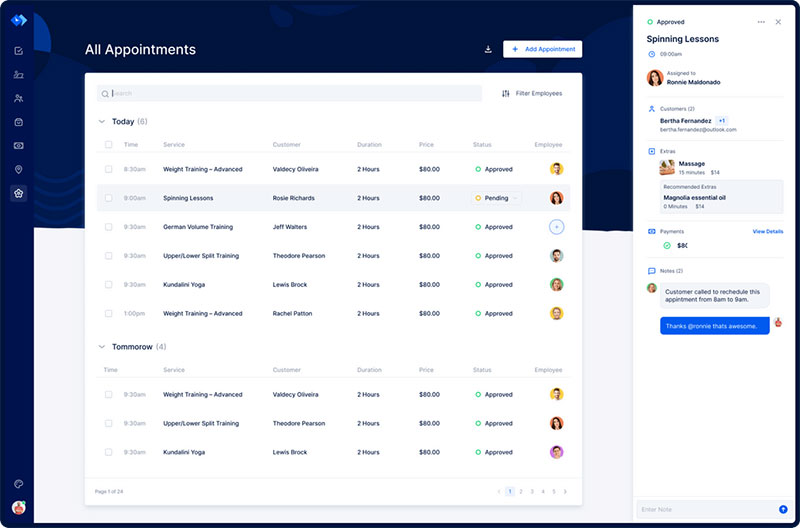
Trafft handles everything for you, even sending automated email or SMS reminders to your clients. No-shows? Not anymore!
The Trafft booking software adapts to different industries for a blissful online booking experience and employee management.
Want to know more? Check out Trafft's awesome features to see what you are missing.
Professional Service Business Examples
Professional services are built on credentials, specialized knowledge, and trust. These are not businesses you walk into without qualifications. Licensing, certifications, or advanced degrees are usually the entry point.
Legal and Financial Services
Statista reported the global legal market was worth $790 billion in 2024. Law firms generate revenue through hourly billing, flat fees, and contingency arrangements depending on the practice area.
Common legal service businesses:
- General practice law firms
- Corporate legal departments serving as outside counsel
- Legal tech startups like LegalZoom disrupting traditional firm models
Financial advisory works similarly. CPA firms, wealth management practices, and tax specialists all sell expertise by the hour or via retainer. H&R Block is one of the more recognizable examples at scale, handling over 20 million returns annually through a mix of in-person and digital service delivery.
Management and Strategy Consulting
Operations Consulting led the management consulting segment with 29.15% revenue share in 2025, while Digital Transformation Consulting is projected to grow at 13.13% annually through 2031 (Mordor Intelligence).
McKinsey, Bain, and BCG operate at the top of this market. Below them sits a long tail of boutique consulting firms focused on specific industries or functions. That second tier is actually where most consulting revenue is generated, just spread across thousands of smaller firms.
Pricing models in consulting:
- Daily or weekly rates for independent consultants
- Fixed project fees for defined scope work
- Retainer arrangements for ongoing advisory relationships
Home and Personal Service Business Examples
These are the businesses most people interact with regularly. Low barrier to entry in some cases, but that cuts both ways. Competition is high and reputation is everything.
Home Maintenance and Repair
The U.S. home improvement market hit $475 billion and grew 26% from 2022 to 2024 (ServiceTitan). Older housing stock is a big driver. The median American home purchased in 2024 was 36 years old, up from 27 years in 2012 (Mordor Intelligence). Old homes need constant work.
High-demand categories:
- HVAC installation and repair
- Plumbing and electrical work
- Pest control (Rollins completed 44 acquisitions in 2024 and posted double-digit growth)
- Roofing and structural repair
Angi processed a 22% year-over-year increase in service requests in 2024. That kind of growth signals strong consumer demand, but also a market getting more competitive on the supply side.
Cleaning and Personal Care
Low startup costs. High repeat potential. Merry Maids and Molly Maid built national franchise networks on this model. But thousands of independent operators run profitable local cleaning businesses without the franchise overhead.
Personal care is similar. Hair salons, nail salons, and barbershops run on appointment volume and client retention. Word of mouth still dominates new customer acquisition here. Nothing replaces a good stylist who knows your name.
About 94% of customers are more likely to book a service when online scheduling is available (GetApp). That alone is a strong reason for personal service businesses to adopt booking tools early.
Creative and Digital Service Business Examples
Remote delivery changed the math for creative services completely. A freelance designer in Austin can serve a client in London without either party noticing the distance. That opened up the market considerably.
Freelance Creative Services
Upwork, Fiverr, and Freelancer.com host millions of active service providers across writing, design, video, and photography. The platforms commoditized basic work and pushed skilled freelancers toward higher-value, specialized offerings.
Common freelance service businesses:
- Copywriting and content creation
- Graphic design and brand identity work, including work done through a creative web designing company
- Video production and editing, sometimes using good animation apps for motion graphics
- Photography for commercial or editorial use
- Virtual assistant services, from inbox management to research
- Mobile app development, including Android app development and small software development for startups
Took me forever to figure out that the pricing model matters as much as the skill. Hourly billing works against creative freelancers. Project or value-based pricing almost always produces better outcomes for both sides.
Digital Marketing and Agency Services
Digital marketing agencies represent one of the most fragmented service markets out there. Thousands of small agencies compete on specialization: some focus on paid search, others on content, others on social media management. Many now offer full-stack digital services, from building a site using a proper website design checklist to running post-launch campaigns.
Agency revenue by model:
| Model | Best for | Common structure |
|---|---|---|
| Retainer | Ongoing channel management | Monthly flat fee |
| Project-based | Website builds, campaign launches | Fixed scope, fixed price |
| Performance-based | Lead gen, ecommerce growth | Fee tied to results |
HubSpot and Salesforce each run large partner ecosystems of certified agencies. Canva built a similar community around design service providers. These platform-adjacent agencies benefit from built-in lead generation that independent shops have to build from scratch.
Technology consulting spending is set to exceed $400 billion in 2025 (Mordor Intelligence). A meaningful chunk of that flows through mid-size digital agencies, not just the big consulting firms.
Technical and Trade Service Business Examples
Trade service businesses are the ones nobody thinks about until something breaks. Then they become the most important call you make all week.
Demand for skilled tradespeople is growing faster than supply. The Bureau of Labor Statistics projects electrician employment will grow 9% from 2024 to 2034, with roughly 81,000 new openings per year. HVAC comes in at 8% projected growth over the same period.
Electrical, Plumbing, and HVAC
The U.S. HVAC market alone is expected to hit $148 billion by 2030 (Statista). That growth is fueled by energy-efficiency mandates, aging building stock, and the AI-driven data center construction boom, which requires 24/7 precision cooling systems.
Trade service business types at a glance:
| Trade | Median Annual Wage (BLS 2024) | Projected Growth (2024-2034) |
|---|---|---|
| Electricians | $62,350 | 9% |
| Plumbers | $62,970 | 4% |
| HVAC Technicians | $59,810 | 8% |
Rollins, one of the largest pest control companies in the U.S., completed 44 acquisitions in 2024 and posted double-digit revenue growth. That is what the trade service business model looks like at scale.
IT Support and Managed Services
Managed Service Providers (MSPs) sell ongoing IT support under contract. Think Geek Squad at the consumer level, or regional IT firms handling network management and cybersecurity for small and mid-size businesses. Many also offer functional testing as part of their software delivery services, particularly those supporting small software development for startups.
MSP revenue model: retainers covering help desk access, device monitoring, backup management, and security patching for a flat monthly fee.
Cybercrime is projected to cost the world $10.5 trillion annually by 2025 (Cybersecurity Ventures). That number is the primary reason cybersecurity consulting and managed IT support are among the fastest-growing B2B service categories right now.
The barrier to entry is low compared to the trades. No licensing in most states. But client trust is hard to build and even harder to recover once lost.
How to Start a Service Business
About 80% of small businesses survive their first year, but only 50% reach year five (SBA, 2024). Service businesses generally have better odds than most because startup costs are lower and cash flow can turn positive quickly.
The problem is not usually getting started. It is staying focused on the right things early.
Identify Your Skill and Define Your Customer
Start with what you can actually deliver. Not what sounds profitable. Not what a YouTube video said had high margins.
What to nail down before launch:
- The specific problem you solve and for whom
- Whether your target customer is a business or an individual
- What makes your service different from the ten other providers already doing it
Poor marketing contributes to 14% of startup failures (Founders Forum Group). That is not a marketing budget problem. It is usually a "wrong customer" problem.
Choose a Pricing Model
Pricing determines whether your business is profitable or just busy. Getting this right early saves years of frustration.
According to a SoDa and Productive survey, project-based pricing drives just under 50% of digital agency revenue. Retainers account for 44%. Hourly billing, despite being the default for new service providers, represents only 30%.
Hourly: simple to start, hard to scale, penalizes efficiency.
Project-based: clean scope, clean price, but scope creep will test you.
Retainer: predictable monthly revenue, best for ongoing work with defined deliverables.
Most service businesses start hourly and graduate to retainers or project fees once they have enough client history to scope work accurately. That is actually the right order, at least in my experience watching this play out.
Minimum Viable Setup
Nothing annoys me more than new service business owners who spend three months on their website before getting a single client. The setup you actually need is much smaller than you think.
- A way to take payment (Stripe, PayPal, invoice).
- A contract template, even a basic one
- A clear offer, clearly priced
- One or two ways to reach potential clients
That is it. Everything else is noise until you have paying customers.
What Makes a Service Business Profitable
Plenty of service businesses generate revenue. Fewer of them actually make money. The difference comes down to a small set of operational factors that compound over time.
Utilization Rate and Recurring Revenue
Utilization rate is the percentage of available hours that generate billable revenue. It is the single most direct lever on profitability in any service business.
Low utilization is not a sales problem. It is a capacity and pricing problem. You either need more clients or fewer service delivery hours per dollar earned.
Retainer-based revenue directly improves utilization predictability. When you know next month's workload in advance, scheduling becomes more efficient and idle capacity shrinks.
Successful digital agencies average 15% net margins, while agencies that target retainer-heavy revenue mixes aim for 25 to 35% net margins (Promethean Research). The gap between those two numbers is almost entirely explained by pricing model and recurring revenue mix.
Productizing Services to Reduce Scope Creep
Productized services are the most underused tool in small service businesses.
Instead of custom quoting every client, you define a fixed package: specific deliverables, fixed timeline, fixed price. Clients know what they get. You know what to deliver. Everyone stops guessing.
Scope creep is the silent margin killer in service businesses. It happens when client expectations exceed what was priced, and the service provider absorbs the difference to keep the relationship.
- Document scope in writing before any work starts
- Price based on outcome delivered, not hours spent
- Bill overages as add-ons, not as goodwill
Referrals, Reputation, and Retention
Acquiring a new client costs five times more than keeping an existing one. That is a well-documented figure across multiple service industries.
The most profitable service businesses are not the ones with the best marketing. They are the ones whose clients stay longer and refer more often.
Key retention drivers in service businesses:
- Consistent delivery quality, not just first-impression quality
- Proactive communication before problems surface
- Clear reporting that ties service activity to client outcomes
TaskRabbit built retention into its model by embedding service booking directly into the point of sale (IKEA furniture assembly, for example). The result: lower acquisition costs and higher repeat rates, because the trigger for rebooking is built into the customer's existing shopping behavior.
FAQ on Service Businesses
What is a service business?
A service business sells skills, time, or expertise rather than physical products. The output is intangible. Think law firms, cleaning companies, consulting practices, and personal trainers. Revenue comes from performing work, not from manufacturing or selling goods.
What are some common examples of service businesses?
Common examples include accounting firms, digital marketing agencies, HVAC companies, hair salons, IT support providers, and freelance designers. Platforms like Upwork and TaskRabbit host thousands of individual service providers across dozens of categories.
What is the most profitable service business to start?
High-margin options include management consulting, digital marketing, bookkeeping, and IT services. Profit depends more on pricing model and client retention than on category. Retainer-based businesses tend to outperform project-based ones over time.
What is the difference between a B2B and B2C service business?
B2B service businesses sell to other companies. B2C businesses sell directly to consumers. B2B contracts are typically larger with longer sales cycles. B2C businesses depend more on volume, local reputation, and repeat bookings.
What are low-cost service businesses to start?
Freelance copywriting, social media management, tutoring, lawn care, and house cleaning all require minimal startup capital. Most need little more than a skill, basic tools, and a way to take payments. No inventory required.
Can a service business be run online?
Yes. Many service businesses operate fully remotely. Copywriters, consultants, web developers, and virtual assistants deliver work entirely online. Platforms like Fiverr and Freelancer.com make it straightforward to find clients without a physical location.
How do service businesses make money?
Through hourly billing, project-based fees, or monthly retainers. Recurring revenue models like retainers produce the most predictable income. Some service businesses also earn through performance-based arrangements tied to measurable client outcomes.
What are examples of professional service businesses?
Law firms, CPA practices, financial advisory companies, and management consulting firms like McKinsey and Deloitte are all professional service businesses. They require credentials or advanced expertise and typically charge premium rates for specialized knowledge.
How is a service business different from a product business?
Product businesses manufacture or resell physical goods. Service businesses sell work performed. There is no inventory in a service business. Capacity, not stock, is the limiting factor. Scaling requires adding people or improving delivery efficiency.
What makes a service business successful long-term?
Strong client retention, consistent delivery quality, and a clear pricing model. Referrals drive most growth in service businesses. Businesses that productize their services and build recurring revenue through retainers tend to survive and grow past the five-year mark.
Conclusion
This conclusion is for an article presenting service businesses examples across every major category, from skilled trades and professional services to B2B consulting and digital agencies.
The common thread is simple: you sell what you know or what you can do.
Whether you are running a local HVAC company, a retainer-based marketing firm, or a solo bookkeeping practice, the fundamentals stay the same. Pricing model, client retention, and service delivery quality determine whether the business actually works.
Platforms like Thumbtack, Angi, and Fiverr have lowered the barrier to finding clients. The harder part has always been keeping them.
Pick a category that matches your skills, define your recurring revenue model early, and build from there.