






Not all service businesses are created equal. Some generate 40% net margins with minimal overhead. Others keep owners working 60-hour weeks for a fraction of that.
The most profitable service businesses share a common structure: low startup costs, recurring revenue, and pricing power that holds up at scale.
This guide breaks down which service models actually deliver strong margins, what the data shows about profit by category, and what separates high-income operators from those stuck trading time for money.
Whether you're evaluating a new business or trying to understand why your current one isn't hitting its financial potential, the answers are in the numbers.
What Makes a Service Business Profitable
Profit margin is what matters, not revenue. A cleaning business pulling $300k a year with 31% net margins beats a staffing agency doing $2M with 8% margins every single time. The owner keeps more money.
Service businesses have a structural advantage: there's no cost of goods sold tied to physical inventory. You're selling time, expertise, or systems. That keeps gross margins high from day one.
But not all service models are equal. Some trade time directly for money with no ceiling. Others build recurring revenue streams that grow without proportional cost increases. That gap in structure is exactly what separates a $80k/year solo operator from a $500k/year service business owner.
Net Profit vs. Revenue: Why the Distinction Matters
According to Homebase research, service businesses like cleaning operations can exceed 31% net profit, while restaurants average just 2.8-4%. Same "business owner" title, wildly different financial outcomes.
Three numbers that actually define a service business's financial health:
- Net profit margin: What you keep after every expense, including your own replacement-cost salary
- Gross margin: Revenue minus direct labor and delivery costs, before overhead
- Owner's discretionary earnings: The real take-home number BizBuySell uses when valuing businesses for sale
Revenue is vanity. Margin is sanity. A 20% net margin on $500k beats a 5% margin on $2M when it comes to actual owner income and business valuation.
The Four Structural Drivers of High Margins
Low overhead: No physical storefront, no inventory, no equipment-heavy delivery.
Recurring revenue: Retainer or subscription billing means you're not starting from zero every month. Client acquisition cost gets amortized across years, not individual projects.
Scalability without proportional hiring: Productized services, automation, and SOPs let you add clients without adding headcount at the same rate.
Pricing power: Niche expertise, credentials, and barriers to entry protect you from race-to-the-bottom pricing. A general virtual assistant charges $20/hour. A HIPAA compliance consultant charges $250/hour for similar time investment.
Recurring Revenue vs. One-Time Projects
This is the single biggest lever on long-term profitability. Here's why the math works so differently:
| Revenue Model | Client Acquisition Cost Impact | Cash Flow Predictability | Margin Trend Over Time |
|---|---|---|---|
| Project-based | High (paid per client acquired) | Unpredictable | Flat or declining |
| Retainer / subscription | Low (amortized over months/years) | Predictable | Improves with tenure |
Managed IT service providers, monthly SEO retainers, bookkeeping subscriptions, and pest control routes all share one thing: the client pays on schedule without the provider re-selling them every month.
BizBuySell data from over 120 business types shows service businesses have consistently ranked at the top for owner profit margins over the past five years. The top-performing model in their data? Pest control, driven almost entirely by recurring contracts and low labor-per-job costs.
The Most Profitable Service Businesses Ranked
The businesses below were selected based on documented net profit margins, startup cost-to-earnings ratios, and scalability potential. These aren't just high-revenue businesses. They're businesses where the owner keeps a meaningful share of what comes in.
Margins listed are typical net profit ranges, not gross margins. Gross margins look better but tell you less about actual owner income.
| Business Type | Typical Net Margin | Revenue Model | Startup Cost Range |
|---|---|---|---|
| Financial Advisory | 35–47% | AUM fee / retainer | $10k–$50k |
| IT Consulting / MSP | 25–35% (top performers) | Managed contracts | $15k–$80k |
| Digital Marketing Agency | 20–30% | Retainer / project | $5k–$25k |
| Accounting / Tax Services | 18–40% (size-dependent) | Fixed fee / hourly | $5k–$30k |
| Legal Services (niche) | 25–35% | Hourly / flat fee | $30k–$100k+ |
| Online Coaching / Courses | 40–80% (at scale) | Subscription / one-time | Under $5k |
| Real Estate Services | 15–30% | Commission / management fee | $10k–$50k |
| Staffing / Recruiting | 10–20% | Placement fee / markup | $15k–$50k |
| Home Services (Cleaning, HVAC, Pest) | 10–31% | Recurring contracts | $5k–$40k |
| Healthcare / Mental Health Practice | 15–35% | Session fee / insurance | $20k–$80k |
| Virtual assistant services | 30–50% | Retainer / hourly | Under $2k |
| Mobile App development | 20–35% | Project / retainer | $10k–$50k |
| Payroll processing | 15–25% | Subscription / per-run fee | $5k–$20k |
| Social media marketing | 20–30% | Retainer / project | $3k–$15k |
| Technical support services | 18–30% | Managed contracts | $5k–$25k |
Financial Advisory and Wealth Management
The Ensemble Practice's 2025 report found that the average advisory firm hit a record 39.2% operating profit margin in 2024, up from 36.4% in 2023. Medium-sized firms led with 47.2%.
High margins come from the AUM fee model: once assets are under management, revenue grows with market returns without adding delivery costs. No additional labor required to "serve" a client whose portfolio appreciates.
- Revenue per relationship manager averaged $1.28 million in 2024 (Ensemble Practice)
- Referrals account for 52% of new clients, keeping acquisition costs low
- The main risk: margin compression during bear markets when AUM shrinks
Vanguard and Fidelity disrupted the commodity end of this market with low-cost index funds. Independent RIAs (Registered Investment Advisors) responded by moving upmarket into comprehensive financial planning, where the fee is justified by breadth of service, not just portfolio management.
Your success story starts with a scheduling app to streamline your calendar
Staying organized has never been easier.
You can now manage your business and grow your brand with a single, powerful software that keeps all of your appointments in line, your clients organized and your business booming.
Trafft is perfect for business owners who need to streamline their booking experience both for their staff and their clients.
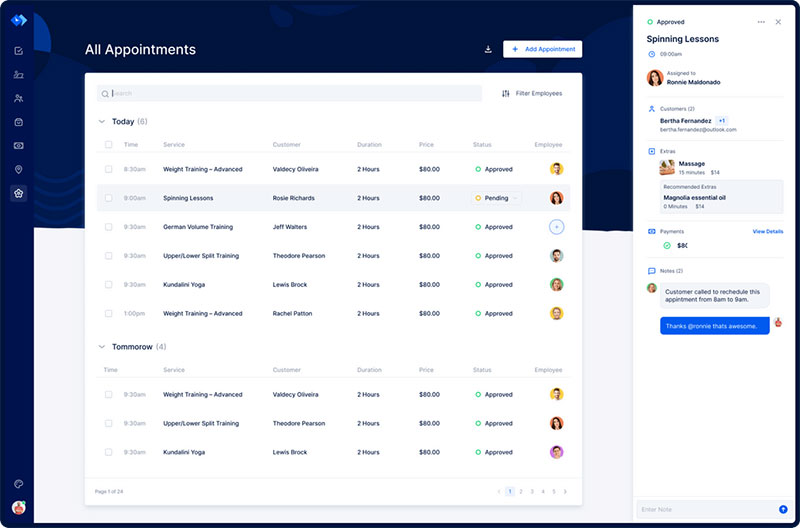
Trafft handles everything for you, even sending automated email or SMS reminders to your clients. No-shows? Not anymore!
The Trafft booking software adapts to different industries for a blissful online booking experience and employee management.
Want to know more? Check out Trafft's awesome features to see what you are missing.
IT Consulting and Managed Services
Average MSP net margins sit at 8-12%, which is genuinely not great. But the top 10% of MSPs hit 25-35% net margins, according to TruMethods president Gary Pica. The gap between average and top-performing operators is wider here than in almost any other service category.
What separates high-margin MSPs:
- Subscription recurring revenue above 50-60% of total revenue
- Service gross margins over 46% (ConnectWise Q2 2024 data)
- Tight vendor stack: 20-25 vendor relationships destroys per-technician efficiency
Working with a reliable software development agency or keeping software developers in-house for custom tooling is one way top MSPs cut per-ticket costs over time. Technical support services bundled into managed contracts also improve utilization without adding significant delivery overhead. The managed IT services market was worth an estimated $319.5 billion in 2024, up from $166.8 billion in 2018 (MSP Insights). That's not a niche. The profitability problem is an execution problem, not a market problem.
Digital Marketing and SEO Agencies
Agency-wide delivery margins of 50-60% are considered healthy. Net operating margins of 20-30% are achievable with the right client mix and pricing model, according to Parakeeto benchmarks.
Promethean Research's 2024 digital agency report found that 83% of agencies now specialize by service mix or industry, and specialization directly correlates with faster growth rates. Generalist agencies compete on price. Specialists compete on outcomes. This applies equally to social media marketing shops, startup PR agencies, and full-service digital firms. The ones growing fastest have a clear vertical, not a broad menu.
A boutique SEO agency in Austin reported a 40% profit margin in 2024 by focusing exclusively on healthcare clients, where compliance knowledge creates a barrier to entry that protects pricing. That's the model worth copying: niche down until you can charge a premium that nobody else can justify without your specific background.
Legal Services (Specialized Niches)
General practice law firms run thin. Specialized practices do not.
Net margins of 25-35% are realistic for estate planning, IP law, immigration law, and business formation specialists. The combination of high hourly rates, low physical overhead, and non-commoditized expertise keeps margins strong even without scale.
Legal services that touch regulated industries like pharmaceutical shipping, warehousing storage compliance, or healthcare tend to carry even higher billing rates because the consequences of getting it wrong are severe.
- Solo estate planning attorneys commonly bill $300-$600/hour with minimal staff costs
- Document automation tools (Clio, PracticePanther) cut administrative overhead significantly
- Subscription legal service models (monthly retainers for business owners) are growing
Accounting and Tax Services
Accounting firms average an 18.4% net profit margin, versus 8.9% for U.S. private companies generally, according to data compiled by Link My Books.
Small firms (under $1M revenue) often see 20-40% margins due to minimal overhead. The 2024 Financial Cents survey of 261 firm owners found bookkeeping was the top profit driver, followed by tax returns. Advisory services ranked third but came with the highest per-hour returns.
The average CPA salary sits around $78,000 annually (BLS 2024), but firm owners clearing 20-40% net margins on $500k+ revenue are well past that number. Clients who need help file them (taxes, that is) every year without fail, which is about as close to guaranteed recurring demand as any service business gets.
The pricing shift is notable. CPA.com data shows reliance on hourly billing dropped from 53% in 2018 to just 10% in 2024, with 84% of firms now using fixed-fee or subscription pricing. Fixed-fee models stop scope creep from eroding margins on repeat engagements. Many firms also bundle payroll processing into their service stack, which adds a recurring revenue line with minimal extra delivery cost per client.
Online Coaching and Course Creation
At scale, this is one of the highest-margin service models that exists. A recorded course costs roughly the same to deliver to 100 students as it does to 10,000. Variable costs are near zero.
Realistic net margins by model:
- 1:1 coaching (solo): 50-70% net, but hard ceiling on revenue
- Group coaching programs: 60-75% net once filled, with leverage on the coach's time
- Asynchronous courses: 70-85% net at scale, near zero marginal cost per student
Tony Robbins built a business worth over $6 billion using this model, but you don't need his scale to see strong margins. A course creator doing $500k/year with a small email list and no team can keep $350-400k. That's almost impossible in most other service categories at that revenue level.
Providing an online course in a specialized niche, whether that's compliance training, care for pets, or professional certification prep, tends to outperform generic topics on both conversion and pricing.
The tradeoff is that data visualization for marketers and audience-building takes real time upfront. Coaches who struggle with this model usually underinvest in audience before launching.
Profit Margins by Service Business Type
These numbers come from IBISWorld industry data, BizBuySell transaction records, and sector-specific benchmarks. They reflect net profit margins for owner-operators, not EBITDA multiples used in M&A contexts.
Gross margin is what's left after direct delivery costs. Net margin is what's left after everything, including overhead, salaries, software, insurance, and rent. The gap between them tells you how efficiently a business type runs its overhead.
Margin Ranges Across Service Categories
| Category | Gross Margin Range | Net Margin Range | Margin Driver |
|---|---|---|---|
| Financial Advisory | 60–75% | 35–47% | AUM fee model, low delivery cost |
| Online Coaching/Courses | 85–95% | 40–80% | Near-zero marginal delivery cost |
| Accounting (small firm) | 60–70% | 20–40% | Recurring clients, fixed-fee pricing |
| Digital Marketing Agency | 50–65% | 20–30% | Retainer revenue, low COGS |
| IT Consulting (top MSPs) | 50–60% | 25–35% | Managed contracts, automation |
| Pest Control | 55–65% | 30–40% | Recurring routes, low labor per job |
| Cleaning Services | 40–55% | 25–31% | Route density, recurring residential |
| Staffing/Recruiting | 20–35% | 10–20% | Volume-dependent, competitive pricing |
Why Some High-Revenue Services Have Low Margins
Staffing agencies move a lot of money. Most of it goes straight back out as contractor wages.
A staffing firm billing $3M/year might keep $300-600k as net profit. An accounting firm billing $600k might keep $150-240k. Both owners clear similar income, but the staffing owner carries 5x the operational complexity.
High revenue does not equal high profit. The businesses worth evaluating are those where the spread between revenue and net income is wide, and where that spread holds up at scale. Financial advisory, pest control, and online education all share this structure.
How Pricing Model Shifts Margins
Same service, different pricing structure, dramatically different margins.
- Hourly billing: Rewards inefficiency, caps earnings, hard to scale
- Project/flat fee: Predictable for the client, risky for the provider when scope creeps
- Retainer/subscription: Predictable for both sides, improves margin over time as delivery gets more efficient
- Value-based pricing: Highest potential, requires proven ROI data to justify
The 2024 CPA.com CAS Benchmark Survey found that hourly billing in accounting dropped from 53% in 2018 to 10% in 2024. Firms switching to fixed-fee models consistently reported better margin control. That trend is visible across most knowledge-based service categories right now.
Low-Overhead Service Models That Scale
Low overhead is the starting point, not the end goal. The real play is combining low overhead with a structure that lets revenue grow faster than costs.
Most service businesses hit a ceiling when the owner runs out of hours. The ones that don't have built delivery systems that don't depend entirely on the owner's personal time.
Solo Operator vs. Agency Model: Margin Comparison
Solo operators often have the best margins in percentage terms. An independent bookkeeper on a Bench-style model keeping 70%+ of revenue is not unusual. But the revenue ceiling is real.
Agency models add headcount, which compresses margin initially, but the ceiling moves much higher.
| Model | Typical Net Margin | Revenue Ceiling | Owner Dependency |
|---|---|---|---|
| Solo operator | 50–70% | $150k–$400k | Very high |
| Small team (2–5 people) | 25–40% | $500k–$2M | Moderate |
| Agency/scaled model | 15–30% | $2M+ | Low (if systemized) |
The transition from solo to team is where most service businesses lose margin temporarily. Hiring before you have systems in place is the most common reason margins drop and don't recover.
Productized Services and Why They Protect Margins
Productized services are scoped, fixed-price offerings with a defined deliverable. "We build your WordPress site in 14 days for $3,500" beats "we charge $125/hour for web development" in almost every margin metric.
Scope is locked. Delivery is templated. Time invested per project drops as the team repeats the same process. Margin improves over time without raising prices.
Basecamp (the project management software company) productized its own consulting methodology before building software. The discipline of scoping services cleanly carried directly into how they built their product. Productized thinking tends to transfer across everything a service business does.
Remote Delivery and Overhead Reduction
Remote service delivery eliminates rent, dramatically reduces admin infrastructure, and widens the talent pool (allowing cheaper hires in lower cost-of-living areas).
In 2024, service-based businesses operating remotely continued to see gross margins of 20-30% higher than comparable in-person operations, according to benchmarks from Fino Partners research.
Tools that replace headcount in remote service businesses:
- Gusto or Deel for payroll and contractor management
- PandaDoc for proposals and contracts
- Calendly for scheduling (eliminates back-and-forth entirely)
- QuickBooks for financial tracking without a dedicated bookkeeper initially
Recurring Revenue in Service Businesses
One client on a 12-month retainer is worth more than four clients on one-time projects, even if the total revenue looks similar. The retainer client costs almost nothing to retain. The four project clients each required a sales cycle.
This is the math most service business owners understand conceptually but don't build toward deliberately.
Retainer vs. Project Billing: Lifetime Value Difference
Consider two digital marketing businesses. Both bill $10k/month. One has 10 clients on recurring retainers. One works on one-off projects.
The retainer business spends maybe 10-15% of revenue on client acquisition. The project-based business spends 30-40%, constantly refilling the pipeline.
- Lower churn = lower CAC amortized over time
- Predictable monthly revenue lets you hire and invest ahead of demand
- Clients on retainer deepen over time, leading to upsell opportunities without a new sales cycle
Agencies adopting retainer models in 2024 reported 20% higher average margins compared to project-based peers, according to Hello Bonsai benchmark data.
Industries Where Recurring Models Are Standard
Not every service converts easily to a recurring model. But more do than most owners realize.
Natural recurring fits: managed IT services, monthly bookkeeping, lawn care routes, pest control, cleaning, property management, monthly SEO retainers, payroll processing.
Harder to convert but possible: legal services (monthly business retainer), consulting (advisory retainer vs. project), personal training (monthly membership), graphic design (brand maintenance package).
Lawn care companies figured this out years ago. ServiceTitan and Housecall Pro exist almost entirely to help home service businesses track and grow their recurring route revenue. The software is built around the insight that recurring customers are a fundamentally different (and better) financial asset than one-time customers.
Churn Rate and Its Effect on Profitability
At 5% monthly churn, a subscription service business loses half its customer base every year. At 2%, it retains 79% annually. That difference in retention rate compounds dramatically over time into either growth or stagnation.
High-margin recurring businesses are almost always low-churn businesses. The margin and the retention are connected: clients who get clear value don't leave, and predictable revenue lets you reinvest in service quality instead of constantly chasing new clients.
This is why financial data visualization matters for service businesses tracking these metrics. Seeing churn and lifetime value in one place changes how operators prioritize their time.
High-Demand Service Businesses With Low Competition
High margin and low competition usually come from the same source: a service that requires specific credentials, experience, or knowledge that most people don't have and can't fake.
General services have general competition and general pricing. Niche services command niche pricing, which is almost always better.
Underserved B2B Niches With Pricing Power
Most service business owners compete in crowded markets because they start with their skills, not with the market. The more useful approach: find a B2B niche with budget, pain, and limited specialist supply.
Examples with documented pricing power:
- Medical billing services: Healthcare providers hate billing. Specialists charge 4-8% of collections with low churn
- HIPAA compliance consulting: Fear of regulatory penalties justifies premium pricing
- SOC 2 audit preparation: SaaS companies need this to close enterprise deals; consultants charge $15-50k per engagement
- Dental practice consulting: The average cleaning costs $288 per patient in many U.S. markets, and practices hire outside consultants to improve scheduling efficiency and cut no-show rates
- ISO certification consulting: Manufacturing clients need it; few consultants specialize in it
These aren't glamorous niches. That's exactly why they're profitable. Nobody is flooding them with venture-backed competitors.
Compliance and Regulatory Consulting
Regulatory complexity creates demand that doesn't respond to economic cycles the way discretionary services do. Companies don't stop needing OSHA compliance help during a recession. They might cut their marketing budget. They won't cut what keeps them out of legal trouble.
NYU Stern data from 2024 confirms that specialized knowledge services consistently achieve net margins near 20% or higher, with pricing power directly tied to the complexity and risk involved in the underlying problem.
Deloitte and the Big Four dominate the enterprise end of compliance consulting. The gap they leave is in the mid-market: companies too large for a solo generalist but too small to afford Big Four rates. That's a well-documented gap with real revenue.
Skilled Trade Niches With Aging Workforce Gaps
HVAC technicians, elevator inspectors, industrial electricians, and commercial plumbers are getting older. The BLS projects significant workforce gaps in skilled trades through 2032 as retirements outpace new entrants.
Find a bicycle for sale and micro-mobility logistics consulting are smaller but emerging trade-adjacent niches tied to urban delivery infrastructure, where maintenance demand is growing faster than qualified service providers.
The profit margin data backs this up. Homebase research shows HVAC businesses typically net 10-14%, but that figure understates what specialized commercial HVAC operators earn. Service contracts on commercial HVAC systems can yield 30%+ margins due to recurring maintenance fees and limited competition in specific equipment types.
Worth noting: skilled trades have higher startup costs than knowledge services. But the barriers to entry protect margins in a way that digital service businesses often can't match.
Starting a Profitable Service Business With Minimal Capital
More than 50% of small businesses in the United States started with less than $25,000 in funding, according to Exploding Topics research. Service businesses skew even lower. The right model costs almost nothing to launch.
The gap between "low startup cost" and "profitable service" is where most business evaluations go wrong. Cheap to start doesn't mean profitable. But several high-margin service categories are both.
Which High-Margin Services Require Under $5,000 to Start
Under $2,000 to launch:
- Bookkeeping (QuickBooks certification: ~$350, basic software: ~$600/yr)
- Virtual assistant services (laptop + Zoom + contracts)
- Social media marketing (Canva Pro, scheduling tool, basic portfolio)
- Social media management (Canva Pro, scheduling tool, basic portfolio)
$2,000 to $5,000 range: Tax preparation (PTIN registration, tax software license), online coaching (website, payment processor, Calendly), and mobile app development consulting. The cost of creating an app for a client typically starts around $10k-$25k, so positioning as a project manager rather than a solo developer keeps your own entry costs minimal.
The SBA reports the average cost of a microbusiness is $3,000. Most knowledge-based service businesses fall into this category, especially in the first year when you're operating solo.
Licensing and Certification Requirements That Affect Entry Cost
Some high-margin categories require credentials before you can legally operate. Skipping this step isn't a cost savings. It's a liability.
| Service Type | Required Credential | Approx. Cost |
|---|---|---|
| Financial advisor (RIA) | Series 65 license | $175 exam fee |
| Tax preparation | PTIN + state license (some states) | $35–$300 |
| Bookkeeping | None required (QuickBooks cert optional) | $0–$350 |
| HVAC technician | EPA 608 certification | $20–$70 |
| Mental health counseling | State licensure (LPC, LCSW) | $200–$1,000+ |
Credentials that are cheap to obtain but protect pricing power are rare. The Series 65 for RIAs costs $175 and unlocks a business model with 35-47% operating margins. That's a good return on a licensing fee.
First Client Acquisition Without an Ad Budget
The SBA recommends building from direct outreach, referrals, and network connections before spending on paid acquisition. This works. Almost every profitable solo service business starts this way.
Three approaches that reliably land the first five to ten clients at zero ad spend:
- Direct outreach on LinkedIn to 20-30 ideal clients with a specific offer, not a general pitch
- Referral agreements with adjacent service providers (accountants referring bookkeepers, for example)
- One piece of published content on a platform where your buyer already spends time
Clutch.co and Thumbtack connect buyers with service providers for B2B and home services respectively. Both work well for early traction without upfront marketing spend.
Factors That Erode Profit in Service Businesses
SPI Research's 2025 Professional Services Maturity Benchmark found that EBITDA across professional services firms dropped from 15.4% in 2023 to 9.8% in 2024, the lowest in five years. Scope creep, rising overhead, and underpricing were the primary culprits.
High-margin service businesses fail financially not because the market dried up, but because internal structural problems went unaddressed. These are the same problems in almost every case.
Scope Creep and Underpricing
Scope creep can cost a service business up to 20% of annual revenue, according to a 2024 PMI Pulse of the Profession report.
A Forrester Consulting study found that 73% of professional services firms experience measurable margin loss from undocumented scope changes. And most let it happen because saying no to a small client request feels uncomfortable in the moment.
The fix isn't saying no more. It's clearer contracts upfront, with defined deliverables, revision limits, and change order processes baked in from day one. PandaDoc or a simple MSA template handles this for under $30/month.
Client Concentration Risk
One client representing more than 30% of your revenue isn't a client relationship. It's a dependency. When that client leaves, cuts budget, or delays payment, the business has a cash flow problem immediately.
Warning signs worth tracking monthly:
- Any single client over 25% of total revenue
- Top three clients combined over 60% of revenue
- No clients added in the last 90 days
The 2024 Accounting Firms Revenue report from Financial Cents found that 56% of accounting firms deliberately culled low-fit clients in 2024. That's not just about quality. It's also about spreading revenue risk across a wider client base to protect margins.
Hiring Ahead of Systems
Replacing an employee costs 1.5 to 2 times their annual salary, according to Josh Bersin research. Hiring the wrong person at the wrong stage is one of the most expensive mistakes a service business makes.
Service businesses should hire when they have repeatable, documented processes for the role, not before. Hiring someone into an undefined role means the owner is still doing the work while also managing a new hire who doesn't have a clear path to follow.
The typical pattern: agency hits $400-500k in revenue, hires two people at once, margins drop from 35% to 12%, owner works more hours than before. This cycle repeats until the owner either fixes the systems or burns out.
The Time-for-Money Ceiling
Purely hourly service businesses hit a revenue ceiling that doesn't move without productizing, delegating, or switching models. The math is fixed: available hours multiplied by hourly rate equals maximum revenue.
At 30 billable hours per week, a $200/hour consultant maxes out at $312,000 per year gross, before taxes, software, and any overhead. That's the ceiling. And it never gets higher without structural change.
The SPI 2025 benchmark found billable utilization at professional services firms sat at just 68.9% in 2024, below the 75% optimal threshold. Most service business owners are already working near capacity and still not capturing full billing potential.
How to Evaluate Profitability Before Starting
Most people skip this step. They find a service they can provide, then look for clients. The smarter order is reversed: verify the market conditions, then decide whether to build the service. Starting a successful service business comes down to picking a model with real margin potential before committing time and money to it.
A structured pre-launch evaluation takes two to three weeks and prevents years of operating a business with a permanently compressed margin.
Key Metrics to Research Before Entering a Market
IBISWorld and NAICS data provide industry-level financial benchmarks for almost every service category in the U.S. These reports show average revenue per business, cost structures, and net profit margins by sector, all broken down at the six-digit NAICS code level.
Five numbers to find before committing:
- Average net profit margin for the specific service category (not the industry average)
- Average billing rate for your target geography and client size
- Typical client acquisition cost reported by operators in the space
- Average client tenure or churn rate, especially for recurring models
- Market saturation in your target niche or region
BLS Occupational Outlook Handbook adds employment growth projections by role, which tells you whether demand is expanding or contracting over the next decade. That's a useful secondary data point when the primary margin data looks thin.
Talking to Operators Before You Enter
Ten conversations with service business owners in your target category will tell you more than any industry report.
Most operators will talk openly about pricing, client acquisition, and what's harder than they expected. Ask specifically about their average project size, their best and worst clients, and where their margins actually land after accounting for all costs. Nobody asks these questions. Almost everyone answers them honestly when asked directly.
SCORE, the SBA's free mentoring program, connects prospective business owners with experienced operators in their sector. It's free, and the conversations are often more candid than anything you'd find in a paid report. I've seen people completely change their business idea based on a single SCORE conversation. Worth doing before spending anything.
Running a Simple Unit Economics Model
Unit economics for a service business comes down to four numbers:
| Metric | How to Calculate It | Target Range |
|---|---|---|
| Average revenue per client | Expected billing rate × expected hours | Depends on model |
| Client acquisition cost (CAC) | Total sales/marketing spend ÷ new clients acquired | Under 3 months of client revenue |
| Gross margin per client | (Revenue − direct delivery cost) ÷ revenue | 50%+ for knowledge services |
| Payback period | CAC ÷ monthly gross margin per client | Under 6 months |
A service business where payback period exceeds 12 months requires significant capital to grow. Businesses where payback is under 3 months can self-fund growth from cash flow. That difference defines whether you need outside capital or not.
Red Flags in a Market That Signal Margin Compression
Not every growing market is a profitable one. Watch for these signals before entering:
- Commoditized pricing across most providers (everyone charges the same range)
- Platforms like Fiverr or Upwork dominating the buyer's first search
- High volume of offshore competition for the exact deliverable you'd offer
- No visible operators in the space with a strong positioning or premium offer
Markets with the above characteristics aren't worth entering at a standard rate. The only viable path in those markets is a clear niche, a specific client segment, or a productized offering that competes on outcome rather than price.
Understanding the right way to present findings from this kind of research also matters. Operators who track their own metrics often use financial charts and graphs to spot margin trends early, before they become a structural problem.
FAQ on Most Profitable Service Businesses
What is the most profitable service business to start?
Financial advisory and wealth management consistently top the list, with average operating margins hitting 39.2% in 2024 (Ensemble Practice). Online coaching and IT consulting also rank high when structured around recurring revenue and low overhead delivery models.
What net profit margin should a service business aim for?
A healthy net margin for most service businesses falls between 20% and 35%. Knowledge-based services like accounting, consulting, and digital marketing can exceed that. Margins below 10% usually signal underpricing, scope creep, or overhead that's grown faster than revenue.
Which service businesses have the lowest startup costs?
Bookkeeping, copywriting, virtual assistant services, and online coaching can all launch for under $2,000. The SBA reports the average microbusiness costs just $3,000 to start. Low startup costs combined with high margins make these models especially attractive for first-time operators.
Is a service business more profitable than a product business?
Generally, yes. Service businesses carry no inventory costs, minimal COGS, and often higher gross margins. BizBuySell data confirms service businesses have led on owner profit margins for five consecutive years, outperforming retail and manufacturing categories consistently.
What makes a service business scalable?
Scalability comes from recurring revenue, documented processes, and delivery systems that don't depend entirely on the owner's time. Productized services and subscription billing models let revenue grow without proportional headcount increases, which is where real margin improvement happens.
How does recurring revenue affect service business profitability?
It significantly improves margins over time. Client acquisition cost gets spread across months or years instead of single projects. Agencies using retainer-based models in 2024 reported 20% higher average margins than project-based peers, according to Hello Bonsai benchmark data.
What are the biggest profit killers in service businesses?
Scope creep, client concentration, and hiring before systems are in place. A 2024 PMI report found scope creep alone can cost up to 20% of annual revenue. Over-reliance on one or two clients adds fragility that compounds quickly when a key relationship ends unexpectedly.
Do I need credentials or licenses to start a profitable service business?
It depends on the category. Financial advising requires a Series 65 license. Tax preparation needs a PTIN. Bookkeeping needs neither. Credentials that are cheap to obtain but protect your pricing power, like the Series 65 at $175, offer some of the best returns on investment available.
How do I evaluate whether a service business idea is actually profitable?
Research average net margins using IBISWorld or NAICS data, then run a simple unit economics model. Check your client acquisition cost, gross margin per client, and payback period. Talk to ten operators in the space before committing. Reports help, but real conversations are faster.
What B2B service businesses have the highest pricing power?
Compliance consulting (HIPAA, SOC 2, ISO), medical billing, and specialized legal services. These niches have limited specialist supply, clients with real budget, and genuine consequences for not solving the problem. Pricing power in these categories is protected by expertise barriers most competitors can't easily cross.
Conclusion
This conclusion is for an article presenting the most profitable service businesses and the structural factors that actually drive net margins.
The pattern is consistent across every high-performing category: recurring revenue, low overhead, and pricing power built on niche expertise.
Financial advisory, IT consulting, accounting, and online coaching all prove it. The business model matters more than the market size.
Before entering any service category, run the unit economics. Check IBISWorld benchmarks, talk to operators, and verify that your client acquisition cost supports the margin you need.
Profitability is a structural decision, not a result of working harder. Build the right model from day one, and the margins follow.