




Five emails to lock down one 30-minute call. That's roughly what manual scheduling runs you, and plenty of people pay it every single week.
Free meeting schedulers take that whole exchange off your plate. You share a link, the other person grabs an open slot, and both calendars sort themselves out.
Loads of tools claim to do this. The ones that actually pull it off without shoving you toward a paid plan on day two are rarer than the marketing suggests, and that's the gap this list is here to sort out.
We ran the free tiers through the stuff that trips people up later: staff limits, calendar sync, whether reminders actually go out, and if you can take a payment at the moment of booking. Trafft and WPAmelia land at the top for reasons that come down to how much their free plans do before a card ever enters the picture.
The 10 Best Free Meeting Schedulers Compared
The order runs on merit. Best overall down. The two service-business platforms lead because their free tiers hand you the most before you hit a wall.
Everything here is a genuine free scheduler. Each one takes bookings, keeps a calendar in sync, and fires off confirmations without charging you. Where they part ways is buried in the fine print of each free plan, which is exactly where most people forget to look.
One thing to put on the table before you read a word of the rankings: Trafft built this list, and Trafft lands at number one because we found that it was number one when we tested it compared to the others. There's nothing unusual about a vendor publishing comparison content, but you deserve to know that going in.
We've tried to be fair to every tool here, including our own, and to show our work so you can judge the calls yourself rather than take them on faith. Where a competitor beats us on something, we've said so.
| Tool | Best For | Free Plan | Paid From |
|---|---|---|---|
| Trafft | Service teams (1 user) | Forever free | ~$13.30/mo |
| WPAmelia | Solo WordPress sites | Free (Lite) | ~$49/yr |
| Calendly | Solo booking links | 1 event type | $10/seat/mo |
| Cal.com | Teams wanting a generous free tier | Unlimited events | $12/user/mo |
| Google Calendar | Google Workspace users | Free | Included |
| HubSpot Meetings | CRM-first sales teams | Free with CRM | Sales Hub tiers |
| Doodle | Group polls | Free (with ads) | ~$6.95/mo |
| Zoho Bookings | Zoho ecosystem | Free/trial | $6/user/mo |
| TidyCal | Budget solopreneurs | Limited free plan | $29 lifetime |
| SavvyCal | Overlap-based booking | Limited/trial | $12/user/mo |
Trafft - Best for service businesses that want a real free tier
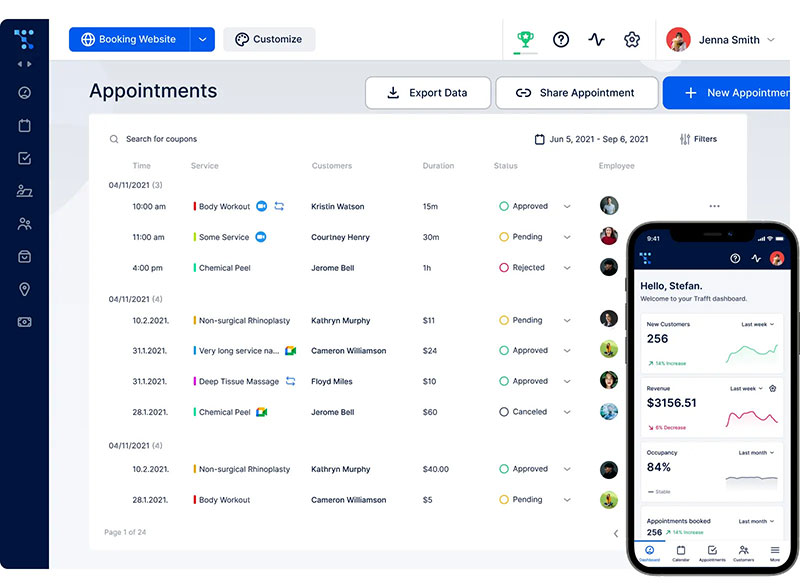
Trafft is the one all-in-one platform on this list whose free plan reads like an actual product instead of a trial you're meant to outgrow. Five staff calendars, unlimited services, unlimited bookings, none of it locked. For a salon, a barber shop, or a small clinic, that's the difference between running your whole schedule at no cost and hitting a paywall the moment a second person needs a calendar.
The free ceiling is really the whole pitch. Where most rivals give you a single calendar and stop there, Trafft gives you room for a team.
What you get on the free plan
- Two-way calendar sync with Google Calendar and Outlook
- Automated email reminders and a customizable booking page
- Staff and resource scheduling across locations
- Embeddable booking widget for any website
- Payment collection through Stripe and PayPal
Pricing stays simple. Free forever for 1 employee. Starter is around $13.30/mo billed annually for 10 users, and Scaling sits around $24.50/mo (verified mid-2026).
The booking page is clean and no-code, and it plays nicely with Zoom, Zapier, Mailchimp, and WordPress. It scales into WhatsApp and SMS reminders and deposit payments as you move up the feature tiers. A couple of things to know upfront: native CRM and accounting hooks are light, and SMS credits run tighter on the lower plans, so heavy texters will want to budget for that.
What we found testing it (July 2026): We set up a fresh free account with two staff calendars, connected a Google Calendar and an Outlook calendar, and pushed a test booking through the widget. Setup took under ten minutes, the two-way sync blocked the slot on both calendars instantly, and the confirmation and reminder emails landed exactly when scheduled. Trafft reports 30,000+ businesses and 5M+ appointments processed, which lines up with how stable the whole flow felt.
Here's the thing most "free" schedulers do: they wall off multi-staff on day one. Trafft just hands you five calendars, and that quietly turns it into something a small team can run on rather than a solo test drive. It sits comfortably next to other solid no-cost booking platforms worth trying.
WPAmelia - Best for solo operators on WordPress
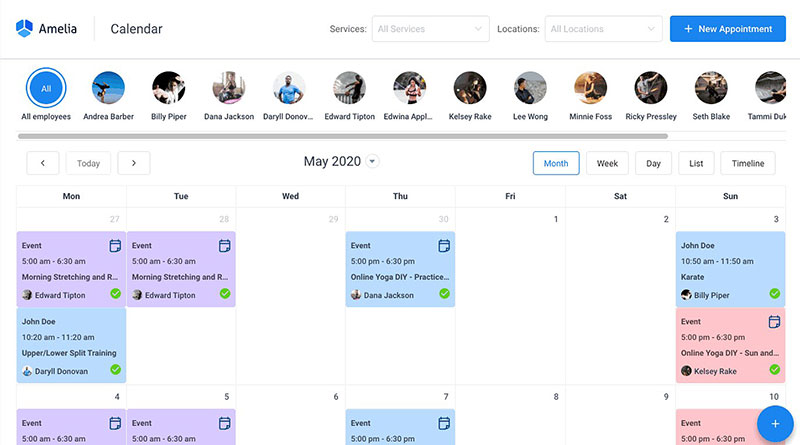
If your booking lives on your own WordPress site, Amelia Lite is the free plugin that lets a one-person business actually take money at booking. Free Square card payments, right out of the box, plus unlimited appointment types on the free tier. That combination is genuinely uncommon among free plugins.
What you get on the free plan
- One employee calendar with unlimited appointment types
- Square payment gateway included free
- Email notifications and a polished booking widget
- Events module with QR-coded tickets on paid tiers
Lite costs $0 on WordPress.org, where it's pulled 90,000+ installs and a 4.6/5 rating. Paid Starter kicks in from about $49/yr, with annual or lifetime billing on most tiers.
The admin polish is real, the release cadence is active, and the documentation goes deep. As you grow, the paid tiers open up a second staff member, extra payment gateways, calendar sync, and repeat-visit scheduling for regulars, so the free plan works as a genuine starting point rather than a locked demo.
What we found testing it (July 2026): We installed Amelia Lite on a clean WordPress 6.9 site and walked the full Date and Time to Payments flow as a customer would. The booking widget was one of the most refined WordPress admin interfaces we tried, and the free Square gateway accepted a live test payment without any paid upgrade prompt. The single-employee cap on the free tier is the wall you hit first, exactly as advertised. The 4.6/5 across 761 WordPress.org reviews tracks with the polish we saw.
Everyone praises Amelia's interface, and fair enough. The part that gets skipped is the actual reason a solo operator picks it over something like Bookly Free: the payment support on the free tier. Bookly strips payments out entirely. Amelia doesn't.
Calendly - Best for a simple one-on-one booking link
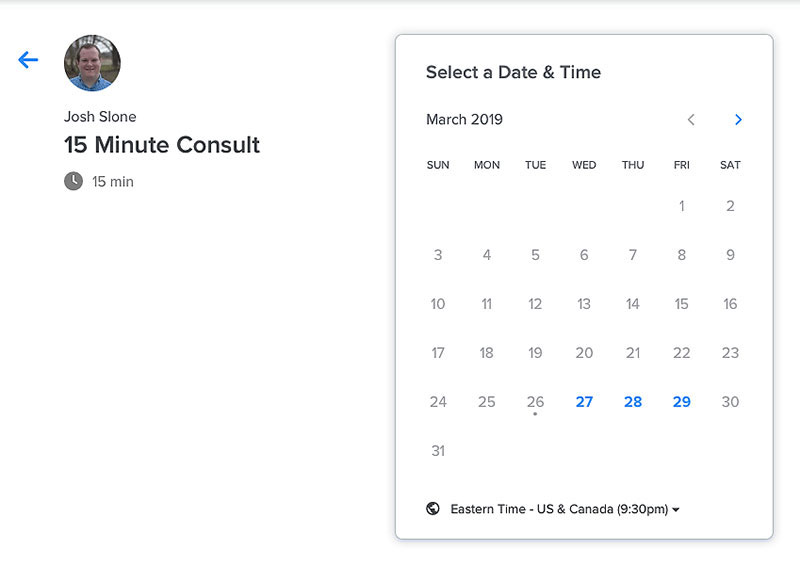
Calendly is the name people already know, and for a freelancer who books one kind of call, that recognition counts for something. The free plan gives you a single event type, one calendar connection, and unlimited meetings. It's the safe default.
What makes it stick is the ecosystem. A big native integration library, plus time zone auto-detection that genuinely just works.
What you get on the free plan
- Shareable booking link with conflict checking
- Zoom and Google Meet link generation
- Time zone auto-detection and buffer time settings
- Confirmation emails on the free tier
The free plan is capped at one active event type. Standard runs $10/seat/mo billed annually, or $12 month to month (verified May 2026).
The invitee experience is polished and it holds up across time zones. Two limits bite, though. No automated SMS reminders and no payment collection on free. And Calendly stopped accepting new iCloud and Apple Calendar connections back in August 2024, so if you're on a Mac and setting up fresh, you can't sync a personal iCloud calendar at all.
What we found testing it (July 2026): We set up a free account, created our one allowed event type, and booked across three time zones from different devices. The auto-detection got every conversion right, and the invitee page felt as clean as its reputation suggests. Then we tried to add a second event type (a 15-minute intro alongside a 60-minute session) and hit the upgrade wall within minutes, which is the exact ceiling most people run into. We also confirmed the single-calendar limit: a busy slot sitting on our second, unconnected calendar was invisible to Calendly, so it happily offered that time.
That single-event cap sneaks up on you, but the conflict-checking gap is the sneakier problem. Free Calendly reads one calendar, so a booking on your other calendar is completely invisible to it. That, not the event-type limit everyone complains about, is where the double-bookings actually come from.
Cal.com - Best for teams wanting a generous free tier
Cal.com is the most feature-rich free plan here, full stop. Unlimited event types, unlimited calendar connections, and free Stripe and PayPal payments on the free tier. If you want depth without paying, this is where you look. The trade is that setup leans a bit more technical than the plug-and-play crowd.
What you get on the free plan
- Unlimited event types and calendar connections
- Built-in video and Stripe/PayPal payment collection
- Routing forms that capture lead data automatically
- Workflow automation included on the free tier
Free forever for one user, with limits that stay generous. Teams start at $12/user/mo billed annually (verified 2026), which is roughly the same per-seat entry as Calendly Standard, except Cal.com throws in routing that Calendly makes you pay more for.
The polish trails Calendly in a few spots, and it's more developer-oriented overall. There's a bigger caveat worth reading twice, though. Cal.com moved its main product to closed source in April 2026. The previously self-hostable open-source codebase now survives only as a separate, community-maintained edition called Cal.diy (MIT-licensed, and described by Cal.com itself as recommended for personal, non-production use). So if self-hosting or full data ownership is the whole reason you're eyeing it, confirm Cal.diy actually covers what you need before you commit, because Teams, Organizations, SSO, and a handful of other features simply aren't in it.
What we found testing it (July 2026): We created a free single-user account, set up three event types with different durations, and connected Stripe. Payments worked end to end with no paywall in the way, and the routing form captured lead answers on the free tier as promised. Setup did take longer than the plug-and-play tools; a couple of the calendar and workflow settings assumed more comfort with configuration than a total beginner would have. No booking cap ever appeared during testing, which matches its reputation as one of the most generous free plans going.
The free feature depth really is unmatched among hosted schedulers. Just walk in knowing that its old "open-source, self-host anything" identity changed in 2026. The hosted product is closed now.
Google Calendar - Best for people already living in Google Workspace
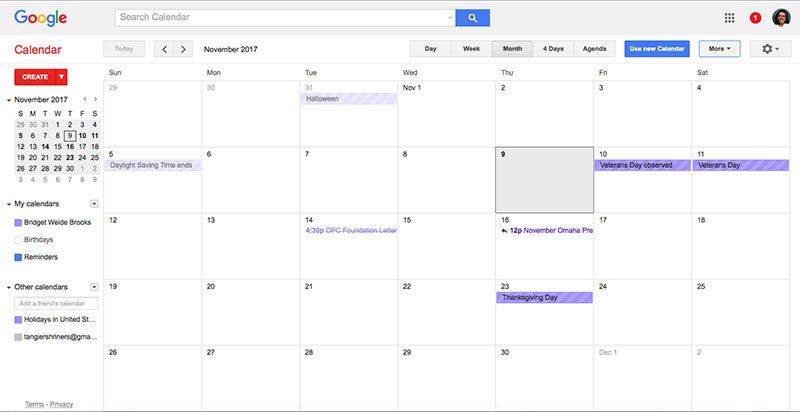
Already running your whole day out of Gmail and Google Calendar? Then the appointment scheduling built right into the calendar is the zero-friction option, because there's nothing new to learn and nothing to sync. Appointment schedules and Find a Time live where your schedule already sits.
What you get on the free plan
- Appointment schedule booking pages
- Shared calendars for team availability
- Find a Time to line up group meetings
- Auto-created events from Gmail
Appointment schedules are free with a personal Google account and also come with Workspace. (Some of the fancier appointment-schedule features have historically been tied to paid Workspace tiers, so double-check what your specific plan actually includes.)
Zero setup, familiar interface, syncing that holds across devices. The booking pages are bare-bones, though. No payment collection, no SMS reminders, and branding is minimal at best.
What we found testing it (July 2026): We created an appointment schedule from a personal Google account and shared the link. The slot picker worked instantly with nothing to configure, and pairing it with a Google Meet link for each booking covered a casual call with zero friction. The moment we wanted an intake question or a deposit, though, there was simply nowhere to add one; the booking page has no field for either.
The trade-off that never gets said out loud: you save yourself a tool, but you lose every single no-show feature along with it. Great for internal meetings. Weak for paid client work.
HubSpot Meetings - Best for CRM-driven sales teams
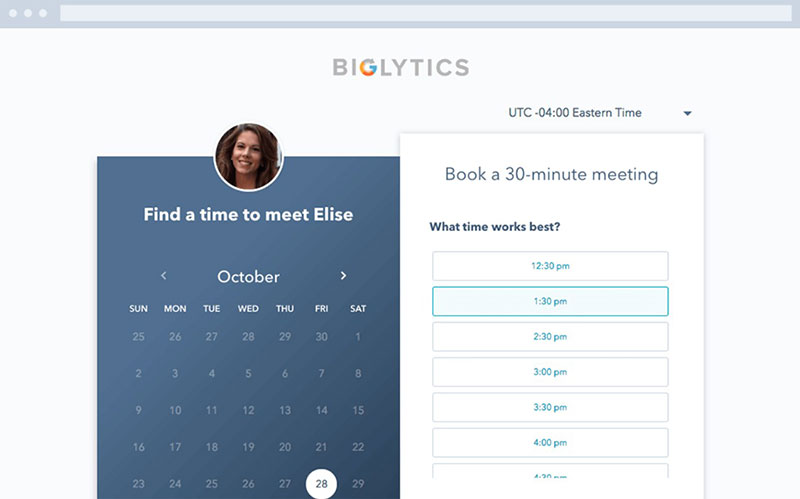
HubSpot's meeting scheduler is baked straight into its free CRM, and that's the entire appeal. Every meeting someone books auto-creates or updates a contact record, so teams tracking a lead from first touch to booked call never have to stitch anything together by hand.
What you get on the free plan
- Automatic contact creation from every booking
- Calendar sync with Google and Office 365
- Customizable booking link and pages
- Full interaction timeline per prospect
It's free with HubSpot's free CRM. Payment collection and custom branding, however, need paid Sales Hub tiers.
The upside is a total lack of gap between booking and CRM, which makes it strong for lead capture and attribution. The catch is just as blunt: the value falls off a cliff the moment you're not using HubSpot, and the good stuff nudges you toward paid Sales Hub.
What we found testing it (July 2026): We spun up a free HubSpot CRM, generated a meeting link, and booked ourselves in as a test prospect. A contact record was created automatically the instant the booking confirmed, with the meeting logged on that contact's timeline, no manual entry and no Zapier bridge needed. When we went looking for a way to collect a deposit at booking, it wasn't there on the free tier; that lives behind Sales Hub.
It only matters if you already run HubSpot CRM, and that's rather the point. This is the one entry here that's a CRM feature first and a booking tool second.
Doodle - Best for group scheduling by poll
Doodle handles the messy problem of getting several people to agree on a time. Instead of a booking page, you propose slots, everyone votes, and the winner books itself. When the hard part is coordination rather than availability, nothing else here comes close.
What you get on the free plan
- Group meeting polls on the free plan
- Calendar sync with Google, Outlook, and Apple
- One-click finalize with auto calendar invites
Free with ads. Pro starts around $6.95/mo billed annually (about $14.95 if you go month to month), and Team from around $8.95/user/mo (2026).
The group-poll flow is the best in the business and it flat-out kills the email back-and-forth. Over 30M monthly users are on it. But the free version carries ads, and the free tier has been trimmed down over the years. Creating a poll now requires an account, and things like reminders and deadlines have quietly moved behind Pro. There's no payment collection and automation is limited.
What we found testing it (July 2026): We built a poll with five proposed slots and sent it to a handful of people to settle a recurring group meeting. It landed on a time in a single round where an email thread would have dragged on for days, and the one-click finalize dropped the invite straight onto everyone's calendar. Two friction points showed up: creating the poll forced an account signup, and the free version served ads on the voting page our invitees saw.
Honestly, Doodle works better as a supplement than a main tool. It's doing a different job entirely. Every other entry answers "book time with me." Doodle answers "when can all of us meet," and that's why it earns a spot rather than competing head-to-head with the booking-page tools.
Zoho Bookings - Best inside the Zoho ecosystem
Running your business on Zoho already? Then Zoho Bookings slots in without any bolt-ons, feeding the same database as your CRM, mail, and everything else. The personalized booking URL just becomes another piece of a suite you already trust.
What you get on the free plan
- Personalized booking URL
- Calendar sync and Zoom integration
- Staff scheduling and reminders
- Office 365 and Google connections
There's a forever-free plan for 1 staff member, plus a 15-day trial of the paid features. Basic starts at $6/user/mo billed annually ($8 monthly), and Premium is $9/user/mo annually (2026).
Setup is clean, the Zoho tie-in runs deep, and the paid entry price is fair. On the downside, a few users have reported the occasional missing meeting link, there's no meeting-approval step, and the iOS app is limited.
What we found testing it (July 2026): We set up the free single-staff plan, claimed a personalized booking URL, and connected a Google Calendar plus Zoom. The CRM sync and URL both worked cleanly, and a Zoom link generated on the booking as expected. The mobile side was the weak spot: the iOS app felt stripped down next to the web dashboard, missing controls we'd just used on desktop.
It's easy to overlook if you live outside the Zoho crowd, and its appeal really does drop for everyone else. For a Zoho shop, though, it wipes out a whole category of integration headaches.
TidyCal - Best budget pick for solopreneurs

TidyCal is the answer to monthly scheduling fees. No-frills, built around a one-time lifetime price, and the free tier already handles booking with Stripe and PayPal payments. Pay $29 once and the recurring cost just disappears.
What you get on the free plan
- Booking pages with calendar connections
- Payment processing via Stripe
- Custom booking pages
- Zoom, Google Meet, and Microsoft Teams integrations
There's a free plan. Individual Lifetime is $29 one-time (via AppSumo), while a recurring Pro subscription runs $12/mo or $99/yr direct from TidyCal (2026).
The cheapest long-term cost on the list, free payment processing on the free tier, and it's dead simple to run. The catch is that the free plan is limited enough that most real users jump to the $29 deal pretty quickly. There's no built-in video, so you're leaning on Zoom or Google Meet links for every call. Both Stripe and PayPal are supported, and you can pick which one runs each booking type.
What we found testing it (July 2026): We created a free account, connected a calendar, and set up a booking type with Stripe attached. Taking a test payment worked on the free tier, which is rare at this price point, and PayPal was available as an alternative processor on the same plan. The limits showed up fast, though: the free plan caps how many calendar connections you get (just one), and there was no native video option, so every meeting leaned on an external Zoom or Meet link. It's clear within a session why most people upgrade to the $29 lifetime deal quickly.
People frame TidyCal as "the cheap one." The honest read is a bit more specific. The free tier is a trial for the lifetime deal, not a standalone free scheduler. But the lifetime deal itself is the best value here.
SavvyCal - Best for overlap-based booking
SavvyCal flips the usual model. Instead of showing invitees a wall of your open slots, it lets them lay their own calendar over your availability, so they pick a time while looking at their own schedule. For anyone booking with equally slammed professionals, that alone cuts a surprising amount of friction.
What you get on the free plan
- Calendar overlay for the person booking
- Single scheduling link and one calendar on free
- Meeting polls without ads
- Clustered meetings to protect focus time
Free access is limited, with a trial layered on top. Paid runs from $10 to $12/user/mo (2026).
The booking experience is probably the most-loved of any tool here, the polls run ad-free, and the focus-time clustering is a nice touch. The free tier, though, sits closer to a trial than a real free plan, and there's no video, CRM, or payments at booking on the lower tiers.
What we found testing it (July 2026): We sent a scheduling link to a few busy people and watched the overlay in action. Invitees could see their own calendar layered over our availability without flipping tabs, and the feedback was consistently positive, it's the smoothest booking experience in this group. The catch was the free tier itself: one link, one calendar, and the more useful pieces sat behind the trial or a paid seat, which makes "free" feel more like a preview here than on the top picks.
That overlay is the one feature nobody else here copies well. SavvyCal earns its spot on the strength of the experience, not the generosity of the free plan, which is genuinely thin.
How to pick the right free scheduler
Match the tool to the job, not the brand name on the box. The free plans mostly split along staff count, whether you can take payment, and how much booking volume they'll tolerate.
| If You Need... | Pick | Why |
|---|---|---|
| Multiple staff, free | Trafft | 1 calendar at no cost |
| Payments on WordPress | WPAmelia | Free Square gateway |
| Unlimited event types | Cal.com | No caps on the free tier |
| Group agreement | Doodle | Poll-based voting |
Solo and simple? Calendly, or a plain Google Calendar link.
Charging at booking? Cal.com, WPAmelia, or TidyCal, since all three fold in free payment processing.
Running a small team? Trafft is the odd one out that treats a free plan like a real product, which is why it fits growing appointment tools built for small operations better than the solo-first names do. Fair warning, since we make Trafft: that's our own call, and the table above lays out exactly why we landed on it, so you can weigh it against the alternatives yourself.
One rule holds no matter which you land on. Test your actual booking volume before you commit, because the free-plan wall is almost never sitting where the marketing page implies it is.
What a free meeting scheduler is and how it works
Strip away the marketing and a free meeting scheduler is just software that lets people self-book a time slot with you at no cost, with zero back-and-forth email.
The loop looks the same across every tool. You connect a calendar, set your availability, share a link or embed a booking page, and the invitee picks whatever slot is open.
Both calendars update the moment it's confirmed, and automatic time zone detection quietly saves you from the classic screwup of booking a 9 a.m. call in the wrong hemisphere. That's the feature you appreciate most when you're setting up a call across different time zones.
SchedulingKit reports 82% of consumers prefer booking online over calling, which is a big part of why self-service booking quietly became the default instead of a nice extra.
There are really two structural flavors, and which one fits decides your tool:
| Type | How It Lives | Examples |
|---|---|---|
| Standalone link | Hosted booking page or link | Calendly·Cal.com·Doodle |
| Site or CRM plugin | Runs inside your stack | WPAmelia·HubSpot Meetings·Zoho Bookings |
And "free" itself means a few different things depending on the tool. You've got free-forever plans like Trafft, free plugin versions like WPAmelia Lite, and free hosted tiers on the likes of Cal.com and Zoho Bookings.
Heallist reports online booking systems save businesses over 8 hours a week that would otherwise vanish into phone tag and manual calendar entry.
What free plans include and where the paywall starts
Just about every free tier covers the same baseline: unlimited bookings, one booking page, calendar sync, confirmation emails. The pressure to upgrade tends to come from three specific limits rather than the basics.
Signpost data suggests businesses see an average revenue bump of around 27% after moving to online booking, so the free plan often pays for itself long before you'd even think about a paid tier.
Free features you can rely on
Calendar sync comes standard. Most free plans give you one-way or two-way syncing with Google Calendar and Outlook.
Self-service booking is the whole point, so you'll get a shareable page where clients pick a slot without ever messaging you.
And email confirmations go out automatically on the free tier, even in cases where SMS is locked behind a paid plan.
Heallist reports businesses offering 24/7 booking see a 37% increase in bookings, and that always-on availability is completely free on tools like Trafft and Cal.com.
Limits that push you to a paid plan
SchedulingKit found 40% of bookings happen after hours, so a free plan that quietly caps your volume ends up costing you the exact slots you couldn't have staffed by phone anyway.
The usual paywall triggers:
- Staff or seat count (Trafft's free tier stops at 1 employee)
- Active event types (Calendly's free plan allows only one)
- Booking volume caps (some free tiers limit monthly bookings)
- SMS reminders, round-robin assignment, and multi-calendar conflict checking
Worth repeating because it burns people: Calendly's free plan reads a single calendar, so a booking on your other calendar stays invisible and creates the exact double-booking the tool was supposed to stop.
Calendar, video, and payment integrations
Zippia data shows automated reminders cut no-shows by 29%, and those reminders only fire reliably when the scheduler connects cleanly to the rest of your stack.
The integrations that end up deciding fit break down like this.
Calendar sync is the big one. Google Calendar and Outlook two-way sync are baseline at this point, while Apple and iCloud support is the recurring gap (Calendly, again, no longer takes new iCloud connections).
Video conferencing means automatic Zoom, Google Meet, and Microsoft Teams links generated at the moment of booking.
Automation covers Zapier bridges plus the native CRM links inside HubSpot Meetings and Zoho Bookings.
Payment collection is where free tiers split hardest. A dependable automated reminder setup pairs with card capture to protect your revenue, but not every free plan actually ships the gateway.
| Free Payments? | Tool | Gateway |
|---|---|---|
| Included free | Cal.com | Stripe - PayPal |
| Included free | WPAmelia Lite | Square |
| Included free | TidyCal | Stripe |
| Paid only | Calendly - SavvyCal | Locked to upgrade |
If you'd rather run bookings from your own domain, most of these tools ship an embeddable widget for building the booking page into your own site.
Data ownership, privacy, and self-hosting options
Where your booking data actually lives is a real differentiator, not a footnote you skim past.
StationX reports 82% of consumers are highly concerned about how their data is collected and used, and a booking page collects names, emails, and custom intake answers on every single submission.
The real split here is control versus convenience. On the control side, Cal.com used to be the obvious open-source, self-hosted pick, but as of April 2026 its main product is closed source. The self-hostable open-source path now runs through the separate, community-maintained Cal.diy edition, which is positioned for personal, non-production use. If self-hosting is a hard requirement for you, weigh that carefully or look at other open-source options before you settle.
On the convenience side, hosted SaaS is faster to launch, but your invitee data ends up sitting on the vendor's infrastructure, under their terms rather than yours.
JumpCloud found 48% of consumers have stopped buying from a company over privacy concerns, which raises the stakes on where those booking records land.
- EU server hosting and GDPR handling matter for European clients
- Ads and forced branding show up on free tiers like Doodle's
- Clean export prevents lock-in when you eventually outgrow a tool
Doodle runs ads on its free version, which is a decent reminder that "free" sometimes just means your booking page is the product.
Frequently Asked Questions About Free Meeting Schedulers
Is Trafft actually free?
Yes. Trafft runs a free-forever plan covering up 1 employee, unlimited services, unlimited bookings, and email notifications. Paid tiers add SMS credits, custom domains, and Zapier, but a small service team can operate entirely on the free plan.
Is WPAmelia free on WordPress?
Amelia Lite is free on WordPress.org. The free tier includes one employee calendar, unlimited appointment types, email notifications, and free Square card payments. A second staff member, calendar sync, or recurring appointments requires a paid license from about $49/yr.
What is a free meeting scheduler?
Put simply, it's software that lets clients self-book a time slot at no cost. You connect a calendar, set availability, share a booking page, and both calendars update automatically when someone picks a slot.
Is Calendly free?
Calendly has a permanent free plan. You get one active event type, one calendar connection, unlimited meetings, and basic Zoom and Google Meet links. Multiple event types, reminders, and payment collection all require the Standard plan at $10/seat monthly (billed annually).
Which free scheduler is best for a small team?
Trafft wins here. Its free plan hands you 1 staff calendar, where Calendly, WPAmelia Lite, and SavvyCal all cap the free tier at a single user. That makes Trafft the rare free pick built for a real team.
Can free meeting schedulers collect payments?
Some do. Cal.com, WPAmelia Lite, and TidyCal include payment collection through Stripe, PayPal, or Square on their free tiers. Calendly and SavvyCal lock card capture behind paid plans, so check before you rely on charging at booking.
Do free schedulers sync with Google Calendar and Outlook?
Yes. Two-way calendar sync with Google Calendar and Outlook is standard on nearly every free tier. Apple and iCloud support is the common gap (Calendly, for one, no longer accepts new iCloud connections), so iOS-heavy users should confirm that specific connection first.
Which free tool is best for group meetings?
Doodle is built for it. Instead of a booking page, you create a poll, participants vote on times, and the winning slot books itself. The free plan allows group polls, though it shows ads.
Do free meeting schedulers reduce no-shows?
They help. Automated reminders cut no-shows by roughly 29%, according to Zippia. Most free tiers include email reminders and confirmations, but SMS reminders are usually a paid feature across Calendly, Trafft, and similar tools.
Where do free plans usually stop?
The paywall hits three limits: staff count, active event types, and booking volume. Calendly caps one event type, and Trafft caps 1 employee. Advanced automation and round-robin assignment are almost always paid.
Conclusion
The best free meeting schedulers aren't the ones with the longest feature list. They're the ones whose free tier stops in the right place for your work.
Trafft leads for small teams that need five staff calendars free. WPAmelia fits solo operators taking Square payments straight from their WordPress site.
Need unlimited event types and open-source control? Cal.com. Coordinating a group? Doodle's poll model settles it in one round.
Watch the three things that decide the paywall: staff count, booking volume, and whether payment collection comes free.
Confirm the calendar sync, video links, and round-robin assignment you actually use before you commit.
Match the tool to your workflow, run a few test bookings, and let the self-service booking page do the rest.