




Most cleaning companies don't have a marketing problem. They have an ad problem.
Knowing how to create a cleaning service advertisement that actually books jobs is different from just "running ads." The wrong setup wastes budget fast, regardless of how good your service is.
This guide covers everything from ad types and copy to targeting, landing pages, and tracking. By the end, you'll know exactly what goes into a cleaning business ad campaign that converts clicks into recurring clients.
What Is a Cleaning Service Advertisement
A cleaning service advertisement is a paid or organic message built to move a specific person from "I need cleaning help" to "I'm booking this company." That's the whole job.
Most cleaning ads fail before they even get read. They're too vague, they lead to the wrong page, or they target the wrong audience entirely. A good cleaning business ad solves all three problems at once.
What it is not: A cleaning ad is not the same as a brand awareness post. Brand awareness tells people you exist. A direct-response cleaning service ad makes them act right now. These are different goals and they need different setups.
The global cleaning services market hit $415.93 billion in 2024 and is projected to reach $616.98 billion by 2030 (Fortune Business Insights). That growth means more competition, not less, which makes your cleaning company ad campaign matter more than ever.
The U.S. contract cleaning market alone was estimated at $95.66 billion in 2023, growing at a 4.8% CAGR through 2030 (Grand View Research). There were also over 55,000 new janitorial companies (including residential cleaners) added in the U.S. between 2023 and 2024 (LocaliQ). You're not advertising in an empty market.
The core job of any cleaning service ad: reduce the gap between "I'm searching" and "I'm booking." Every element, the offer, the photo, the headline, the call to action, exists to close that gap faster.
Types of Cleaning Service Ads
Not every ad type works the same way. Some capture people already searching. Others reach people who haven't thought about booking yet. Knowing the difference changes how you spend.
| Ad type | Intent level | Best for | Cost model |
|---|---|---|---|
| Google Local Services Ads | Very high | Immediate bookings Trust-first |
Pay per lead |
| Google Search Ads | High | Active searchers Any budget |
Pay per click |
| Facebook / Instagram Ads | Medium | Visual proof Local awareness |
Pay per click Per lead |
| Nextdoor Ads | Medium | Hyper-local Neighbor trust |
Pay per impression |
| Direct mail / door hangers | Low–medium | Residential neighborhoods Move-ins |
Fixed print cost |
Google Local Services Ads
These sit above everything else on Google, including regular paid ads. The Google Guaranteed badge is attached to every listing, and you only pay when someone contacts you, not when they click.
For house cleaning services, Google LSA cost per lead averages $15-$45, with a national average around $28 (Buzzz). That's low compared to most paid channels, and 30-40% of first-clean leads convert to recurring service (Blue Grid Media). A $25 lead that turns into a $250/month recurring client generates $3,000/year.
One thing to know: five reviews seems to be the tipping point where steady lead flow kicks in (ZenMaid). Under that, Google still shows your ad, just less often.
Google Search Ads
Search ads give you something LSAs don't: control over messaging, headlines, and landing pages. That flexibility matters when you're running a specific offer like a deep cleaning special or a move-in cleaning deal.
LocaliQ data from 2024-2025 shows that Cleaning/Maid/Butler Services had a 17.65% conversion rate for search ads, the highest in all of home services. The click-through rate for the same category hit 9.01%, also among the top performers in the segment.
- Use exact and phrase match keywords only
- Build a negative keyword list from day one (DIY, "how to clean," "free")
- Enable call extensions so people can dial directly from the ad
Facebook and Instagram Ads
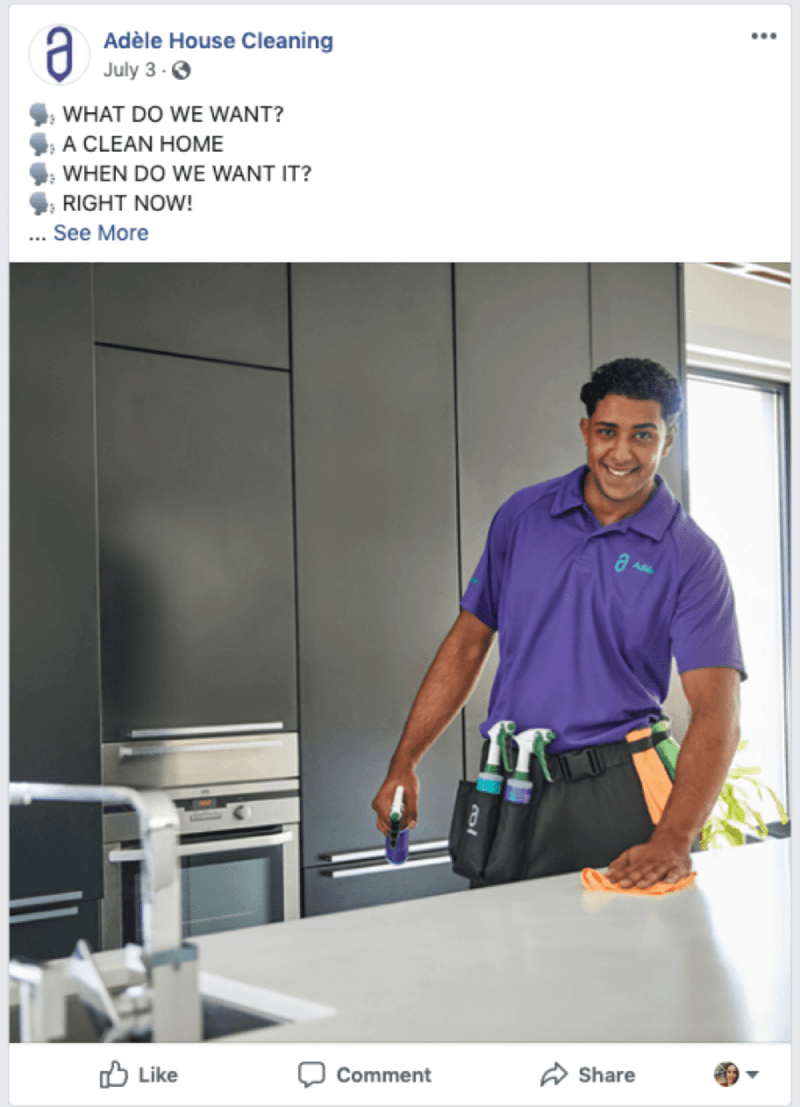
Best use case: before-and-after photos, recurring client promotions, retargeting people who visited your site but didn't book.
Facebook ads cost significantly less per click than Google Search, making them a solid complement to your search strategy (WordStream, 2025). The average cost per click on Facebook across all industries is $0.70 for traffic campaigns.
These ads work best for cleaning businesses when the creative does the talking. A real photo of a sparkling kitchen beats a stock image every time. Homeowners who recently moved are a particularly strong audience to target through Meta's behavioral filters.
Which Ad Type Fits Your Budget
Budget determines where to start, not where to stop.
Under $300/month: Google LSAs or Nextdoor. Both are low-cost entry points with high local relevance.
$300-$1,000/month: Add Google Search ads with a tight geographic radius and a focused keyword list. Keep your service area small.
$1,000+/month: Layer in Facebook retargeting, direct mail to specific zip codes, and start testing landing page variations to improve your cleaning ad conversion rate.
Get more bookings with the right tool for the job
Staying organized has never been easier.
You can now manage your business and grow your brand with a single, powerful software that keeps all of your appointments in line, your clients organized and your business booming.
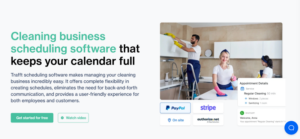
Trafft is the perfect cleaning business software for business owners who need to streamline their booking experience both for their staff and their clients.
Here's how Trafft enhances your operations:
- Centralized appointments: Keeps all your appointments organized, ensuring smooth operations.
- Client management: Organizes client details to improve service delivery and customer satisfaction.
- Automated reminders: Sends automated email or SMS reminders to reduce no-shows significantly.
- Industry adaptability: Tailors the booking experience to suit various industry needs, enhancing both client and employee interactions.
- Comprehensive features: Offers a range of features designed to optimize booking, management, and marketing processes.
Want to know more? Check out Trafft’s awesome features to see what you are missing.
Trafft is FREE for up to 5 users!
Key Elements Every Cleaning Ad Needs
Strip a cleaning service ad down to its basics and you get five things. Every one of them needs to be right. Missing even one cuts your conversion rate.
LocaliQ data shows cost per lead increased by 10.51% year-over-year for home services businesses in 2024-2025. With leads getting more expensive, what's in the ad matters more than it used to.
The Offer
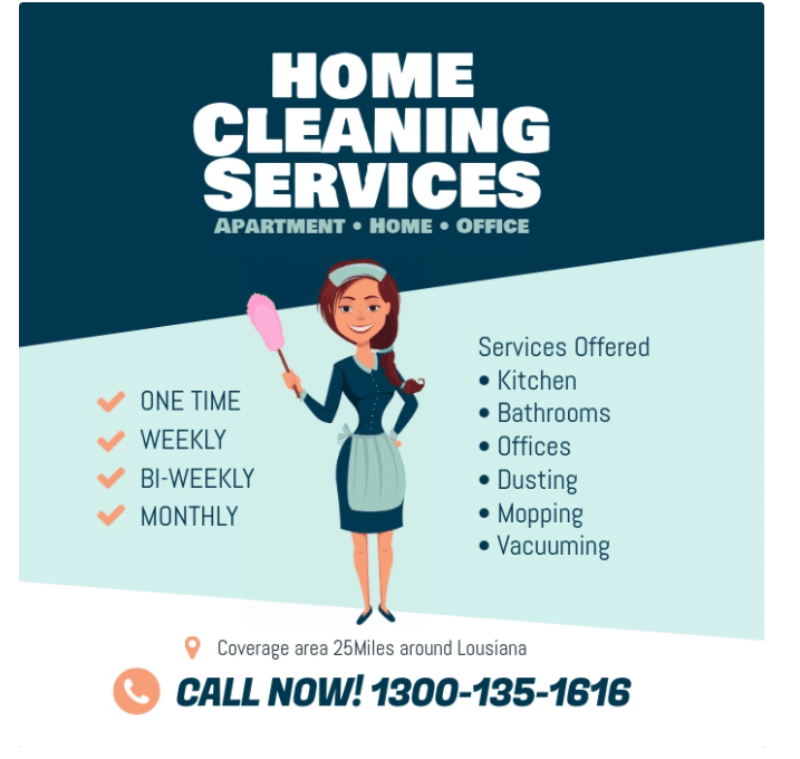
Generic offer: "Professional cleaning services. Call us today."
Specific offer: "$99 deep clean for 2-bedroom homes. Book by Friday."
The second one tells someone exactly what they're getting, what it costs, and when to act. Vague ads make people click away. Specific offers make people book.
Trust Signals
9 out of 10 consumers say unclean public spaces give them a negative impression of a business (Cleango data). The reverse is also true: visible proof that you're legitimate flips that reaction in your favor.
- Star ratings and review count (Google, Yelp)
- Bonded and insured badge
- Years in business
- Number of homes or offices cleaned
Landing pages with social proof convert 34% better than those without (Invesp, 2024). Put your trust signals where people actually see them: near the booking button, not buried at the bottom.
Visual Proof
Cleaning is a visual service. Before-and-after photos do more work than any headline.
Real photos of actual jobs, dirty grout becoming clean tile, a cluttered kitchen turning spotless, build credibility that stock photography never can. Uniformed staff in photos also adds professionalism without saying a word. Clients at Merry Maids and similar franchise operations consistently report that visual ad content outperforms text-only promotions in engagement and click-through.
The Call to Action
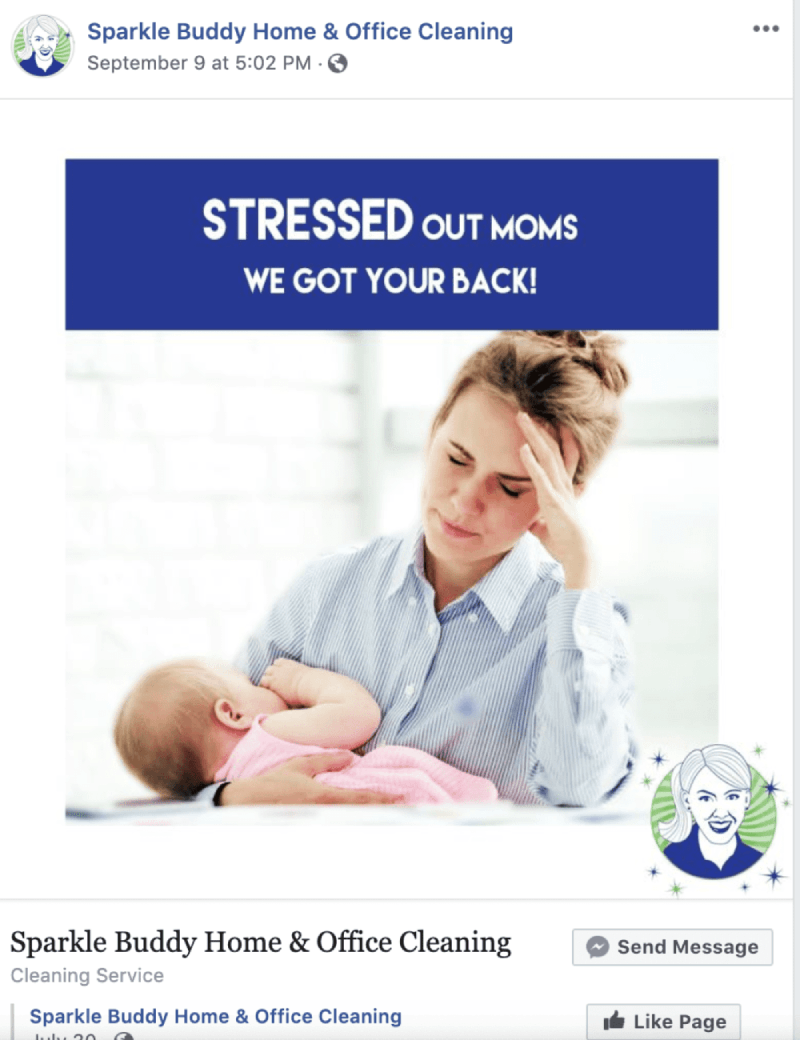
Every ad needs exactly one action for the reader to take. One, not three.
"Book online," "Call now," or "Get a free quote" all work. Pick one per ad, make it a button or a bolded phrase, and put it where the eye lands first. Personalized CTAs convert 202% better than generic versions (Firework, 2024).
How to Write the Ad Copy
Most cleaning ad copy makes the same mistake: it leads with the company name. Nobody searching "house cleaning near me" cares who you are yet. They care about what you solve.
Lead with the problem. "Hate scrubbing bathrooms? We handle it." works better than "XYZ Cleaning Co. is here to help!" Every time.
Headline Formulas That Work
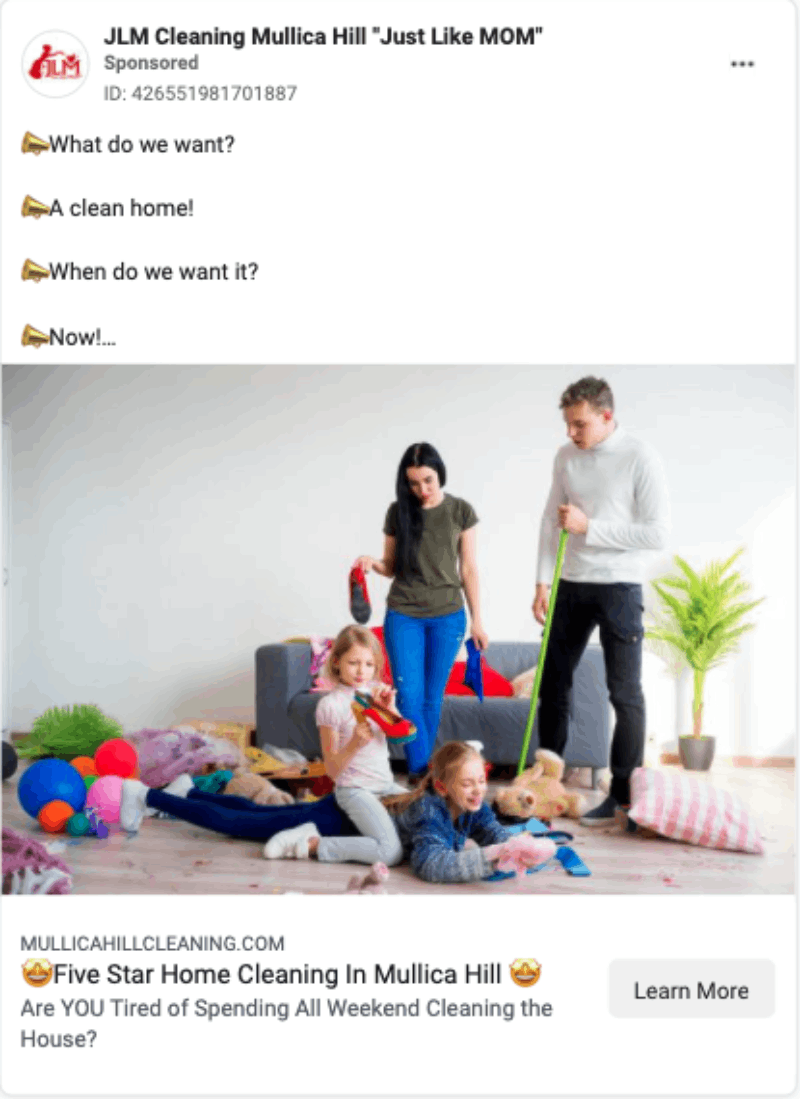
A headline has about two seconds to hold attention before someone scrolls. These structures work consistently for cleaning service ads:
- Offer + location: "$89 Deep Clean - [City Name] Homes"
- Problem + solution: "Move-Out Stress? We Handle the Full Clean"
- Social proof + offer: "500+ Happy Clients. Book Your First Clean Today"
- Urgency + specificity: "3 Openings Left This Week - Book Now"
Avoid headlines that sound like every other maid service ad: "Reliable. Affordable. Professional." That's what every competitor says. It means nothing to someone choosing between five results.
Body Copy by Platform
Google Search ads: You get 30 characters per headline and 90 characters per description. No room for filler. Every word earns its place.
Facebook and Instagram: You have more room, but shorter still wins. Under 150 characters in the primary text tends to outperform longer copy (Polymer). Use the extra space for a second trust signal or to reinforce your offer, not to repeat yourself.
Direct mail: This is where longer copy can work. People hold a postcard. Use that moment to address one objection, like "fully insured, background-checked staff," before listing your offer and phone number.
Headline Examples by Ad Type
Google Search headlines:
- "House Cleaning [City] - Book Online"
- "Deep Clean Special - $X for 2BR Homes"
- "Same-Day Cleaning Available - Call Now"
Facebook ad headlines:
- "Your Kitchen Could Look Like This"
- "We Cleaned 200 Homes in [City] This Month"
- "First-Time Client Deal - Book This Week"
Direct mail headlines:
- "New to [Neighborhood]? We'll Make It Feel Like Home"
- "Your Neighbors Use Us. Here's Why."
Targeting the Right Audience
Targeting too wide wastes budget. Targeting too narrow limits reach. Most cleaning business ad campaigns get this wrong in one direction or the other.
More than half of home service customers now search via mobile devices (Amra and Elma). That shapes where and how you target, not just who.
Demographic and Geographic Targeting
The highest-converting audiences for residential cleaning ads share a few traits consistently:
- Dual-income households (less time = more willingness to pay)
- Homeowners rather than renters
- Ages 30-55 in suburban zip codes
- People who recently moved (intent is highest in the first 30 days)
On Google, set your radius tight. A 10-15 mile radius around your base keeps travel time low and local relevance high. On Facebook, layer the geographic filter with the "recently moved" behavioral category. That combination targets people who actively need a cleaning service and haven't found one yet.
B2B vs. Residential: Different Audiences Entirely
Commercial cleaning client acquisition works differently from residential. The decision-maker is usually a facilities manager or office manager, not a homeowner scrolling Facebook at 9pm.
Residential: Facebook, Google LSAs, Nextdoor, direct mail. Emotional, visual creative. Respond to the inconvenience angle.
Commercial / janitorial: LinkedIn outreach, Google Search with commercial-specific keywords ("office cleaning service [city]"), email sequences to property managers. Lead with reliability, compliance, and bonded/insured status. The commercial segment accounts for over 80% of the global cleaning market revenue by some estimates (Fortune Business Insights, 2024).
How to Set Up a Google Ad for a Cleaning Service
There are two separate Google ad products that matter for cleaning businesses. They work differently, live in different dashboards, and suit different goals. Mixing them up is a common and expensive mistake.
Google Local Services Ads Setup
LSAs live at lsa.google.com, completely separate from the standard Google Ads platform. Setup requires a background check, license verification, and a verified Google Business Profile (required as of November 2024).
Businesses with the Google Guaranteed badge and response times under 5 minutes see 40% higher conversion rates while maintaining similar per-lead costs (Buzzz). Set up text notifications the moment a lead comes in. Every minute of delay costs you ranking and conversions.
Key setup steps:
- Verify your Google Business Profile first (matches must be exact)
- Select your service categories carefully: "house cleaning" and "deep cleaning" are different match types
- Set your service area by zip code, not by radius, for tighter control
- Start with a weekly budget of: target leads x average CPL ($28 for cleaning)
- Dispute invalid leads promptly; Google approves disputes automatically if your rate stays under 15%
Google Search Ads Setup
Search campaigns give you headline control, landing page selection, and keyword targeting that LSAs don't allow. Use them together when budget allows; run them standalone when you're starting out.
Campaign structure for a cleaning service:
- Campaign type: Search (not Performance Max, not Display)
- Match types: Phrase match and exact match only. Broad match burns budgets fast in this industry.
- Negative keywords to add immediately: "DIY," "how to," "free," "products," "supplies," "jobs," "hiring," "mop," "vacuum"
- Bid strategy: Maximize Conversions once you have 30+ conversions tracked; manual CPC before that
- Ad extensions: Call extension (with a trackable number), location extension, and sitelinks pointing to your booking page and pricing page
Conversion tracking is non-negotiable before spending a dollar. Without it, you're guessing. Set up Google Tag Manager to fire a conversion event on your booking confirmation page or on a tracked phone call over 60 seconds.
How to Set Up a Facebook or Instagram Ad for a Cleaning Service
Facebook and Instagram ads reach people before they search. Google catches active intent. Meta builds it. Both have a place in a cleaning business ad campaign, but they work differently and need different setups.
Start with a $10-$25 per day budget for at least 7-10 days before judging results. Meta's algorithm needs that window to exit learning mode (Cleaning Business Marketers, 2025). Pulling the plug on day three is the most common wasted-budget mistake on the platform.
Campaign Objective Selection
For cleaning companies, use the Leads objective. It collects phone numbers, emails, and quote requests directly from a Meta Instant Form without the person ever leaving the app.
The alternative is sending traffic to your landing page, which gives you more context on visitor behavior but adds friction. A lead form removes that friction entirely. Leads campaigns on Meta still cost significantly less per lead than comparable Google Search campaigns (WordStream, 2025).
- Leads objective: Best for quote requests, first-clean bookings, same-day cleaning inquiries
- Traffic objective: Use this for retargeting people who visited your booking page but didn't convert
- Awareness objective: Only useful when launching in a new neighborhood or after direct mail drops
Audience and Creative Setup
Target homeowners aged 30-65 within a 10-15 mile radius. Layer in the "recently moved" behavioral filter inside Meta Ads Manager. That combination is the closest thing to guaranteed high-intent in residential cleaning ads.
On creative: real photos beat stock every time. A before-and-after cleaning photo from an actual job in your city is worth more than any professionally shot image of someone else's kitchen. Video performs even better, but a single image ad with a strong offer still converts.
Keep primary text under 150 characters. The average cost per click on Facebook across all industries is $0.70 for traffic campaigns (WordStream, 2025). With the right visual, you're paying very little per qualified click in a low-competition local market.
Retargeting and Scaling
Once you have traffic, retargeting is where the real cleaning service lead generation gains are.
Retarget anyone who:
- Visited your booking page but didn't submit
- Watched 50%+ of a video ad
- Opened your Instant Form but didn't complete it
Retargeting ads that offer a limited-time discount (around 20% off) with a 3-5 day window consistently outperform cold audience ads (Polymer). Warm audiences need less convincing. They need a reason to act now.
Landing Page Requirements for Cleaning Ads
Sending ad traffic to your homepage is the single most expensive mistake in cleaning service advertising. A homepage is designed to introduce your business. A landing page is designed to convert one specific visitor into one specific action.
Unbounce data from Q4 2024 (analyzing 41,000 landing pages with 464 million visitors) shows the median landing page conversion rate across all industries is 6.6%. Well-optimized pages regularly hit 15-20%. That gap is almost entirely a page design and message match problem.
Must-Have Sections
Headline: Specific, benefit-first, location-included. "Affordable Deep Cleaning in Austin - Book in 60 Seconds" outperforms "Welcome to Our Cleaning Service" every time.
Offer block: State your price or offer above the fold. People leave when they can't find what something costs. If you don't publish pricing, at least anchor the value: "Most 2BR homes start at $X."
Trust signals: Star ratings, review count, bonded/insured badge, years in business. Place these near the booking button, not the footer.
Single CTA: One action. "Book Now," "Get a Free Quote," or "Call Us." Not all three.
Page Speed and Mobile
Pages that load in under 2 seconds see a 30% higher conversion rate than slower pages, and 53% of mobile users abandon a page that takes more than 3 seconds (Firework, 2024).
More than half of home service customers search via mobile (Amra and Elma). Your landing page must load fast, render cleanly on a phone screen, and have a phone number that's a tappable click-to-call link.
Tools that work for cleaning service landing pages without needing a developer:
- Unbounce (best conversion optimization features)
- Housecall Pro (built-in booking, no separate page needed)
- A dedicated page on your WordPress site built with Elementor
Message Match
The headline on your landing page must mirror the headline in your ad. Exactly.
If your Google Search ad says "Deep Clean Special - $99 for 2BR Homes," your landing page headline better say the same thing. Any disconnect between the ad and the page drops your Quality Score in Google, raises your cost per click, and kills conversions. Brandelite research confirms that mismatched ad-to-page messaging is one of the primary reasons cleaning ad campaigns fail to generate booked jobs despite decent click-through rates.
How to Measure If Your Cleaning Ad Is Working
CTR tells you if people clicked. Conversion rate tells you if people cared. Cost per booked job tells you if the ad is actually making money. Most cleaning businesses track the first two and ignore the third.
B2C cleaning leads average a $30 cost per lead across paid channels (WebFX, 2026). That number is useless without knowing what percentage of those leads convert to booked jobs and what each job is worth.
| Metric | What It Measures | Healthy Benchmark |
|---|---|---|
| CTR (Google Search) | Ad relevance and headline quality | 9%+ for cleaning/maid services |
| Conversion rate | Landing page and offer quality | 17%+ for cleaning category |
| Cost per lead | Efficiency of your ad spend | $15–$45 (LSA) $28 avg |
| Cost per booked job | True ROI of the campaign | Track monthly Set your own floor |
Call Tracking
Most cleaning business bookings start with a phone call, not a form submission. Without a separate trackable number for each ad source, you have no idea which channel is actually generating revenue.
CallRail is the most widely used tool for this at the small business level. It assigns unique numbers per campaign, records calls, and pushes data into Google Analytics and Google Ads automatically. Without call tracking, without that layer, you're flying blind on roughly 60-70% of your actual conversions.
When to Pause vs. Optimize
Optmyzr data shows exact match keywords consistently produce the highest ROAS and CTR of any keyword type. Start there before expanding.
Pause an ad when: it has received 100+ clicks with zero conversions and you've already ruled out landing page issues.
Optimize first when: CTR is low but cost per click is normal. That's a creative or headline problem, not a targeting problem. Swap the headline before cutting the campaign.
Common Mistakes in Cleaning Service Ads
Studies from multiple PPC research sources put wasted Google Ads spend between 40-76% for businesses that don't actively manage their campaigns. Cleaning service ads are not exempt from that pattern.
The mistakes below show up repeatedly across residential cleaning ad campaigns, regardless of market size or ad budget. Fix even two of these and your cost per booked job drops.
No Dedicated Landing Page
Running ads to a homepage is the fastest way to burn a cleaning business ad budget. Homepages have navigation menus, multiple CTAs, and no message match with the ad that sent someone there.
A dedicated cleaning service landing page removes distractions and aligns exactly with the ad's offer. Companies with 10-15 dedicated landing pages see 55% higher conversion rates than those with fewer than 10 (2024 research). For a cleaning company, that means one page per service type or promotion, not one page for everything.
Stock Photos and Generic Visuals
Every cleaning company uses the same stock photo of a smiling person in rubber gloves. It blends into the feed and signals nothing real about your business.
Real photos from actual jobs in your service area are what convert. A photo of a bathroom you cleaned in the same neighborhood where the ad is running builds immediate local trust. That's not a design preference. It's a conversion strategy.
Broad Match Keywords Without Negative Lists
Using broad match keywords in Google Ads without a negative keyword list is a budget leak. Your cleaning service ad will show for searches like "cleaning jobs near me," "how to clean grout," and "cleaning supply stores." None of those people are booking a service.
Negative keywords to add immediately:
- jobs, hiring, employment, career
- how to, DIY, tips, free
- supplies, products, mop, vacuum, sponge
- certification, training, course
Without this list in place from day one, 40-60% of ad budget can go to irrelevant clicks in a cleaning campaign (Mainline Lead Service).
Targeting Too Wide a Geographic Area
Bigger radius does not mean more bookings. It means longer drive times, higher fuel costs, and leads from neighborhoods where word-of-mouth has no effect. Google LSA research confirms that cleaning companies that tighten their radius to zip codes closest to their base consistently see better lead quality and faster close rates.
Start with a tight geographic radius. Expand only after you've saturated the core area and have enough reviews to compete in the new zones.
Ignoring Conversion Tracking
Without conversion tracking, you are guessing. There is no way around this.
Set up Google Tag Manager, fire a conversion event on your booking confirmation page, and track phone calls over 60 seconds as conversions in Google Ads. Do the same in Meta Ads Manager using the Meta Pixel. Before you spend a dollar on any cleaning service ad campaign, this infrastructure needs to be in place. Otherwise, your bidding strategy has no data to learn from and your performance reports are meaningless.
FAQ on How To Create A Cleaning Service Advertisement
What makes a cleaning service ad effective?
A specific offer, real photos, and a single clear call to action. Vague ads like "professional and reliable cleaning" convert poorly. Lead with the customer's problem, include a price anchor, and make booking impossible to miss.
Which platform is best for cleaning service ads?
Google Local Services Ads for immediate bookings. Facebook and Instagram for visual proof and local awareness. Start with Google LSAs if budget is tight. They show above all other results and charge per lead, not per click.
How much should a cleaning business spend on ads?
Start with $300-$500 per month. Google LSAs for house cleaning average $28 per lead. A $300 monthly budget generates roughly 10-12 leads. Scale once you know your cost per booked job and recurring client value.
Do I need a landing page for my cleaning ads?
Yes. Sending ad traffic to your homepage kills conversions. A dedicated landing page with one offer, trust signals, and a single booking CTA consistently outperforms a general website page by a significant margin.
What should my cleaning ad headline say?
Lead with a specific offer and location. "Deep Clean Special - $99 for 2BR Homes in Austin" outperforms "Professional Cleaning Services." Specific beats generic. Include a number, a location, or a deadline whenever possible.
How do I target the right audience for cleaning ads?
On Google, use tight geographic radius and high-intent keywords. On Facebook, target homeowners aged 30-65 within 10-15 miles, filtered by the "recently moved" behavioral category. Skip broad demographic targeting until you have conversion data.
What images work best in cleaning service ads?
Real before-and-after photos from actual jobs. Uniformed staff in client homes. Avoid stock photography. A genuine photo of a sparkling kitchen you cleaned last week builds more trust than any professionally staged image.
How do I measure if my cleaning ad is working?
Track cost per lead, conversion rate, and cost per booked job. Use call tracking with a unique number per ad source. CTR and clicks are secondary. Revenue per campaign is the only metric that actually matters.
What are the most common cleaning ad mistakes?
Running ads to a homepage, using stock photos, skipping negative keywords, and setting too wide a geographic radius. Also: launching without conversion tracking in place. Fix those five and most cleaning ad campaigns improve immediately.
Should I run Google Ads or Google Local Services Ads?
Both serve different purposes. Google LSAs are pay-per-lead and show above standard ads, ideal for trust and immediate bookings. Google Search Ads give you headline control and landing page flexibility. Run both when budget allows.
Conclusion
This conclusion is for an article presenting a full picture of cleaning service ad strategy, from Google LSAs and Facebook targeting to landing pages and call tracking.
A strong cleaning business ad campaign isn't built on one good headline. It's built on the right platform, a specific offer, real visual proof, and a booking page that removes every possible obstacle.
Track your cost per booked job. Dispute invalid leads. Tighten your service radius. Add negative keywords before you spend a dollar on broad match.
The residential cleaning market keeps growing. Competition is increasing just as fast.
The businesses that consistently win on paid search and Meta Ads are not the ones with the biggest budgets. They're the ones who get the fundamentals right and measure everything.