




Most owners land on a name they love in about ten minutes, then spend the next two weeks finding out someone else already has it.
That's normal now. Verisign reported 386.9 million domain registrations across all top-level domains at the end of Q4 2025, with .com and .net holding 173.5 million of them. Whatever short, punchy word just came to mind, somebody probably registered it years ago. So availability decides the shortlist, and the creative part happens inside whatever is left.
It usually happens at a bad moment too, somewhere between the lease paperwork and a sign quote you haven't approved yet. A class 44 trademark search is rarely on anyone's mind at that stage. It should be.
What Makes a Barbershop Name Cool Instead of Just Available
Mostly, people can repeat it. If a name can't be spelled after hearing it once, it stops with whoever heard it.
Before a name goes on the sign, I'd want it to pass these:
- You can say it in one breath without tripping on the second syllable
- A stranger types it into Maps correctly on the first try
- It fits on a storefront sign and in a booking app listing without getting cut off
- Nobody holds a live mark on it in the barbering and grooming class
- It still makes sense after you add beard trims or colour, or put in a second chair
The competition is dense. IBISWorld counted 154,925 barber shops operating in the US in 2025, up 2.2% on the previous year. Every good short name in the tool and trade category has been used somewhere.
Why easy names beat clever ones
There's actual research behind this. A Princeton study published in PNAS in 2006 found that fluently named stocks outperformed disfluently named ones in the short term, and ease of pronunciation was the whole mechanism. People trust names that are easy to process, and they trust them faster.
For a barbershop it's simpler than that. A guy standing outside with ten minutes to kill picks the shop whose name he can already picture telling his mate about.
Blind Barber built a national brand on two ordinary words. Anyone can repeat it, spell it and search it.
How a name moves by word of mouth versus on a map pin
Word of mouth rewards rhythm. A map pin rewards clarity.
Out loud, you want something short with the stress on the first syllable, and nothing like a hyphen or a numeral that needs explaining. Typed into a search bar is a different problem. Deliberate misspellings and swapped-in letters fall apart there, and so does the silent apostrophe that quietly breaks a search.
Names that work both ways do a chunk of your barber shop advertising for free. Clients pass them on and you don't pay for the reach.
Barbershop Name vs Legal Business Name vs DBA
The name on your sign and the name on your paperwork are rarely the same string. They don't need to be.
Underneath everything sits the registered entity, usually an LLC or sole proprietorship filed with your Secretary of State. That's what carries the EIN and the bank account. On top of it you file a fictitious business name (the DBA) with the county clerk, which is what legally lets the entity trade under something else.
And then there's the name clients actually see. It's painted on the window, printed on the loyalty card, and shows up on Booksy, Squire, or Square Appointments.
So "Vega Holdings LLC dba Ironside Barbers" is the normal arrangement, not an edge case. The state board of cosmetology and barbering licenses the shop under the entity. Clients never see that part.
Getting these filed in the right order is part of the groundwork covered in opening a barbershop from scratch. Skipping the DBA is the single most common reason a new shop can't open a business bank account in its own name.
In practice, your booking platform, your card machine receipts and your Google listing all show the trading name. Your lease and your insurance certificate show the entity. Write down which is which before a landlord asks.
How Long Should a Barbershop Name Be?
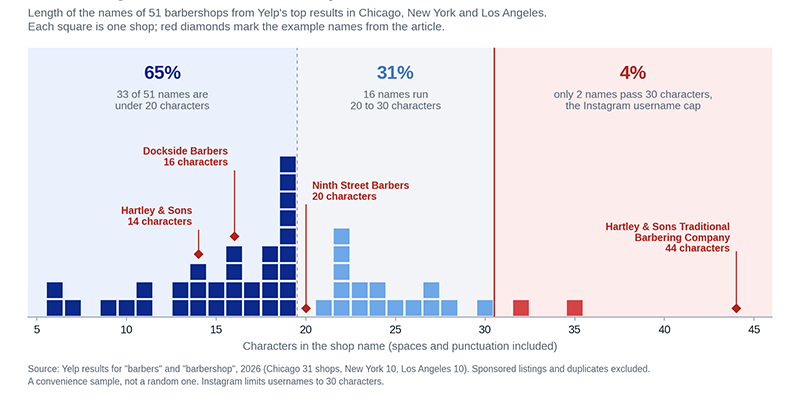
Aim for two words and keep it under 20 characters. Most of the good ones land at two or three syllables, which fits a standard storefront, fits a handle, and still comes through when someone shouts it across a noisy shop floor.
A few outside limits push you in the same direction:
- Instagram caps usernames at 30 characters, letters, numbers, periods and underscores only (Hootsuite, 2025)
- Google Business Profile wants the name to match your real-world name as shown on signage and stationery, and extra keywords are grounds for suspension (Google Business Profile Help)
- Signdealz and other national sign fabricators put a typical illuminated channel letter set at $3,000 to $4,000 for a standard storefront installation
The sign cost is the one owners actually feel. Each extra letter gets fabricated, wired, mounted and permitted on its own, so "Hartley & Sons Traditional Barbering Company" costs real money that "Hartley & Sons" does not.
Single words have the best recall and are the hardest to clear. Anvil, Quarry, Meridian: memorable, and almost always taken at the .com and the handle.
I lean toward the noun-plus-Barbers pattern for most shops. Dockside Barbers or Ninth Street Barbers clears far faster, reads instantly as a barbershop, and gives Google an obvious category signal without stuffing keywords into the name field.
Anything past four words gets shortened by clients anyway. They'll call it whatever the first word is, so make the first word the one you want.
Length matters again in the barbershop logo lockup. A long name forces smaller letterforms, and you lose legibility at 20 feet.
Check the handle and the listing before you fall in love with the name. A shop that can't get a usable name on its barber booking app ends up with a handle full of underscores nobody can recite.
The Naming Styles Barbershops Actually Use
Nearly every operating shop falls into one of the styles below. Some clear easily, and some are a slog.
| Style | Example | Best fit | Clearance difficulty |
|---|---|---|---|
| Surname | Rudy's Barbershop | Owner-operator, one location | Easy |
| Tool and trade | Strop & Steel | Traditional wet shave shops | Hard, heavily used |
| Heritage and era | Truefitt & Hill | Premium, hot towel service | Moderate |
| Locale and street | Pall Mall Barbers | Neighborhood walk-in trade | Easy |
| Pun | Blind Barber | Personality-led independents | Moderate |
| Luxury lounge | The Grooming Room | Above-median pricing | Hard |
| Single abstract word | Schorem | Brand-led, expansion minded | Very hard |
Whichever style you pick, the trademark search runs in the same place. The USPTO adopted the Nice Classification, Thirteenth Edition, version 2026 on 1 January 2026, and barbering and grooming services still sit in class 44.
Surname names and what happens when the owner sells
Nothing clears faster than a surname. Nothing is harder to sell, either.
You get instant accountability and zero ambiguity about who's cutting your hair, and in most markets there's no trademark conflict to worry about. Fellow Barber and Rudy's both trade on that plain-spoken tone.
Where it goes wrong is the sale. Someone buying "Delgado's Barbers" inherits a name that points at a man who no longer works there. Shops built for resale tend to skip the founder's surname entirely, or pair it with a category word so it reads as a brand and not a person.
Pun names that survive and the ones that read as a gimmick
The puns that last are real phrases that happen to describe the work. You can say Blind Barber or Fellow Barber with a straight face, and that's most of the test.
If the joke only lands with a deliberate misspelling, skip it. Hair-force, Kutz, Klipperz, Shear Madness and the rest of that family break voice search and spelling, and they date almost immediately.
Puns also narrow the menu. A shop named around shaving looks odd once half its revenue comes from fades and colour.
Tool and trade names are the most crowded category on the register
Razor, blade, clipper, shear, strop, comb and chair appear in thousands of registered marks and domain registrations across the grooming class.
You can still use the style. The second word just has to do the work, which is why Strop & Steel clears where Razor Barbers doesn't.
Wahl, Andis and Oster references turn up in shop names constantly, and they carry their own risk. Put a live manufacturer mark in your trading name and you're inviting a letter you don't want.
Cool and Modern Barbershop Names
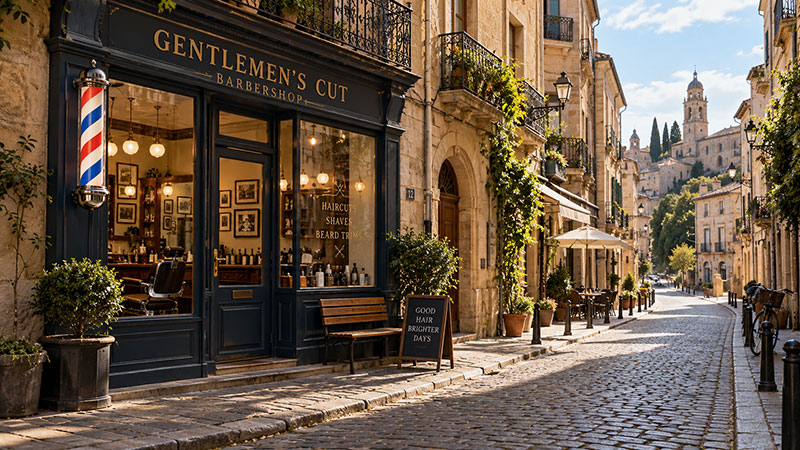
Modern names lean short and flat, with very little ornament. They look clean in a sans-serif wordmark and still work when cropped into a circular profile picture. If you're struggling to get beyond the obvious combinations, a business name generator can help produce a larger first-round list before you start checking trademarks, handles and domains.
Single abstract words
- Quarry
- Meridian
- Kestrel
- Rook
- Vantage
- Foundry
- Talon
- Ember
- Halcyon
- Lantern
- Ironclad
Expect a fight with these. Single common nouns are the most contested category at both the .com and the handle, so either budget for buying a domain or plan on a suffix.
Blade and edge references
- Sharp Line
- Fade Theory
- Keen Cut
- Razor District
- Steel & Fade
- Bladehouse
- Clean Line Barbers
- Sharp Practice
- Edge & Co
Locale and street
A locale name tells a stranger where you are before he reads the address. None of the other styles do that.
- Northside Barbers
- Dockside Barbers
- Ninth Street Barbers
- Broad Street Barbers
- Westgate Barbers
- Harbor Barbers
- Alleyway Barbers
- Uptown Fade
- Grand Ave Barbers
- Corner Cut
They also tie you to a lease. Move three miles and the name becomes a small lie. People recommending this style rarely mention that.
Minimal two-word names
- True Cut
- Fine Line
- Slow Fade
- Quiet Hands
- Sharp Habit
- New Standard
- Clean Break
- Good Company Barbers
If none of these fit your shop, a broader run of barbershop name ideas covers the categories left out here.
Classic, Vintage, and Old-School Barbershop Names
Heritage names sell the service menu before the client sits down. He expects hot towels and a straight razor, and a price that reflects the time it takes.
| Era cue | Vocabulary it pulls in | Saturation risk |
|---|---|---|
| Ampersand surname | & Sons, & Co, Brothers | High |
| Numbered shop | No. 4, Chair 12, dates | Low |
| Pole and lather | Strop, mug, brush, towel | Moderate |
Ampersand and surname formats
- Webb & Sons
- Hale & Co
- Marlowe & Hart
- Barrow & Bell
- Flint & Sons
- Crowe & Company
- Ashby Brothers
"& Sons" and "Co." are so common in this category that they've stopped setting anyone apart. The surname carries the weight. The tail barely matters.
Truefitt & Hill has traded on exactly this format since the 1800s, which is why it reads as heritage and not costume.
Numbered and dated shops
A number implies a history without actually claiming one. Surnames can't pull that off.
- Chair No. 4
- Shop Twelve
- Barber 1910
- Six Chairs
- Third Chair Barbers
Floyd's 99 Barbershop built a multi-state chain on a first name plus a number. That's about as durable as this pattern gets.
Pole, lather, and wet shave references
- The Red Pole
- Lather House
- Strop & Steel
- Mug & Brush
- Hot Towel Co
- Poles & Lather
- The Barber's Chair
Prohibition and back room framing
Only use these if the fit-out backs them up. In a bright walk-in unit under fluorescent light, they read as a costume.
- The Back Room
- Gentleman's Hour
- The Standard Shave
- Whiskey & Shears
- Smoke Room Barbers
- The Ledger
Premium and Grooming Lounge Names
A premium name sets a price expectation before the client sees a price list. That's really all it's for.
A handful of words push perception upward. "Lounge" suggests seating and a drink in hand. "Parlour" borrows the heritage feel but softer. "Club" hints at memberships and a regular chair with your name on it, while "Atelier" implies one practitioner with a booked-out diary. "Room" is the quietest of the lot, and probably the least likely to date.
Names for shops charging above the local median
- The Grooming Room
- Cedar & Oak Grooming
- House of Kane
- Blackthorn Grooming
- Oakwell Barber Club
- Saint & Sable
- Monarch Grooming
- Bellwether Barber Club
- Larkspur Grooming Lounge
- The Ashford Room
- Kingsway Barber Club
- Hartwell & Co Grooming
- The Barber Atelier
- Ivory & Ash
- Velvet Chair
- The Gentlemen's Parlour
A premium name only holds up if the room does, so make this call alongside the barbershop design work, not after it.
Premium name versus neutral name
Going premium does a few useful things for you:
- Anchors a higher price before the conversation starts
- Filters out people shopping purely on price
- Makes memberships, packages and standing appointments feel natural
- Leaves room to add shaves, colour and retail later
It isn't free, though.
- Walk-in volume drops, because passers-by assume they can't afford you
- First-visit reviews get harsh when the room doesn't match the name
- Expectations rise on everything, from towels and product to how long people wait
- If the vocabulary goes out of fashion, it dates faster than a plain surname
The mismatch is what actually hurts. Put a lounge name on a shop running $18 walk-ins and you get reviews complaining about value, not the haircut. Those reviews sit on the profile for years.
Before committing, check whether local trade supports that price point. Naming and the question of whether a barbershop turns a profit at that price end up being the same decision.
Names for Mobile, Home, and Single-Chair Setups
Without a storefront, the name carries the whole first impression. There's no sign, no window and no passing trade to help.
This is also where most barbers actually are. Barbers held about 75,800 jobs in 2025, and 80% of them were self-employed, according to the Bureau of Labor Statistics Occupational Outlook Handbook. Most barber names in the US belong to one person, not a shop floor.
People will read your name on a van wrap, in a text message, or on a booking link. Never on an awning. So words like "shop", "parlour" and "lounge" become a problem, since they imply a place someone can walk into. A mobile round covers several neighborhoods, so the name has to survive moving around, and ideally it still fits if you take a lease one day.
Mobile and van-based names
- Cut & Come
- Doorstep Barbers
- The Travelling Barber
- Roadside Fade
- House Call Barbering
- Curb Cuts
- Barber on Route
- Mobile Sharp
Keep place names out of a mobile name. A locale word sends clients looking for a building that doesn't exist, and some of them will leave a one-star review because they couldn't find you.
Operationally, a van-based round has more in common with a mobile hair salon than with a fixed shop. The name should reflect that from day one.
Home studio and spare room names
Home-based barbers need a name that sounds deliberate. "The Back Room Barber" reads as a decision. "Dave's Garage Cuts" reads as an apology.
- Studio Nine Barbering
- The Front Room
- Quiet Chair
- Appointment Only Barbers
- Kept Barbering
- The Small Shop
Single-chair and booth names
With a single chair, the client is buying the person. Surnames work hardest here.
- Marsh Barbering
- Cut by Reyes
- Chair Nine
- Vance & Chair
- Solo Barbering Co
Renting a chair inside someone else's shop adds a constraint. A booth rental arrangement usually means your name sits under the shop's name on every listing and every receipt.
Which Naming Style Fits Your Shop Type
Your business model picks the style more than your taste does. Once you know your price and volume, and whether you want a second location, you're usually down to one or two formats that work.
| Shop type | Style that fits | Length target | Avoid |
|---|---|---|---|
| Budget walk-in | Locale or plain descriptive | 2 words, under 18 characters | Lounge and club vocabulary |
| Neighborhood mid-tier | Surname or locale | 2 words | Abstract coinages nobody can spell |
| Premium lounge | Heritage or luxury register | 2 to 3 words | Puns and tool references |
| Mobile or home | Service-led or surname | 2 words, no place name | Anything implying a storefront |
| Multi-location plan | Single abstract word or surname blend | 1 to 2 words | Street names, unit numbers |
It helps to decide what you're really competing on. If it's price, the name should just say what the place is. A shop selling the quality of the cut is better off putting the barber front and centre, usually through a surname. And if convenience is the pitch, a locale name does most of that job for you.
A name built for one location looks different from a name built for six. The expansion-minded ones drop geography and the owner's surname, and they stay short enough to repeat on every future sign.
That belongs in the same document as your pricing and chair count. Most owners who get this right make the naming call while the barbershop business plan is still being written, well before the lease is signed.
How to Check Whether a Barbershop Name Is Available
Go in cost order, starting with whatever is cheapest and most binding. Buying a domain takes two minutes. Unwinding a trademark conflict takes months. So the trademark search goes first.
- Search the USPTO trademark database for the exact name and close variants in class 44
- Search your Secretary of State business register for the entity name
- Search your county clerk's fictitious business name index for the trading name
- Check the .com at a registrar such as GoDaddy or Namecheap
- Check the Instagram and TikTok handles
- Search Google Maps for the name within 30 miles of your address
- File the entity, then the DBA, then buy the domain and claim the handles the same week
- Create the Google Business Profile once the signage is up and the address is real
Step 6 is the one people skip, and it catches what the registers miss. An unregistered shop two towns over trading under your exact name won't show up in any database. It will still split your search traffic and your phone calls.
Reading a class 44 trademark result
Ignore the hit count and look at the status field.
A live mark is in force. If it's confusingly similar to yours and in the same class, that's a real risk, even when the goods description reads differently.
Dead or abandoned registrations have lapsed, and the name is usually available. Usually. A business that never stopped trading under it can still hold common law rights.
Pending means an application is in examination, and filing behind it puts you second in line on the same string.
Confusing similarity covers sound and meaning, not just spelling. As far as an examining attorney is concerned, "Ironside Barbers" and "Iron Side Barber Co" are the same thing.
Handle and domain fallbacks when the .com is gone
Some fallbacks hold up fine:
- Adding the city, as in ironsidebarbersaustin.com
- Adding the category (ironsidebarbershop.com)
- Taking the .co or your country extension if your trade is local anyway
Others cause trouble later. Numbers nobody can guess, hyphens that disappear when the name is spoken, and deliberate misspellings that break both the handle and the search.
Use the same string for the domain, the handle, and the listing in whatever barbershop software you run. When choosing between available website domains, prioritize something short, easy to say aloud and close to the trading name. When those don't match, clients end up on a competitor's profile.
What Clearing and Registering a Barbershop Name Costs
If you file it yourself, expect a few hundred dollars. The trademark is the biggest line and also the only optional one.
Current figures, as of 2025 and 2026:
- A federal trademark costs $350 per class as a base application fee, effective 18 January 2025, after the USPTO merged the old TEAS Plus and TEAS Standard options
- Writing your own description instead of picking from the USPTO Trademark ID Manual adds a $200 per class surcharge, bringing the total to $550 per class, plus another $200 per additional 1,000 characters beyond the first 1,000
- In California, LLC formation is $70 for the Articles of Organization plus $20 for the Statement of Information, per the Secretary of State fee schedule
- A DBA in Los Angeles County is $26 for one business name and one registrant, $5 for each additional name or registrant, plus a $10.75 online service fee (Los Angeles County Registrar-Recorder/County Clerk)
Treat the California numbers as examples. Fees are set county by county and state by state, and the only number you can rely on is the one on your own registrar's site.
Then there's newspaper publication, which almost nobody budgets for. Several states require a new fictitious business name to run in a local paper for four consecutive weeks before the filing is complete.
Renaming later costs several times all of this. New signage, cards, aprons and window decal, a reprinted price list, and a stretch where half your regulars can't find you.
Put the naming and filing spend in your opening budget from the start, next to the rest of your service business expenses. It's small money if you plan for it.
Do Barbershop Name Generators Produce Usable Names?
They're good for getting unstuck. Choosing the name and clearing it are still on you.
| Tool | What it does | What it does not do |
|---|---|---|
| Namelix | Generates short brandable coinages, checks domains | Check trademark databases |
| Shopify name generator | Combines your keyword with common suffixes | Filter by industry saturation |
| Looka | Turns a chosen name into logo directions | Generate the name strategy |
A free domain is not a free name, and generators blur that. Namelix runs live domain checks next to every suggestion, but a name can be wide open at the registrar while a live mark sits on it in class 44.
They also all converge. Every generator fed the keyword "barber" pulls from the same pool of suffixes, so thousands of owners see nearly identical shortlists in the same week.
I'd use one for the first 30 candidates and stop there. Throw out anything you can't pronounce on the second read, then run what's left through the clearance steps yourself.
What the Chains Name Themselves and What a Single Shop Should Take From It
Chains name for repetition across hundreds of markets. You don't have that constraint, and copying chain naming wholesale gets you a bland shop.
Great Clips and Supercuts say what happens inside and nothing else. No personality at all, but enormous recall at scale. Sport Clips went a different way and built a whole service format into the name, which filters the clientele before anyone walks in.
What's worth copying is the character count. Every one of those names fits a small storefront, and a stranger says it correctly the first time.
Two chain habits I'd ignore completely. Chains sand down local character because they operate in markets they don't know, and you don't have to. And they describe the service in the name, which gains a single shop in a single neighborhood nothing. It just loses you the chance to say something specific.
A one-location shop up against a chain down the road wins on exactly what the chain gave up. A name that sounds like a person picked it.
When a Clever Barbershop Name Backfires
Almost every regretted name fails in one of the ways below, and most of them are visible before the sign goes up.
- Misspellings like Kutz, Klipperz and Hare Force break voice search, spelling and map queries all at once
- A narrow pun built on shaving looks wrong once fades and colour carry the revenue
- Street names die the day the lease moves three blocks
- A surname leaves the next owner with a name pointing at someone who left
- Lounge vocabulary on a walk-in shop turns into value complaints in reviews
- A name that blows the sign budget gets shortened badly by the fabricator
Renaming a shop that already has reviews
Edit the existing Google Business Profile. Don't create a second one.
Sometimes a rename is worth it:
- The name is actively limiting the menu or the price point
- A departed owner's surname is still on the door
- There's a conflict with a live mark and you'd like to fix it before it becomes a legal letter
Know what you're signing up for, though.
- Google can request reverification after a name edit, and changed fields stay pending until it clears
- Directory listings, citations and the website all have to match the new name, or the edit looks like spam
- Regulars searching the old name find nothing for weeks
- Every physical asset gets replaced at once
Update the website and signage first, then the profile. Google cross-checks the name against the rest of the web before approving the change, so the outside world has to agree with the edit before you submit it.
The listing isn't the real risk. Losing regulars is. You spent years building a clientele, and some of them will just stop seeing you in search.
Names that fail the phone and voice search test
| Pattern | What breaks |
|---|---|
| Substituted letters (Kutz, Fadez) | Typed search, spelling over the phone |
| Ampersand or symbol in the string | Handles, URLs, voice queries |
| Homophone pairs (Shear, Sheer) | Map results split between spellings |
| Four or more words | Recall, sign cost, listing display |
You can test this in 30 seconds. Say the name to someone who's never heard it, ask them to type it into Maps, and watch what they type.
If they hesitate, the name isn't clever. It's expensive.
When living with a mediocre name beats renaming
Past a certain point, the rename costs more than the bad name does.
If the shop has years of reviews behind it and the name is merely plain, keep it, as long as there's no trademark conflict. Plain names don't lose clients. Confusing ones do.
It's different when the name blocks the price you need to charge or misrepresents what you actually do. Same if it sits on someone else's live mark in class 44. Those get worse every month you leave them, so change it.
FAQ on Cool Barbershop Names
Is "barbershop" or "barber shop" the correct spelling on a sign?
Either is fine. The closed form is more common on US signage and it's what the Google Business Profile category uses.
Pick one and use it identically on the sign, the website and every listing.
What should go on the sign when the legal name is too long?
Put the trading name on the sign. "Ironside Barbers" goes on the channel letters while "Vega Holdings LLC" stays on the lease and the insurance certificate.
Google requires the profile name to match what the signage actually says.
Can two barbershops in different states share the same name?
Yes, and thousands do. State registers only check names within that state, so an identical shop name somewhere else creates no filing conflict.
A federal trademark in class 44 changes that, since registration covers the whole country.
Do you need a trademark at all for a single-location shop?
No. A registered entity plus a DBA filed with the county clerk is enough to trade legally under the name.
File the trademark when you're planning a second location, a franchise, or retail products carrying the name.
What name works for a female barber opening a men's shop?
Whatever would work for anyone else. Surname, locale and tool-based formats carry no gender signal, and clients book on the cut.
I'd just avoid names leaning hard on gentleman or fellas vocabulary. They narrow the clientele for no good reason.
What Do You Lock In First With a Barbershop Name?
Clear the name before you spend anything on branding. Run the class 44 trademark search, file the entity and then the DBA, then buy the domain and claim the handles. The logo lockup, window decal and channel letters come last.
That order isn't arbitrary. Paperwork is reversible. A fabricated sign isn't, and neither are a few hundred loyalty cards.
Naming for clearance does cost you the sharpest single-word options, since short common nouns tend to sit under live marks and overpriced domains. Settling for two words gets you a faster, cleaner filing. I think that's usually the better deal.
The name won't bring in money on its own. That depends on chair time and rebooking, and on whether walk-ins keep coming, which is the work covered in running a successful barbershop.