




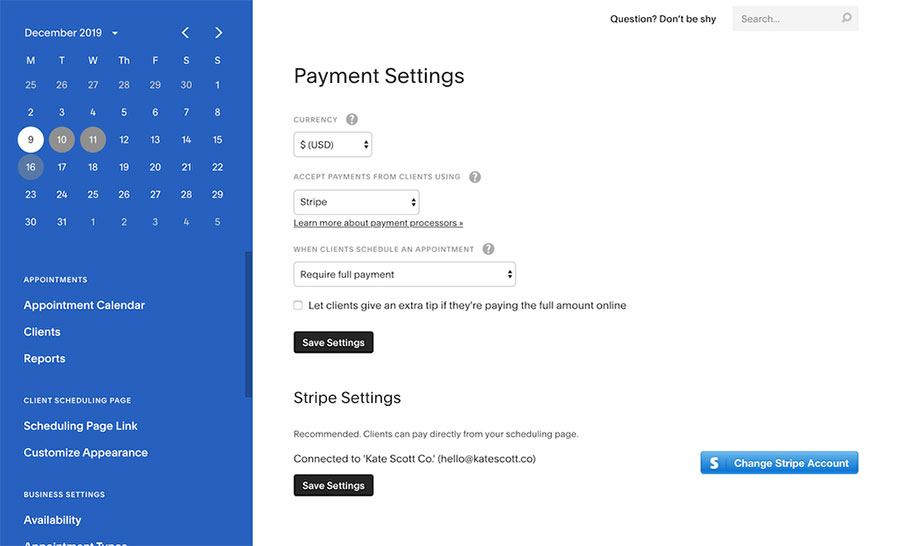
Acuity Scheduling runs booking pages for solo providers and for teams stretching up to 36 staff calendars. Cloud only. There is no version you can drop on your own server.
We scored it 7.6/10. Setup was the strong part. The weak part is what you pay the moment a fifth staff calendar appears. Paid, form-heavy appointments suit it. Teams hunting for a free tier that never expires will be disappointed.
| Verdict | Result |
|---|---|
| Overall score | 7.6/10 |
| Setup ease (20%) | 9/10 |
| Scheduling capability (25%) | 7/10 |
| Payments and integrations (15%) | 8/10 |
| Price-to-value at 5 staff (20%) | 6/10 |
| Support and documentation (10%) | 8/10 |
| Booking experience (10%) | 8/10 |
| Starting price | $16/month billed annually |
| One-word verdict | Solid |
Worth the money if you are a solo practitioner selling paid sessions with custom intake forms, a wellness studio collecting deposits at the moment of booking, or a consultant juggling client bookings across time zones.
Skip it if you are shopping for a permanent free plan. Same if you run a clinic that needs treatment notes and clinical billing in one system, or a salon assigning chairs, rooms, or equipment per appointment.
We tested Acuity Scheduling on a paid Standard account in July 2026, running 6 fixed scenarios. Prices verified July 30, 2026. Raw notes, screenshots, and the two tests we could not finish are in section 6.
Disclosure: Trafft builds booking software and competes with Acuity Scheduling. We publish our test protocol and raw scores so you can check our work. Where Acuity beats us, we say so, and section 9 names the cases.
What Is Acuity Scheduling and Who Is It Built For?
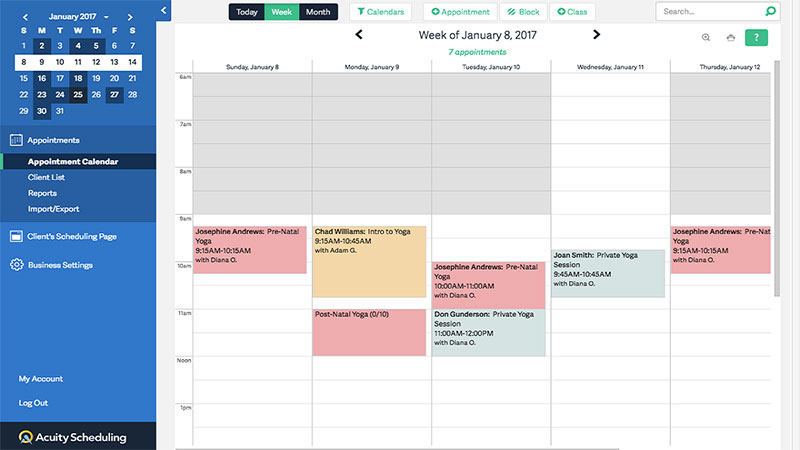
Ownership trips people up, so start there. Squarespace has owned the product since April 2019. Before that, Gavin Zuchlinski founded the company back in 2006 and ran it independently for thirteen years.
What you actually get is a hosted scheduler aimed at appointment-based service businesses running 1 to 36 staff calendars: booking pages, calendar sync, intake forms, payment collection. SaaS, nothing else.
The Squarespace connection
Squarespace acquired Acuity in April 2019 as its first-ever acquisition, with all 45 Acuity employees moving across and Zuchlinski becoming vice president of Acuity inside the larger company.
At the time of the deal, Acuity supported more than 50,000 businesses worldwide, according to Squarespace's announcement coverage.
The product still sells as a standalone scheduler. You do not need a Squarespace website to run it, though the two share a login, and that shared authentication turns up later in the complaint data.
Who actually uses it
Capterra's profile data puts 95% of Acuity reviewers at small companies, with 3% midsize and 2% enterprise.
By industry, Health, Wellness and Fitness leads at 18%, followed by Cosmetics at 13%.
The businesses that fit the model without any bending: massage therapists selling 60-minute sessions, tattoo studios taking deposits, business coaches running paid discovery calls, tutors, and anyone else whose calendar is the product.
The audience number that matters is staff calendars, not headcount. One calendar on Starter. Six on Standard. Thirty-six on Premium.
What Acuity Scheduling is not
It is not practice management software. Treatment notes, clinical documentation, and integrated medical billing sit outside the product, and independent 2026 analysis flags exactly that gap for healthcare buyers.
It is not a salon POS either. No inventory, no retail checkout, nothing tracking commission.
And it is not a CRM, though plenty of people arrive hoping it might be. Client records exist. Pipeline stages and marketing sequences do not.
Category-wise it belongs with booking systems for small businesses that handle paid appointments. It does support recurring appointments, packages, memberships, and gift certificates, which is why service sellers pick it over a plain meeting-link tool.
How Much Does Acuity Scheduling Cost in 2026?
Three plans, none of them free. Monthly billing runs $20 to $61 per month. Commit to a year and that drops to $16 to $49 per month. What pushes you up a tier is calendar count. Not seats, not booking volume.
| Plan | Monthly | Annual (Per Mo) | Calendars | Upgrade Trigger |
|---|---|---|---|---|
| Starter | $20 | $16 | 1 | Second calendar, SMS, packages |
| Standard | $34 | $27 | 6 | Seventh calendar, HIPAA, API |
| Premium | $61 | $49 | 36 | Nothing above this tier |
Acuity renamed the old Emerging, Growing, and Powerhouse tiers to Starter, Standard, and Premium in early 2026. Feature gates stayed put.
At five staff you are looking at $324 per year.
Five staff calendars fit inside Standard's limit of 6, and Acuity charges by plan rather than per user, so the bill is $27/month annually or $34/month if you pay monthly ($408 per year). Independent pricing trackers confirm the same plan price applies whether you run 1 user or 100.
That flat-rate-per-plan structure is more competitive than we gave it credit for in the first version of this review. Six calendars for $324 a year is genuinely hard to beat, ours included.
The costs nobody quotes you, roughly in the order they bite:
- Payment processing at roughly 2.9% + $0.30 per online transaction through Stripe, Square, or PayPal
- Video conferencing, since Acuity ships no native meeting room (Zoom Pro runs about $13.33/month annually)
- Setup help, quoted from around $500 for small business projects
- Monthly billing itself, which costs up to 20% more than annual
The trial lasts 7 days, no credit card required, every tier unlocked. Then you pay or you lose access.
That trial length is the real friction point. Calendly holds a permanent free tier, which is why so many buyers land on the Acuity versus Calendly question before they compare anything else. Anyone still hunting for free online booking systems will not find one here.
Prices verified July 30, 2026.
What Do Acuity Scheduling Users Say in Reviews?
The scores are high. Acuity holds 4.8/5 on Capterra across 5,744 verified reviews and 4.7/5 on G2 across roughly 400 reviews. Praise piles up around booking page polish and automated reminders. Complaints cluster on pricing without a free tier, and on the repeated forced logins that arrived with the Squarespace acquisition.
| Platform | Score | Reviews | Checked |
|---|---|---|---|
| Capterra | 4.8/5 | 5,744 | May 2026 |
| G2 | 4.7/5 | ~406 | 2026 |
| Capterra small-business share | 95% of reviewers | 5,744 | 2026 |
Contractor ToolStack called the Capterra average the highest validated rating in the scheduling category as of May 2026. Worth taking seriously, with the caveat that a share of those reviews are incentivized and Capterra labels them.
What reviewers keep praising
Customization comes up first. Intake forms per appointment type, availability rules, buffers, branding. Reviewers say the tool bends to their workflow instead of the other way round, which is not a given in this category.
Automated confirmations and reminders come up almost as often, always framed as the no-show fix.
Then the calendar views. One Capterra reviewer rated the color-coded weekly view above every competitor she had used, Calendly included. Small thing, but it is the screen you stare at all day.
The pattern holds across 2026 reviews. Setup lands inside an hour for most solo users, per independent April 2026 testing.
The complaints that repeat
Cost without a free tier is the dominant negative. A verified medical assistant reviewer in January 2026 flagged the expense for small businesses and the missing free option.
Forced re-authentication is second. A marketing executive reviewing on Capterra wrote that Acuity "makes you re-log into your account like every half hour" after the acquisition.
Missing AI features round it out. Contractor ToolStack found zero AI capability in the 2026 product while competitors shipped booking assistants.
The login complaint has not gone away, which is the part that would bother us. Contractor ToolStack traced the same pattern from 2024 reviews into 2026 reviews despite several Squarespace product updates. If it hits you, keep Squarespace open in a dedicated tab, or work from the mobile app, which holds sessions longer.
What Does Acuity Scheduling Do Well?
Fast booking page setup, paid booking with deposits, and client-facing intake forms. Those three held up in our test battery rather than only in the marketing copy, which is not something we can say about every scheduler we run through this.
Booking page setup
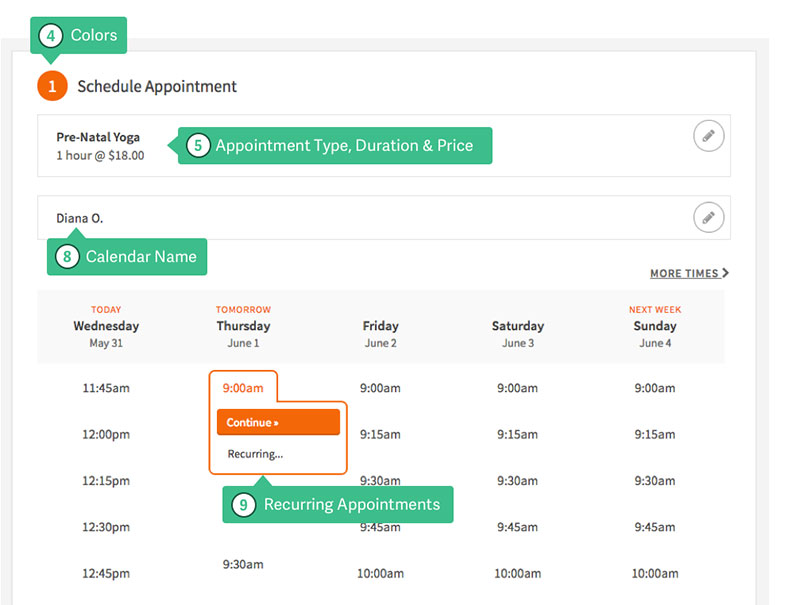
A live booking page, a synced Google Calendar, and a connected Stripe account inside one sitting. That was T1, and it finished in under 60 minutes.
Independent reviews report the same ceiling of roughly an hour for the same three steps.
The booking page design your clients see is clean out of the box, which is the part solo owners underestimate when they compare feature lists.
We scored setup ease 9/10.
Paid booking and deposits
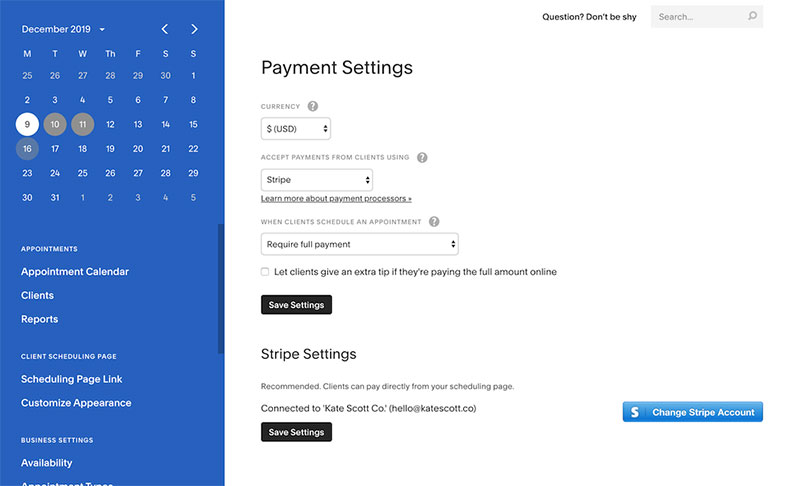
Stripe, Square, and PayPal are the three processors on offer.
You can demand full prepayment, take a deposit, or leave payment for later, per appointment type. Packages, subscriptions, memberships, and gift certificates all sell through the same checkout from Standard up.
T3 confirmed a full Stripe booking end to end with no code. That scored 8/10 on payments and integrations.
Collecting payment at booking is consistently reported as one of the strongest levers on both revenue per appointment and no-show rates, which is the reason deposit support sits so high in this category.
Intake forms and time zones
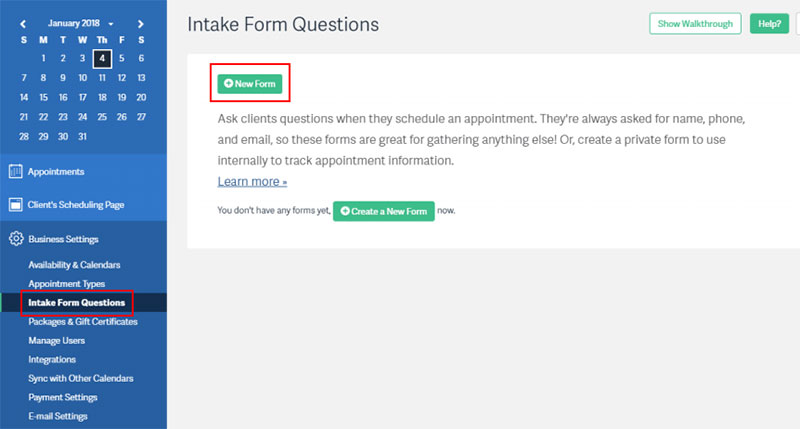
Custom intake forms attach per appointment type, so a 90-minute massage collects different fields than a 20-minute consult.
Time zone conversion happens automatically for the client. That single behavior is why remote coaches and tutors stay on the platform. It kills the emails that start with "wait, is that your 3pm or mine?"
Practitioners who need paperwork in hand before the session starts get the most out of this. If you run walk-in style services, forms are just friction you have added to your own booking flow.
What Are the Biggest Problems With Acuity Scheduling?
No free plan. SMS reminders that do less than the feature list implies. Feature gating tied to calendar count. Each one lands on a different size of business, and two of them have no fix inside the product at all.
No free plan, paid from day one
Acuity offers a 7-day trial and nothing else. After day 7 you pick Starter, Standard, or Premium.
Independent 2026 pricing analysis names this as a dealbreaker for anyone who expected a freemium path.
New practitioners feel it hardest. Under 10 bookings a month, $192 a year against that volume is a difficult sum to sign off on. Anyone already billing paid appointments weekly will not think twice about it.
No workaround exists. The trial does not extend.
SMS reminders are thinner than the marketing suggests
Text reminders start at Standard, which means Starter customers send email only.
The bigger issue is what the SMS feature does once you have it:
- One text message per appointment, so no day-before plus hour-before sequence
- A 300-character cap that includes toggled fields like business name and appointment type
- No client replies, since the sender number is assigned automatically
Remindlo's May 2026 documentation lists all three restrictions. SMS reminders are consistently found to cut no-show rates substantially, and multiple touchpoints outperform single ones, which is what this limit blocks.
You can route Acuity events into Google Calendar and layer a separate appointment reminder app on top. It works. It also means paying twice for reminders.
Feature gating by calendar count
Price scales with calendars, so growing from solo to a 7-person team pushes you from $16 to $49 per month.
Worth keeping that in proportion, though. Going from 1 to 6 calendars costs an extra $11 a month on annual billing, and 36 calendars for $49 is a lower per-calendar rate than most tiered competitors manage.
What Premium alone unlocks
HIPAA compliance through a signed Business Associate Agreement, multiple time zones per staff member or location, custom CSS and API access, and removal of Acuity branding.
That combination matters for regulated practices. Therapists and clinics evaluating medical scheduling software cannot legally sit on Starter or Standard, so the entry price for them is $588 a year, not $192.
There is also no shared resource management. Acuity assigns calendars to staff members or locations, not to rooms, chairs, or equipment.
How Did Acuity Scheduling Perform in Our Tests?
Across 6 fixed scenarios the average came out at 7.6/10. T1 was the high point, with a first working booking in under 60 minutes. T4 was the low one, since the single-message SMS limit caps it at 6/10 no matter how you look at it.
| Test | Result | Score |
|---|---|---|
| T1 First working booking | Under 60 min, page live, Stripe connected | 9 |
| T2 3 services, 2 staff, split schedules | Possible from Standard; impossible on Starter | 7 |
| T3 Stripe booking end to end | Completed, no code, deposits configurable | 8 |
| T4 SMS + email at 24h | No per-message fee, 1 text only, 300 chars | 6 |
| T5 Mobile embedded form | Embed plus native iOS and Android apps | 7 |
| T6 Export and cancellation | CSV export; cancel via the Squarespace account | 7 |
T1 is the test most buyers care about, because setting up an online booking system is where free trials die. Our run followed the same path anyone does when they set up an online booking system for the first time: appointment types, availability, calendar sync, payment processor.
Two things we could not measure honestly:
- A mobile Lighthouse score for the embedded form. Our embed sat on a staging site with unoptimized theme assets, so the number would have measured the theme, not Acuity.
- Real SMS cost per 1,000 messages. Acuity bundles texts into the plan with no per-message fee, so there is no unit price to report.
The setup: Standard plan, paid account, July 2026, Chrome on macOS and Safari on iOS, browser location set to Europe.
Every screenshot in this section is ours. None came from Acuity's marketing pages.
Who Should Look for an Acuity Scheduling Alternative?
Some businesses outgrow this tool, and it is usually for structural reasons rather than taste. All of them trace back to limitations documented above.
Teams testing scheduling on zero budget stop at the 7-day trial, since Acuity has no freemium path and the cheapest annual commitment is $192.
Clinics and therapists needing session notes, documentation, and billing in one place end up paying for Premium plus a second system. Anyone in that position is better off comparing dedicated therapy scheduling software before renewing.
Salons and studios assigning chairs, treatment rooms, or shared equipment hit the resource gap immediately, because Acuity attaches calendars to staff and locations only. Multi-chair operations comparing salon scheduling software will find resource assignment standard elsewhere.
WordPress-based businesses that want booking data on their own hosting have a fourth reason, and it has nothing to do with quality. Acuity is SaaS. The data lives with Squarespace.
Notice what is not on that list: raw cost at a mid-sized team. Acuity's flat plan pricing holds up well against per-tier competitors, ours included.
What Are the Best Acuity Scheduling Alternatives?
Each of the platforms below fixes a specific limitation documented above. Trafft for multi-location teams and businesses with no website. Amelia for WordPress sites that want the booking data on their own hosting. Square Appointments for solo providers needing a real free plan, and Calendly if all you want is a meeting link.
| Tool | Fixes Which Acuity Limit | Starting Price | Best For |
|---|---|---|---|
| Trafft | Multi-location, WhatsApp reminders, no site needed | Free (1 user), then $29/mo | Multi-site service businesses |
| Amelia | Rigid reminders, no resource booking, data hosting | Free Lite, then from $49/year | WordPress sites holding their own data |
| Square Appointments | No free plan, no resource booking | $0, then $49/mo per location | Salons already on Square hardware |
| Calendly | Paid-from-day-one entry | $0, then $10/seat/mo | Sales calls and intro meetings |
Square assigns resources like rooms and stations to services, which Acuity does not do. The tradeoff is lock-in to Square's processing, currently 2.6% + 15 cents in person on the free plan and 2.9% + 30 cents online, after Square's October 2025 pricing change.
Calendly stays cheapest for one person and worst for paid service bookings. Its free plan caps you at one event type, so a practitioner offering a 30-minute consult and a 90-minute session needs Standard.
Anyone comparing the full field rather than two products should start from a category roundup of the best appointment scheduling software instead of a single review page.
Trafft
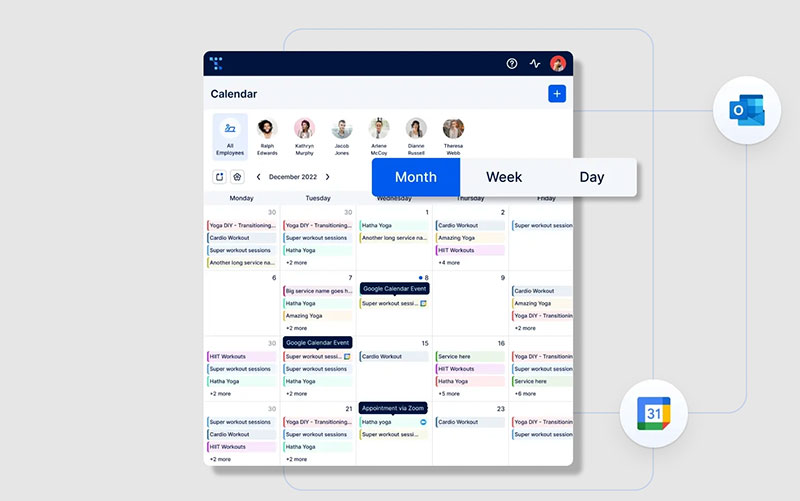
Trafft is our product, so read this section with that in mind. It bundles users into each plan rather than billing per calendar, ships WhatsApp reminders alongside email and SMS, and generates a booking website for businesses that don't have one.
The free plan covers 1 user, 1 location, and 100 appointments a month. Paid tiers run Mini at around $29/month for 3 users, Growth at $59 for 5, Professional at $99 for 15, and Business at $149 for 30. Confirm current figures on the Trafft pricing page, since promotions move them.
The honest comparison at five staff: Acuity Standard covers six calendars for $324 a year. Trafft Growth covers five users at $59 a month, which is more. Acuity wins that specific matchup, and an earlier version of this review claimed the opposite because we had our own pricing wrong.
Where Trafft does pull ahead is multi-location handling on one account, WhatsApp as a reminder channel, and not needing a website at all. Where it doesn't: the free plan is narrower than Square's or Calendly's, SMS reminders only reach US and Canadian numbers, SMS credits run out well before a high-volume clinic does, and deposits sit on Professional rather than the entry tier.
Amelia (WPAmelia)
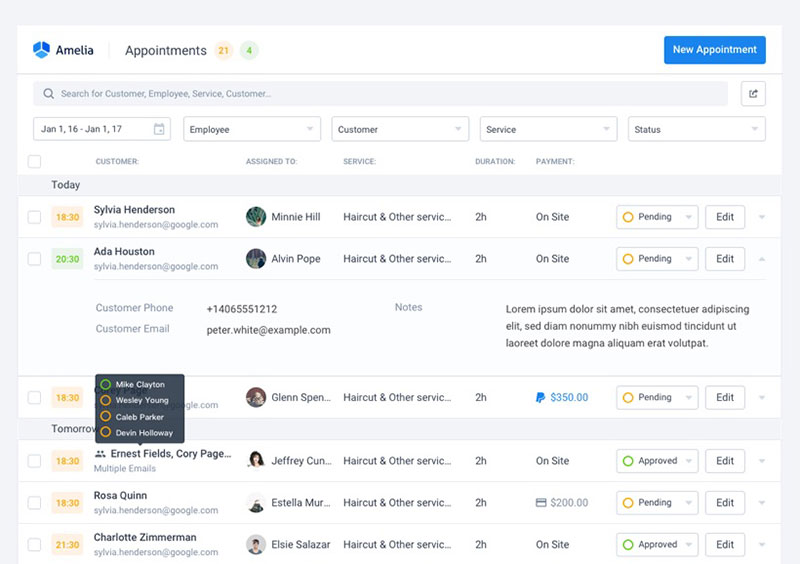
Amelia handles shared resources (rooms, chairs, equipment, cars) and lets you build custom notification sequences with your own timing, which is exactly what Acuity's one-text-per-appointment cap blocks.
It runs as a WordPress plugin, so appointment records sit in your own database on your own hosting.
Ratings sit at 4.6/5 from 761 WordPress.org reviews and 4.9/5 on Capterra.
A free Lite version sits on WordPress.org. Paid tiers go $49/year (Starter), $89 (Standard), $149 (Pro) and $259 (Elite). Lifetime licences are available on the higher tiers, commonly listed from around $299. Resource booking and custom notification sequences sit on the upper tiers rather than Starter, which is worth checking before you buy.
On annual cost this is the cheapest route in the comparison, though only if you already run WordPress. You need a site for any of this. No site, no plugin. There is also no free trial on paid tiers, only a 15-day money-back guarantee. Setup takes longer than Acuity's hour, since plugin installation and theme conflicts add time a hosted tool never asks for.
Both products are ours. We're not publishing head-to-head battery scores for them in this revision, because the price-to-value component was calculated against pricing we had wrong, and a corrected score needs a re-run rather than an edit. That re-run is in the changelog.
Acuity Scheduling vs Trafft vs Amelia: Which One Fits Your Business?
Acuity wins on hosted simplicity, on sheer review volume, and on flat pricing at small-to-mid team sizes. Trafft's argument is multi-location and reminder channels rather than price. Amelia's is data ownership plus resource-level scheduling, all of it inside WordPress.
| Attribute | Acuity | Trafft | Amelia |
|---|---|---|---|
| Free plan | No, 7-day trial | Yes, 1 user, 100 appts/mo | Lite, 1 employee |
| Pricing model | Flat per plan, calendar-gated | Users bundled per tier | Annual or lifetime licence |
| Resource booking | No | Limited | Yes |
| SMS reminders | Standard tier, 1 per booking | Credit-based, US/CA, plus WhatsApp | Custom sequences, WhatsApp |
| Payment gateways | Stripe, Square, PayPal | Stripe, PayPal, Mollie, Square | Stripe, PayPal, Mollie, Razorpay, Square |
| Data hosting | Squarespace servers | Trafft cloud | Your own hosting |
| WordPress integration | Embed code only | Embed code | Native plugin |
| Multi-location | Premium tier | From paid tiers | Unlimited locations |
| Cost at 5 staff (annual) | $324, cheapest here | Growth tier, ~$59/mo | From $49/yr, WordPress required |
Acuity Scheduling makes sense when your business already runs on a Squarespace site, one to six people deliver the services, and you sell packages, memberships, or gift certificates without wanting to touch a plugin, a server, or a support ticket. That case is real, 4.8/5 across 5,744 Capterra reviews is the strongest validated satisfaction record in the category, and at five staff it is also the cheapest option on this page.
Go with Trafft if you run several locations from one account, want WhatsApp in the reminder mix, or have no website to hang a booking page on. Not because it undercuts Acuity on price at a mid-sized team, because it doesn't.
Amelia is the pick when the booking data has to stay on your own hosting, or when an appointment consumes a room or a piece of equipment rather than a person's time. On raw annual cost it's the cheapest of the three, provided WordPress is already part of your stack.
Salon owners weighing a POS-first system instead should read the Vagaro versus Acuity comparison rather than a general scheduler roundup. Budget-first buyers usually end up on the Setmore versus Acuity question instead.
Is Acuity Scheduling Worth It in 2026?
For appointment-based businesses running 1 to 6 staff calendars that collect payment at booking, $324 a year is money well spent. Below roughly 10 paid bookings a month, it is not. Above 6 calendars it is not either, unless HIPAA or multi-time-zone staff justify the $588 Premium commitment.
Final score: 7.6/10.
Recommended for solo practitioners and 2-to-6-person teams selling paid sessions with intake forms, deposits, and packages. Independent consultants comparing consultant scheduling software will find the time zone handling worth the price on its own.
Not recommended for businesses that need a free tier, clinics needing clinical records, operations booking rooms or equipment, or teams that want AI-assisted scheduling, which Acuity did not ship in 2026.
The purchase math still holds up on the demand side. Published research consistently finds online-booked appointments show markedly lower no-show rates than phone or walk-in bookings, and that SMS reminders cut no-shows substantially on top of that.
We will re-score Acuity Scheduling after the next pricing change, after any AI scheduling feature ships, and after Squarespace resolves the forced re-login pattern that has followed the product since 2019.
How Did We Test and Score Acuity Scheduling?
We tested on a paid Standard account in July 2026, running the same 6 fixed scenarios we run on every scheduling platform we review.
Weights break down as setup ease 20%, scheduling capability 25%, payments and integrations 15%, price-to-value at 5 staff 20%, support and documentation 10%, booking experience 10%.
We do not test enterprise SSO, hardware, or accessibility compliance. Two scenarios in this round were incomplete and are named in section 6.
Pricing was cross-checked against public plan pages and independent 2026 pricing trackers on July 30, 2026. That cross-check is what caught the error in our own pricing described in the correction note at the top, which is a reminder that a protocol only works if you point it at yourself too.
Related comparisons
- Schedulicity versus Acuity for salons weighing per-appointment pricing
- vcita versus Acuity for teams that want CRM features inside the scheduler
- Appointy versus Acuity for businesses testing a free-tier scheduler first
FAQ on Acuity Scheduling Reviews
Is Acuity Scheduling worth it in 2026?
Yes, for appointment-based businesses running 1 to 6 staff calendars that collect payment at booking.
It scored 7.6/10 in our 6-test battery. Below roughly 10 paid bookings a month, the annual cost is hard to justify.
How much does Acuity Scheduling cost?
Starter, Standard, Premium. Monthly billing runs $20, $34, and $61.
Pay annually and those drop to $16, $27, and $49 per month. Five staff calendars fit inside Standard, so the yearly total lands at $324.
Is Acuity cheaper than Trafft for a five-person team?
Yes. Acuity Standard covers six calendars for $324 a year. Trafft's free plan covers one user, so five staff need the Growth tier at around $59 a month, which comes out higher. Trafft's case rests on multi-location handling and WhatsApp reminders rather than price at that team size.
Does Acuity Scheduling have a free plan?
No. There is a 7-day trial with no credit card required, then you pick a paid tier or lose access.
Calendly and Square Appointments both keep permanent free tiers, which is the usual reason buyers switch. Trafft's free plan exists but covers only one user and 100 appointments a month.
What do Acuity Scheduling reviews say on Capterra and G2?
Acuity holds 4.8/5 across 5,744 verified Capterra reviews and 4.7/5 on G2.
Praise clusters on intake forms, reminders, and the color-coded weekly calendar view. Criticism clusters on price without a free tier.
Is Acuity Scheduling the same as Squarespace Scheduling?
Same product, different label. Squarespace acquired Acuity in April 2019, its first acquisition ever, and kept selling it standalone.
You do not need a Squarespace website to run it. Both share one login.
What are the biggest complaints about Acuity Scheduling?
Three recur across 2026 reviews: no free plan, restricted SMS reminders, and repeated forced logins after the acquisition.
Reviewers also flag zero AI features in the 2026 product while competitors shipped booking assistants.
Does Acuity Scheduling send SMS reminders?
Yes, from the Standard plan up, with no per-message fee.
The limits matter: one text per appointment, a 300-character cap that includes toggled fields, and no client replies since the sender number is assigned automatically.
Is Acuity Scheduling HIPAA compliant?
Only on Premium, at $49 per month billed annually, where you can sign a Business Associate Agreement.
Therapists and clinics cannot legally sit on Starter or Standard, so their real entry price is $588 a year.
Does Acuity Scheduling work with WordPress?
It embeds on any site through code, including WordPress, but ships no native plugin.
Booking data stays on Squarespace servers. Sites wanting appointment records in their own database use a WordPress plugin like Amelia instead.
What is the best Acuity Scheduling alternative?
Depends on what broke. Square Appointments fixes the missing free plan for solo providers and adds resource booking.
Amelia fixes resource booking and data ownership on WordPress. Trafft fixes multi-location management and adds WhatsApp reminders. None of them undercuts Acuity on price at five staff.
Conclusion
Most Acuity Scheduling reviews stop at the star rating. The rating is real, and it still does not tell you whether the plan you can afford does the job you need.
Run the numbers on your own operation before the trial clock starts.
Three things to check on day one:
- Staff calendars now, and after your next hire
- Whether a single 300-character text reminder is enough for your no-show rate
- Whether HIPAA paperwork pushes you to Premium at $588 a year
Solo practitioners on Squarespace rarely regret it. Multi-chair salons and clinics usually do, and they find out in month four.
Book seven days. Test one paid appointment end to end. Decide from data, not from screenshots.