





Mindbody complaints are unusually consistent, and almost none of them are about whether the software works. They are about price, what the contract says, and how long it takes to reach a human.
Mindbody is a cloud-based business management platform for fitness, wellness, salon and spa businesses. Back-office software on one side, a consumer marketplace app on the other, selling classes and appointments to new clients on commission.
More than 40,000 businesses run on it, from single-room yoga studios to multi-location medical spas. Operators usually weigh it against WellnessLiving, Vagaro and Boulevard.
Capterra's 2026 profile records 4.0 out of 5 across roughly 2,980 verified reviews, with value for money the lowest sub-score at 3.6.
And the fine print matters more here than with most platforms. Mindbody's published Terms of Service set a 90-day initial term and state that fees paid are non-refundable.
What Is Mindbody and What Does It Do?

Two products share one subscription. There is the back office where you run scheduling, payments and payroll, and there is a consumer app where clients search for classes and appointments near them and book. New clients arriving through that app carry a commission.
That second half is the part no standalone scheduler has. Most booking tools stop at your own website.
The product breaks into module groups that cover roughly this ground:
- Class scheduling, appointment booking, and waitlist management
- Point of sale, retail inventory, gift cards, and package tracking
- Client records, membership billing, auto-pay contracts, and recurring payments
- Staff payroll, permissions, and room and resource scheduling
- Attendance reporting, retention metrics, and lapsed client alerts
- Automated email campaigns, SMS marketing, promo codes, and lead pipeline
Mindbody reports more than 40,000 businesses on the platform, a figure its parent company repeated in its 2026 merger announcements.
The verticals span yoga and Pilates studios, gyms, integrative health clinics, medical spas, and hair and beauty businesses. Depth of coverage varies a lot by vertical, which is where most of the review friction starts.
Something worth knowing before you evaluate anything else. Mindbody is not one interface. There is a browser-based back office for owners, a staff app for the desk, and a consumer app your clients download, which competes for attention with every other studio in your area.
Businesses coming from a simple salon scheduling setup tend to underestimate how much of the platform they will never open.
The retail side runs on Mindbody hardware. If you already use point of sale systems built for a salon counter, that gets replaced, not integrated.
Who Owns Mindbody, and Why Ownership Shows Up in Your Invoice
This changed substantially in 2026, and most Mindbody reviews still describe the old structure.
Vista Equity Partners took Mindbody private in February 2019 for approximately $1.9 billion, at $36.50 per share, after it had traded on Nasdaq since 2015. Vista is no longer the sole owner.
Here is how the ownership chain runs now:
- In June 2025 the group rebranded as Playlist, a parent brand covering Mindbody, Booker and ClassPass, led by CEO and ClassPass founding chairman Fritz Lanman
- January 2026 brought the announcement of a merger with EGYM, the German smart-gym-equipment and corporate-wellness company
- The merger closed on 31 March 2026. It included $785 million in new equity and valued the combined business at $7.5 billion. Affinity Partners led the round, with Vista Equity Partners, Temasek and L Catterton participating
- By April 2026 Playlist had launched Kite, a separate enterprise platform for multi-brand franchise operators. Mindbody and Booker continue operating independently for single-brand businesses
Two earlier acquisitions still shape the product. Booker was bought in 2018 for a reported $150 million and became the salon and spa product line. ClassPass was acquired in October 2021 alongside a $500 million investment led by Sixth Street.
Playlist now sits over roughly 40,000 Mindbody-powered businesses, more than 88,000 ClassPass venues, over 20,000 EGYM Wellpass employer partners and more than 33,000 EGYM-equipped locations.
Why does any of this matter to a studio owner? Because the same company that bills you monthly also owns the consumer app charging commission on clients it sends you, owns ClassPass, which sells access to your classes at a discount, and now owns the equipment and corporate-wellness layers too.
Long-tenure reviewers on Capterra describe repeated year-over-year price increases, including one operator reporting a climb past $1,000 CAD per month. Private equity ownership does not cause that on its own. It does explain why the renewal conversation goes the way it does.
What Does Mindbody Cost per Month?
Mindbody has become less transparent on price, not more. The number you find depends entirely on which page you land on.
Capterra's pricing page now lists all three tiers as Custom Quote. G2's product card shows Contact Us for the entry plan, while G2's separate pricing page has cited both $79 and $99 per location. Capterra's comparison cards still show $99. Mindbody's own pricing page has published a "starting at" figure that has moved between $79 and $99.
Treat every one of those as a floor for a single location, not a quote.
Billing is per location, not per business. A three-location studio on the entry tier sits at roughly $300 monthly before anything else lands on the invoice. Staff logins are unlimited per location, so adding people does not raise the bill. Adding sites does.
| Tier | Published price | Reported real-world range | What it unlocks |
|---|---|---|---|
| Starter | "From $79–$99/mo per location", or quote only depending on source | $99–$159/mo per location | Booking, payments, POS, basic reporting, app listing |
| Accelerate | Quote only | $259–$279/mo per location | Advanced analytics, room and resource management, Client Pick-a-Spot, promo codes |
| Ultimate | Quote only | $499–$699/mo per location | Automated email and text campaigns, lead pipeline, retention analytics, AI Concierge |
| Ultimate Plus | Quote only | $699+/mo per location | Reported top tier; bundles add-ons otherwise sold separately |
The real-world ranges are cross-referenced operator and reseller reports from 2025 and 2026, not published rates. Use them to sanity-check a quote, not to budget from.
Read the tier column again. The marketing tools most small studios actually want sit two tiers above the price they were quoted.
Starter, Accelerate, Ultimate: what each tier unlocks
Starter covers a solo instructor or a single room. Business management tools, integrated payments, branded website booking widgets, a listing on the Mindbody app, and basic reporting.
Accelerate exists for studios with rooms, equipment, or reserved spots to manage. Resource scheduling and Client Pick-a-Spot are the real reasons to move up.
Ultimate is where marketing lives. Automated campaigns, a built-in sales pipeline, higher message limits, the client growth and retention analytics, and since mid-2026, AI Concierge.
Operators comparing this against booking systems built for small businesses often find the feature they need sits one tier up, and that tier costs more than the whole competing product.
The fees that do not appear on the pricing page
Payment processing is the big unknown. Mindbody runs its own processor and does not publish rates. Third-party breakdowns put card-present transactions near 2.99% + $0.30 and online near 3.60% + $0.30, with older sources citing roughly 3.5% flat. None of those are official figures, so get the rate in writing before you sign.
A branded mobile app is a paid add-on on Accelerate and Ultimate, quoted separately, with operator reports landing somewhere between $75 and $300 per month.
SMS and email overages get billed on top once you pass your tier's message limits. API access is free under 5,000 calls per billing cycle, then charged per call, which matters if a third-party integration polls your site.
Then there is data export at cancellation. Operators on Reddit and in BBB filings repeatedly report a fee around $500 to get their data out in a machine-readable format. It is not published anywhere, and it does not appear in the quote.
Some things have moved the other way. AI Concierge, the 24/7 AI front desk Playlist launched for Mindbody in July 2026, is included in the Ultimate plan rather than sold separately. Customized Websites, launched in August 2026, is available to Mindbody and Booker customers at no additional cost. Messenger[ai], the older AI front desk product, still has live product pages, so ask which one your quote actually covers.
For context on the gap, Vagaro's entry plan starts at $23.99 per month. The difference between what Vagaro and Mindbody charge is the single most common reason small operators start shopping.
How does the Mindbody marketplace commission work?
Mindbody's own app page confirms that commissions apply to new client acquisitions, promoted offers, and affiliate bookings, on top of standard payment processing. It does not publish the rate.
Third-party fee breakdowns put that commission at 20% of the first purchase, capped at $30, with a combined effective rate near 23.5% once processing is stacked on top.
It gets triggered by:
- A new client who found you through the Mindbody app and buys
- Promoted intro offers surfaced in the app's deals section
- Dynamic pricing on unsold class spots
- Affiliate Network bookings
Existing clients do not trigger it, and neither do new clients you acquired yourself through your own website or referrals.
That distinction is cleaner in the documentation than in practice. Reviewers who already had a full marketing funnel describe the commission as a tax on discovery they were paying for anyway.
One more clause worth knowing. Mindbody's Terms of Service state that you agree not to introduce credit card processing fees of your own, so passing card costs to clients as a surcharge is off the table.
What Do the Review Scores Actually Say?
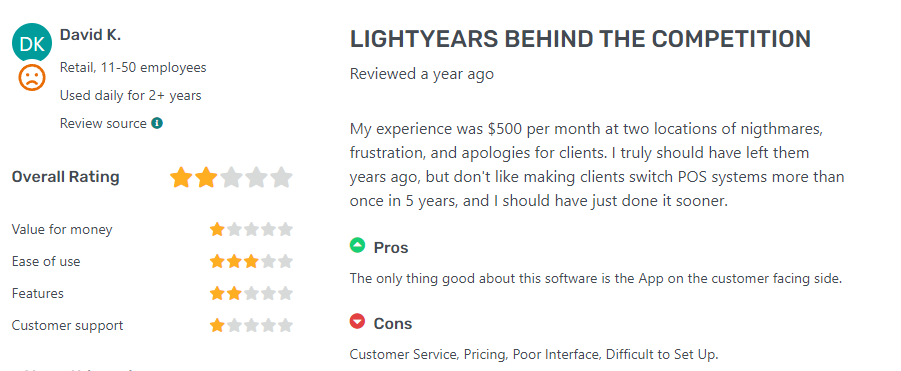
A blended average hides the story here. The operator software and the consumer app get rated by different people for different reasons.
Key figures, as of September 2026:
- Capterra: 4.0/5 across roughly 2,980 verified reviews (Capterra's own pages show 2,982 and 2,993 depending on where you look)
- Capterra sub-scores run features 4.0, ease of use 3.9, customer service 3.8, value for money 3.6
- 67% of Capterra reviewers rate value for money as good or excellent
- G2: 3.7/5 across roughly 527 to 566 reviews, with 85.1% of reviewers from small business
- G2 sub-scores run meets requirements 7.9/10, quality of support 7.8/10, ease of use 7.6/10, ease of admin 7.3/10, ease of setup 6.9/10, product direction 6.5/10
Capterra's sentiment split runs 2,237 positive, 359 neutral, and 386 negative. So roughly three quarters of reviewers are content, and the unhappy quarter is loud, specific, and consistent.
The star breakdown on the sibling Software Advice profile is 1,435 five-star, 808 four-star, 359 three-star, 141 two-star and 247 one-star. That one-star cluster is unusually large for a platform this established.
Value for money at 3.6 is the lowest score on the Capterra profile. Nothing else on the card drops that far, which tells you the complaint is about price, not capability.
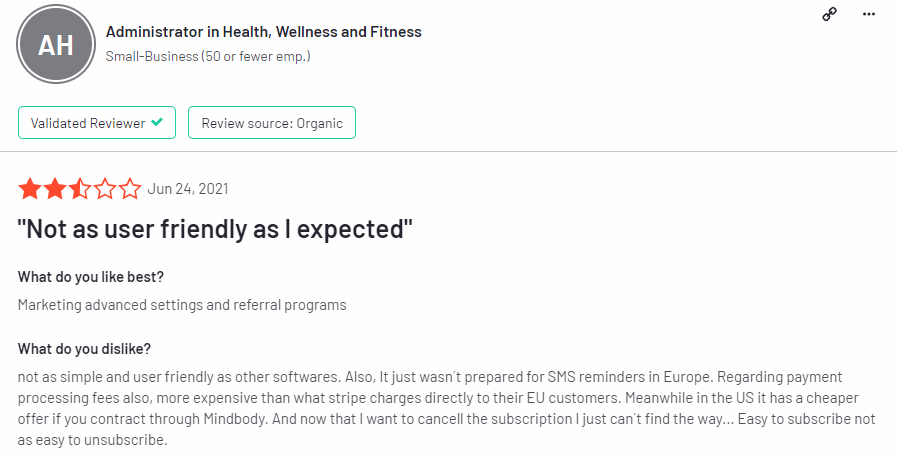
On G2, product direction at 6.5 and ease of setup at 6.9 are the two weakest numbers. Onboarding is where the goodwill from the sales call gets spent. Product direction is where long-tenure operators register how they feel about the changes being made around them.
What Do Mindbody Users Praise Most?
Consolidation, mostly. One system holding bookings, member records, payments, retail, and payroll, instead of four tools duct-taped together.
The positive reviews come mostly from established multi-location operators rather than solo practitioners, and they keep landing on the same ground.
Reporting depth is the one owners name first. Attendance breakdowns by class type, inactivity flags for members who have gone quiet, automated anniversary emails, churn prediction. Owners who run on data call this the reason they stay.
Marketplace discovery is second. Mindbody reports more than 3 million active users searching and booking on the app. In a dense urban market, that is a real acquisition channel rather than a vanity number.
Then there is sheer feature surface area. Two decades of development shows in complex class types, multi-service scheduling, and resource management that smaller platforms cannot match at the high end. Capterra's features sub-score of 4.0 is the highest of its four secondary ratings.
Mindbody's own case library cites East Austin Athletic Club using the platform to cut payroll admin time and drive a 15% business gain. Vendor-published cases are directional, not independent.
For salon and spa operators specifically, the appeal is that it replaces the whole stack. Owners weighing it against other all-in-one salon platforms are choosing between breadth and price, not between features.
What Are the Most Common Complaints?
The same themes repeat across Capterra, G2, and Better Business Bureau filings, and they are remarkably stable year to year.
| Complaint | What reviewers describe | Who it hits hardest |
|---|---|---|
| Pricing opacity | Quote-only tiers, increases at renewal | Single-location studios |
| Support quality | AI chat first, slow path to a human | Everyone, worst outside the US |
| Contract lock-in | No mid-term exit, sales framing felt misleading | New signups inside a fixed term |
| Unused depth | Paying for modules never opened | Solo instructors, small gyms |
The support experience described in reviews
Chatbot, then a ticket, then a help article telling you to fix it yourself. That sequence comes up again and again.
One Capterra reviewer with 2+ years on the platform describes a subscription past $1,000 CAD monthly alongside replies that arrive as AI responses or links to documentation.
Account rep turnover comes up repeatedly too, with owners reporting they found out their rep had left only when nobody answered.
Capterra's 3.8 customer service score is the second-lowest number on the profile, and it has not moved meaningfully across recent review cycles. G2 scores support slightly better at 7.8 out of 10, which fits the pattern. Routine questions get answered. Complex or billing-related ones do not.
Interface changes and platform-side decisions
Reviewers report frequent changes to the back office, login flows, and staff permissions, with several describing permissions narrowing while pricing went up. The 2025 Universal Login rollout drew a particularly sustained round of complaints.
One long-tenure Capterra reviewer describes a 300% price climb across their time on the platform, ending with fewer permissions than they started with.
The tension underneath all of this is that the platform optimizes for the marketplace and for enterprise accounts. Small operators experience those decisions as changes done to them rather than for them. The launch of Kite as a separate enterprise product in April 2026 is worth watching here, since it moves the largest franchise accounts onto different software and leaves Mindbody serving the single-brand middle.
What Are the Contract Terms and How Do You Cancel?
Mindbody's published Terms of Service set a 90-day initial term with automatic renewal in successive 30-day periods, unless an Order Form specifies otherwise. That last clause is the whole story.
The term reviewers actually run into sits in the Order Form, not the Terms of Service. Capterra and BBB complaints describe 12-month and 24-month fixed terms signed through DocuSign during onboarding, and a January 2026 Capterra review is titled around a $1,200 one-year contract.
Two documents, two answers. The public terms read month-to-month after 90 days. The signed Order Form governs, and it frequently does not.
Mindbody's own March 2026 guidance confirms both readings. Unless you are on a fixed-term commitment, you can generally cancel after the 90-day minimum with 30 days' notice. If you signed a fixed term, cancellation is not available mid-term.
The Terms of Service state that early termination leaves you responsible for all fees owed for the entire subscription term, that payment obligations are non-cancelable, and that fees paid are non-refundable.
The support documentation requires at least 30 days' notice before the end of the relevant subscription term, and states that cancellation dates discussed with support or the chatbot are tentative until internal review approves them.
So if you are leaving, do it in this order:
- Find your Order Form. It was emailed at signing and sits in your DocuSign account. Request a copy from support if you no longer have it.
- Read the term length and end date on the Order Form, not the Terms of Service. That is the date that governs.
- Submit written cancellation at least 30 days before that end date, stating clearly whether you are cancelling the full subscription or a single add-on.
- Get written confirmation. Chat and phone confirmations are explicitly tentative until internal approval.
- Keep the email thread. BBB records show disputes resolved when the operator produced documentation of a prior written request.
Two more things on timing. Partial service periods are not processed, so cancelling mid-cycle does not shorten the bill. And once the account closes, you and your clients lose access, though Mindbody allows reactivation within 90 days of the cancellation date.
The promotional discount is where the sharpest complaints originate. Multiple BBB filings describe operators who accepted a months-free offer, tried to cancel within hours or weeks, and were held to a full 12-month term regardless.
Who Is Mindbody Right For?
Mindbody suits established multi-location operators with staff, rooms, retail and memberships to coordinate. It suits them best when someone other than the owner runs the back office.
The platform assumes an administrator exists. That single assumption explains most of the fit and most of the mismatch.
The fit is strongest for:
- Spas, medical spas and salons with service menus, rooms and equipment to book against each other
- Multi-location businesses needing datashare, cross-site staff permissions and IP restrictions on logins
- Studios in dense urban markets where consumer app discovery brings clients a website never would
- Operations selling memberships, packages, retail and gift cards through one point of sale
- Owners who make decisions off attendance and retention data rather than instinct
There is a rough revenue floor to it. Once monthly subscription plus processing drops below roughly 2% of revenue, the cost argument mostly disappears and the feature depth starts paying for itself.
Integrative health clinics and wellness centres running mixed appointment and class schedules also land here, because few competitors handle both cleanly in one calendar.
One caveat that never shows up in the sales deck. Feature depth only converts to value if staff actually learn it, and the platform is not learnable in an afternoon.
When Mindbody Stops Being Worth the Cost
Mindbody fails hardest for solo practitioners, referral-driven businesses, and programming models the platform was never built around. Not because the software breaks, but because you pay for surface area you never open.
| Situation | Why it fails | What happens instead |
|---|---|---|
| Solo instructor, one room | Enterprise depth, enterprise price | Most modules never opened |
| All clients from referrals | Marketplace commission with no upside | Paying for discovery you already did |
| CrossFit box, martial arts school | Programming and belt tracking not native | Workarounds in spreadsheets |
| Needs marketing, small budget | Campaign tools sit on the top tier | Buying an external email tool anyway |
The referral-driven case deserves its own line. If your clients arrive through word of mouth and Instagram, the marketplace listing adds nothing and the commission structure is pure drag.
Capterra reviewers repeatedly describe onboarding stretching toward eight weeks before the system is genuinely usable. For a business with 40 clients and one instructor, eight weeks of setup against a platform you will use 20% of is a bad trade at any monthly price.
Martial arts schools and CrossFit boxes hit a different wall. Belt progression, benchmark workouts and WOD tracking live in purpose-built platforms, and Mindbody handles them by not handling them. G2 does not even list Mindbody in its Martial Arts Software category.
A single instructor with a class or two per week gets further with one of the free booking systems available than with any tier of this platform.
What Are the Best Mindbody Alternatives?
The alternatives split by vertical, not by price. Salon and spa operators leave for a different set of platforms than studio and gym operators, and solo practitioners leave for a third set entirely. A fourth group leaves the commission model behind altogether.
| Platform | Capterra rating | Entry price | Best fit |
|---|---|---|---|
| Trafft | 4.9 (49 reviews) | Free, then $29/mo | Flat monthly bill, no commission, any vertical |
| Amelia | 4.9 (246 reviews) | $49/year | Booking that lives on your own WordPress site |
| WellnessLiving | 4.4 (604 reviews) | $69/mo flat rate | Direct Mindbody replacement, studios |
| Vagaro | 4.7 (3,653 reviews) | $23.99/mo, per bookable calendar | Salons, barbershops, small spas |
| Boulevard | 4.6 (364 reviews) | From $158/mo | Salons and med spas wanting front-desk polish |
| Mangomint | 4.9 (298 reviews) | From $165/mo | Salons and spas prioritising usability |
| Zen Planner | 4.3 (268 reviews) | From $99/mo | Gyms, martial arts, CrossFit |
| ABC Glofox | 4.4 (356 reviews) | Quote only | Boutique studios and small chains |
Every one of those ratings sits above Mindbody's, which is less damning than it looks. Smaller review pools skew high, and a platform with nearly 3,000 reviews carries two decades of accumulated grievance that a five-year-old competitor has not had time to collect. Trafft's 49 reviews and Amelia's 246 are worth reading with that in mind.
A fuller shortlist of platforms operators move to after Mindbody is worth building before any sales call, because the quote you get depends on what else you have priced.
Alternatives that skip the commission entirely
Neither of these has a consumer marketplace. That is either the whole point or the reason to stop reading, depending on where your clients come from.
Trafft
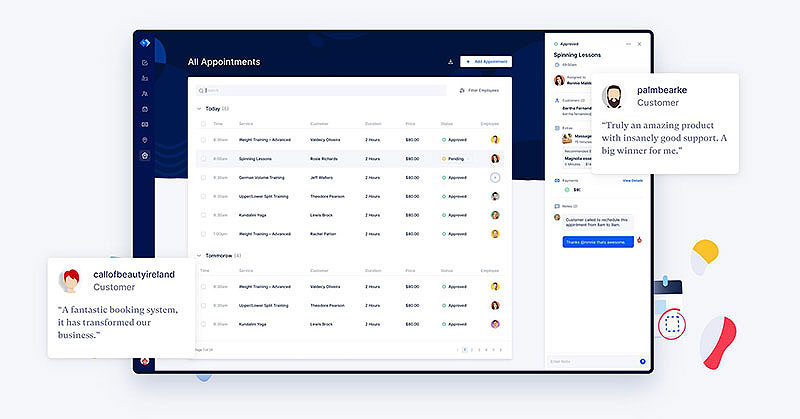
Trafft publishes a free tier for one user, one location and 100 appointments a month, then Mini at around $29 for 3 users, Growth at $59 for 5, Professional at $99 for 15, and Business at $149 for 30. Annual billing knocks off roughly 25%.
No commission on anything, no per-booking fee, no add-on maths at renewal.
Against Mindbody's $99 Starter and quote-only upper tiers, the appeal is that the price is on the website and stays there. Professional and Business carry unlimited locations, so a two-site studio does not trigger a second subscription. There is also a white-label build for agencies managing accounts on behalf of clients, and a fitness and sports setup aimed at studios specifically.
Amelia
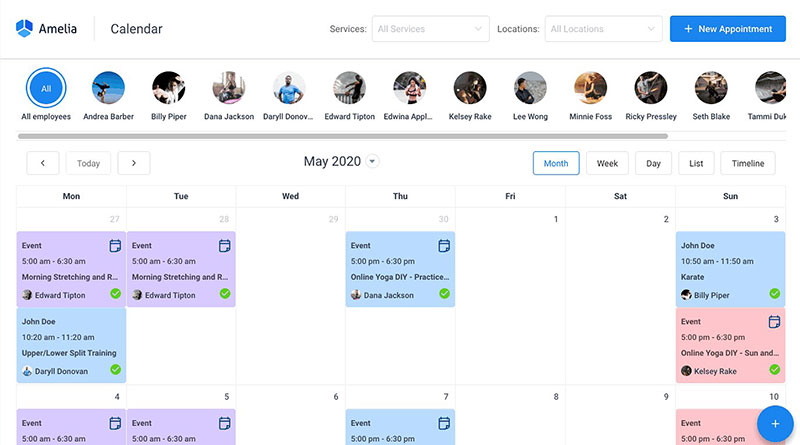
The outlier here, because it is not SaaS at all. Amelia is a WordPress plugin licensed per domain: Starter $49 a year, Standard $89, Pro $149 for five domains, Elite $259 for unlimited, with lifetime licences on the upper tiers.
For a studio already running a WordPress site, that is a rounding error next to $99 a month. The trade is that you maintain it.
Check the tier ladder before you buy. Multiple payment gateways start at Standard, and calendar sync, Zoom and event tickets sit on Pro, which is where most studio deployments land. Instructors checking schedules from the floor work through the WordPress backend or the business mobile app.
What you lose moving to either: marketplace discovery, and the deeper membership and payroll machinery Mindbody carries. Trafft handles recurring appointments and packages fine. Neither is built for complex membership contracts.
Alternatives for studios and gyms
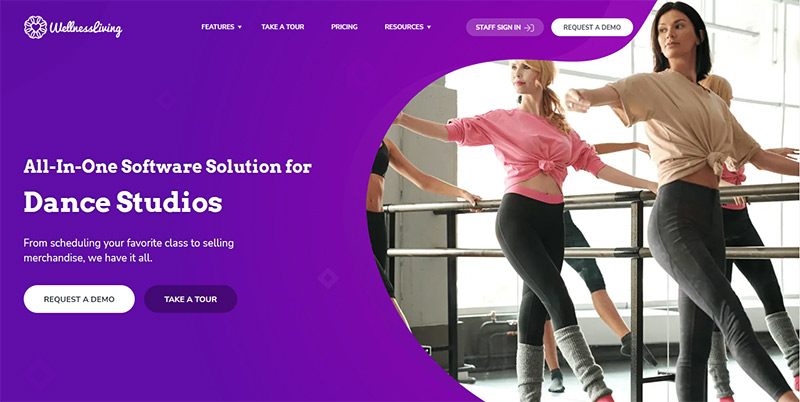
WellnessLiving is the most common landing spot. It was built as a direct competitor, publishes a $69 entry price, and its onboarding team runs standard Mindbody migrations with spreadsheet templates supplied up front. On G2 it beats Mindbody by 1.8 points on ease of setup (8.6 versus 6.9) and 1.2 points on quality of support (9.0 versus 7.8), which maps precisely onto Mindbody's two weakest scores.
Zen Planner publishes tiers starting at $99 per month and lands with gyms and martial arts schools that need member management more than marketplace reach.
ABC Glofox stays quote-only, which reproduces the pricing opacity problem. Its Capterra customer service score sits well above Mindbody's 3.8, though, and it outscores Mindbody on every G2 dimension.
Operators weighing Glofox against Mindbody usually come down to one question. Does marketplace discovery bring you enough clients to justify the difference?
Momence and Walla both target boutique studios with flat monthly pricing and no consumer marketplace, which is either the point or the dealbreaker depending on where your clients come from.
Alternatives for salons and spas
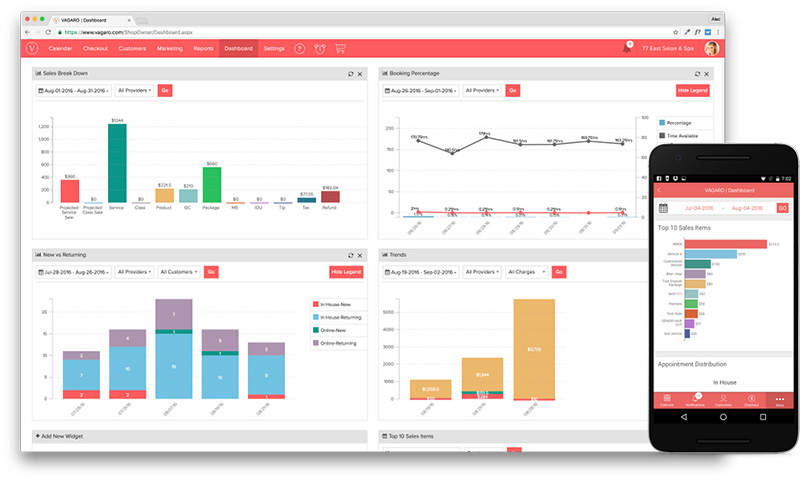
Vagaro holds 4.7 across 3,653 Capterra reviews, the largest verified review pool in the category and the most common destination for hair and beauty businesses. Worth noting that Vagaro added opt-in marketplace booking fees of its own in July 2026, so the "no commission" argument for switching no longer holds cleanly.
Boulevard sits higher up the market at $158 per month, aimed at salons and med spas where the front desk experience is part of the brand.
Mangomint scores 4.9 across 298 reviews from $165 per month, with the strongest value-for-money rating of any platform in this comparison at 4.8 and a perfect 5.0 for customer service.
Understand the trade before you move, though. Boulevard and Mangomint have no consumer marketplace. You keep 100% of every new client's first purchase, and you also do 100% of the work finding them. If a flat bill is the goal, Trafft's salon setup and Amelia's WordPress route sit well below all three on price.
Alternatives for solo practitioners
GlossGenius holds 4.8 across 348 Capterra reviews at $28 per month billed monthly or $24 billed annually, built for independent stylists and estheticians. US only.
Acuity Scheduling and Square Appointments are appointment-only tools with no class or membership machinery, and Square carries a genuinely free tier. Trafft's free tier belongs on this shortlist too, since 100 appointments a month covers a lot of one-person practices without a card on file.
Moving to any of them costs you resource scheduling, complex class types, payroll, and the reporting depth that made Mindbody worth considering in the first place.
For a one-person business, that list is not a loss. It is a description of features that were never going to get used.
How Do You Export Your Data and Move Off Mindbody?
Client records, contact details and visit history export cleanly to Excel through the Reports area. Stored payment credentials are the problem, and they are the reason migrations stall.
Sources disagree on card data, and the disagreement matters. Boulevard's migration documentation states Mindbody can perform a CSV export including unencrypted credit card data for a fee. Independent migration guides published in 2026 state flatly that card data does not transfer between systems because of PCI rules, and that members must re-enter cards.
Treat the second position as your planning assumption and the first as something to ask about in writing. Plan for members re-adding cards, and treat any card-on-file transfer as an unexpected win.
Budget for an export fee as well. Operators on Reddit and in BBB filings consistently report a charge around $500 for a full machine-readable data export at cancellation. It is not published, so ask about it in writing before you sign, not when you are leaving.
The migration sequence that works:
- Pull the client export first. Reports, then Clients, then Mailing List, then Export to Excel.
- Export appointment and class history using the Schedule at a Glance report, with the Scheduled By option switched on if available.
- Run a membership and auto-pay audit: active contracts, billing dates, credits, frozen accounts, and outstanding class pack balances.
- Pull a gift card liability report. Outstanding balances are a real debt and they do not migrate themselves.
- Pull twelve months of marketplace attribution before you lose access, so you know what the commission was actually buying.
- Pick a go-live week from the quietest stretch of your calendar, never a January or a September.
- Email members twice: two weeks out explaining the move, and on cut-over day with the new booking link and the card re-entry instruction.
Watch the calendar horizon. Most platforms will not import a schedule booked more than twelve months out, so a retreat already on the books gets rebuilt by hand.
Cancel only after the new system is live. Rebuilding your online booking setup takes longer than the sales call suggested, and the notice period runs in parallel whether you are ready or not.
What Integrates With Mindbody, and What Does Not?
Mindbody runs a public integrations marketplace with connectors across payroll, access control, marketing, accounting and reputation management. The gaps are specific and predictable.
Its integrations marketplace claims businesses using integrations earn 10% more revenue and see 40% more bookings than those that do not. That is a vendor figure and should be read as one.
Native and well-supported:
- Payroll through ADP, Paychex and Exact Payroll
- Marketing through Mailchimp, Constant Contact, Perkville, Meta Ads and Google Ads
- Door access and turnstile hardware for gyms running unstaffed hours
- Reserve with Google, so classes book directly from Search and Maps
Accounting runs through Bookkeep, the marketplace connector that posts daily sales and payment summaries into QuickBooks Online, Xero, Zoho Books, NetSuite or Sage Intacct. Without it, the standard workflow is a monthly sales report reformatted in a spreadsheet by hand.
Zapier is not a first-party integration. The connection is reported to run through a third-party webhook bridge, which is a distinction worth confirming before you promise your team an automation.
Payments sit outside the integration question entirely. Mindbody Payments is proprietary and cannot be swapped.
One thing to watch after the EGYM merger. Playlist is consolidating AI tooling across its brands, and the Terms of Service now name usage-based services including SmartDesk, other AI tools and Attentive. Anything priced per use is worth pinning down in a quote rather than assuming it is bundled.
Studios that need something the marketplace does not cover end up buying workflow automation tools to bridge the gap, which is a real cost line nobody quotes you.
How to Evaluate Mindbody Before You Sign
Get everything in writing before the discount expires. Every complaint pattern in the reviews traces back to something a buyer accepted verbally.
- Request the quote itemised: tier, per-location count, every add-on, and the processing rate in writing. A verbal rate is not a rate.
- List your five must-have features and ask which tier each one sits on. The marketing tools you were shown in the demo may be two tiers up.
- Ask for the term length and the exact end date before signing, and read the Order Form rather than the public terms.
- Ask what a data export costs at end of contract, in what format, and whether card tokens are included. Get the number, not a reassurance.
- Ask which AI product your quote covers, since AI Concierge, Messenger[ai] and SmartDesk are all live names with different pricing treatment.
- Model the commission against your real new-client mix. If 80% of clients come from referrals, marketplace reach is worth close to nothing to you.
- Price two alternatives on the same feature list before the call, so the quote has something to sit against.
One question changes the conversation more than the others. Ask what your monthly total will be at renewal, not at signing. Reviewers describe the gap between those two numbers as the reason they left.
Skip the promotional discount if it extends the term. A few free months against a longer lock-in is the trade that produces most of the complaint filings.
Run the same feature list past two or three scheduling platforms worth shortlisting before you take the demo. Walking in with comparison pricing changes what you get quoted.
FAQ on Mindbody Reviews
Who owns Mindbody now?
Mindbody is a brand inside Playlist, which also owns Booker, ClassPass, EGYM and Kite. Playlist completed a $7.5 billion merger with EGYM on 31 March 2026, backed by $785 million in new equity led by Affinity Partners. Vista Equity Partners, which took Mindbody private in 2019, is now one investor among several rather than the sole owner.
Is Mindbody the same product as ClassPass, Booker or Kite?
No. Playlist owns all four, but each runs as a separate product with its own pricing and terms. Booker serves salon and spa accounts, ClassPass is the consumer class-pass marketplace, and Kite, launched in April 2026, is the enterprise platform for multi-brand franchise operators.
What is the difference between the Mindbody app and the Mindbody business software?
The consumer app is where clients search, book and buy. The business software is the browser-based back office where owners manage scheduling, point of sale, client records and payroll. Different audiences, different logins, different fee structures.
Why does onboarding take so long?
Migration runs through discovery, data mapping and import, system configuration, a parallel run, staff training, then client communication. Rebuilding pricing options, memberships and auto-pay contracts accurately is the slow part, not the software install itself. G2's ease-of-setup score of 6.9 is Mindbody's second-weakest rating for a reason.
Does Mindbody offer a free trial or a free plan?
No free version exists. G2's 2026 data records no free plan and no free trial, while some third-party listings report a credit-card-required trial that converts automatically. Get trial terms confirmed in writing before signing anything.
Can you negotiate the quoted price down?
Yes. No tier now carries a reliably published figure, so every quote is built by a sales rep and varies by configuration. Priced alternatives in hand change the number. Refuse discounts that extend the term.
What Should You Check First Before Committing to Mindbody?
Check the Order Form term length before anything else, because Mindbody pricing, tier gating and marketplace commission all stop being negotiable the moment that document gets signed. Every other part of the evaluation stays reversible.
The order of operations matters more than the shortlist:
- Term length and exit terms first, including the data export fee
- Tier placement of your must-have features second
- Commission modelled against your real client mix third
Term first, because it is the one clause no renegotiation reaches later. Tier placement second, because it sets the actual monthly figure rather than the quoted one.
What you accept in exchange is marketplace reach against per-location billing and no control over your processor.
Ownership, tier packaging and add-on structure verified September 2026. Mindbody's position inside the merged Playlist-EGYM group is new enough that pricing and product bundling are still moving; a published price on Accelerate would change this position.
Operators building the salon-side shortlist usually read what Vagaro users report next.