




How much do barbers make is a question that resolves to a pay range set by chair occupancy, pay model, and location rather than one fixed number.
The figure changes by pay model: an employee draws a wage plus commission and tips, while a booth renter keeps the full ticket and pays rent, product, and taxes out of it.
That spread comes from chair occupancy and pay structure, not from skill or years behind the chair.
How Much Do Barbers Make?
The median barber in the U.S. earns $38,210 a year, or $18.37 an hour. That comes from the Bureau of Labor Statistics Occupational Employment and Wage Statistics release for May 2025, occupation code 39-5011.
Don't take that number at face value. It mixes base or hourly pay with commission on services and tips. For anyone renting a chair, it also includes whatever is left after rent. Those behave very differently, and one figure hides that.
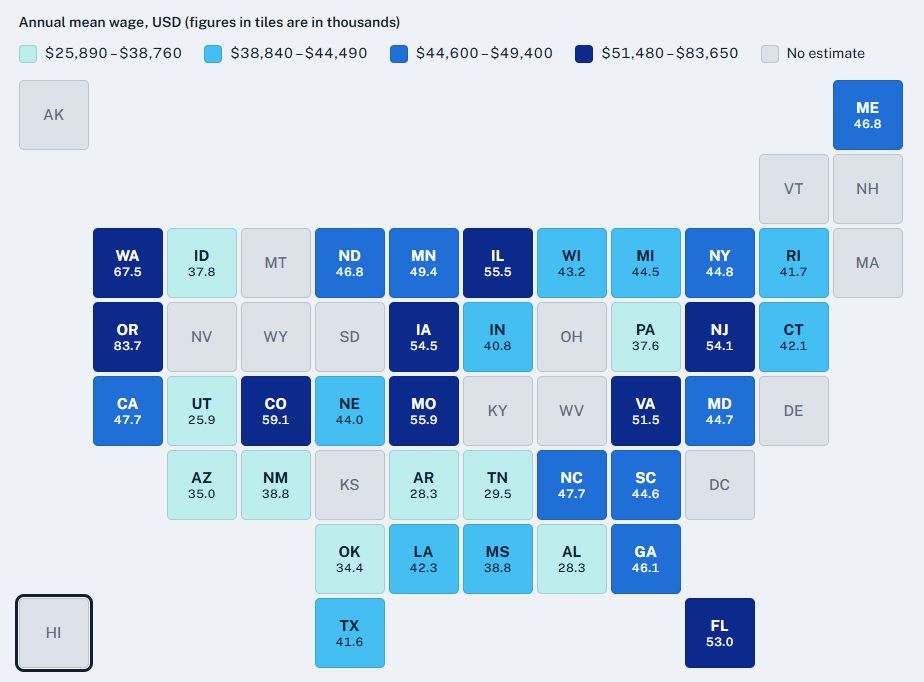
Average annual wage of barbers, by state, May 2025
Here's the rest of the barber data from that release (BLS OEWS, May 2025):
- Median annual wage: $38,210
- Mean annual wage: $47,070
- 10th percentile: $28,600
- 90th percentile: $76,460
- Employed barbers counted: 15,000
The mean is almost $9,000 higher than the median. That usually means a small group at the top is pulling the average up, and in barbering that group is easy to picture: a few people with full books charging premium prices.
The 15,000 headcount is smaller than it looks, too. It only counts barbers on somebody's payroll.
What Is a Barber’s Hourly Rate?
At the 10th percentile it's $13.75. At the 90th it's $36.76, and the median lands at $18.37 (BLS OEWS, May 2025). So the top tenth earns roughly 2.7 times what the bottom tenth does. Most personal care jobs don't spread out that much.
| Percentile | Hourly | Annual |
|---|---|---|
| 10th | $13.75 | $28,600 |
| 25th | $15.18 | $31,570 |
| 50th (median) | $18.37 | $38,210 |
| 75th | $28.35 | $58,960 |
| 90th | $36.76 | $76,460 |
Hourly framing has a problem, though. Booth renters don't have an hourly rate. They charge per service and pay rent whether the chair is busy or empty.
The hours don't line up either. Time between appointments, slow walk-in stretches, cleaning the station, restocking neck strips. None of it is paid, and it happens every single day.
What Counts as Barber Income?
For an employee, money comes in as base or hourly pay, commission on services, tips, and a smaller commission on retail product. Booth renters swap the first two for gross service collections and pay rent out of that.
Wages, commission, and tips
Base pay is a set rate for time on the clock, and it shows up on Form W-2. Service commission is a percentage of the ticket total, paid by the shop.
Tips are voluntary. The client pays them, and under federal law they belong to the barber.
Then there's retail commission, a cut of the pomade, beard oil, and clipper guard sales at the front counter. It's pocket money for most people. Wage surveys pick up the first three fairly reliably, while retail commission gets folded in or left out depending on how the shop runs payroll.
Why booth rent revenue is not a salary
A renter collects 100% of the ticket and then starts paying out. Rent, product, card processing, insurance, license renewal, self-employment tax. All of it comes off the top before anything counts as take-home.
So when a barber says they "make $90,000," they may be quoting gross collections that net out closer to $55,000. Neither number is wrong. They just measure different things.
This is a big reason the aggregator sites and the federal figure disagree so loudly. OEWS surveys employers and states plainly that self-employed workers are excluded. Job-board averages throw posted ranges, self-reported gross, and tips into one figure and don't label any of it.
Which States Pay Barbers the Most?
On mean annual wage, the District of Columbia came out on top at $89,810 (BLS OEWS, May 2023). Washington was next at $61,830, then New York at $49,700. Utah, at $29,660, sat near the bottom of the states with published data.
| State | Hourly mean | Annual mean | Employment |
|---|---|---|---|
| District of Columbia | $43.18 | $89,810 | Not released |
| Washington | $29.73 | $61,830 | 660 |
| New York | $23.90 | $49,700 | 1,370 |
| Texas | $21.21 | $44,120 | 2,670 |
| Utah | $14.26 | $29,660 | 330 |
Metro numbers say more than state lines do. In the same release, Seattle-Tacoma-Bellevue paid a mean of $63,010 and Salt Lake City paid $28,410.
A couple of warnings before anyone books a U-Haul.
- A high mean usually tracks cost of living, not opportunity. The Washington premium looks smaller once Seattle rent enters the maths.
- Small samples produce unstable medians. When BLS reports 330 barbers in a state, one high-end shop moves the number.
Texas has more barbers than any other state. It pays below Washington and above Utah, which is about what you'd expect with a big population and moderate costs.
How Do Barber Pay Structures Work?
Most American shops pay barbers an hourly wage with a tip credit, a commission split, booth rent, or a hybrid that guarantees a minimum against commission. Which one you're on decides your tax form and how much of the risk lands on you. It also sets your ceiling, which people tend to ignore until they hit it.
Hourly and guaranteed minimum
Under the Fair Labor Standards Act, an employer may pay a tipped worker a cash wage as low as $2.13 an hour and claim a tip credit of up to $5.12, provided wages plus tips reach the $7.25 federal minimum every workweek (DOL Fact Sheet #15). A tipped employee is defined as one who customarily receives more than $30 a month in tips.
This setup makes sense when you're new, don't have a book yet, and need rent money you can count on. Once your book fills up it stops working for you, because the hourly rate pays nothing extra for the extra volume.
Plenty of states remove the tip credit entirely and require full state minimum wage before tips. Check the state rule, not the federal floor.
Commission split
The shop takes a percentage of every service ticket and covers the fixed costs out of its share: lease, utilities, product, reception, walk-in marketing, and payment processing.
The nice part is that a slow week costs you nothing. The shop buys product and handles the front desk, and since you're on W-2, the employer pays half the payroll tax.
What you give up is bigger than it sounds. The split applies to every dollar you bring in, forever. The shop sets the price menu, and the schedule usually belongs to them as well.
Shops running commission need the numbers tracked cleanly, which is where barbershop management software earns its keep at payroll time.
Booth rent
Booth rent makes the barber a tenant. You keep the full ticket and set your own prices, and you owe a flat fee whether you cut 40 heads that week or 4.
The ceiling is yours, and every extra client is worth full value. But the rent is due in January. January is slow.
If you're weighing a chair, read the agreement the way a tenant reads a lease, because that's what renting a booth legally is. Look for who supplies towels, who owns the client list, and how much notice you need to give.
Hybrid and employee-versus-contractor status
Hybrid deals pay hourly against commission, and you get whichever is higher that pay period. You see these a lot with barbers building a book inside a busy shop.
| Model | Tax form | Who sets prices | Who buys product |
|---|---|---|---|
| Hourly or commission | W-2 | Shop | Shop |
| Booth rent | 1099-NEC and Schedule C | Barber | Barber |
| Hybrid guarantee | W-2 | Shop | Shop |
The real risk here is misclassification. A shop that dictates hours, prices, and product while paying 1099 has a contractor on paper and an employee in practice.
How Much Do Barbers Make in Tips?
Tips come from the client, they're voluntary, and they belong to the barber, not the shop. The average amount is harder to pin down. No federal survey publishes a gratuity percentage for barbershops, so any single tip figure you see online came from a vendor poll rather than a measured sample.
The tax side is documented, and it changed recently.
The One Big Beautiful Bill Act, signed July 2025, created a federal income tax deduction of up to $25,000 a year in qualified tips for tax years 2025 through 2028. IRS proposed regulations released in September 2025 list 68 qualifying occupations. Barbers are in the personal appearance and wellness group.
It comes with conditions. Tips have to be voluntary, so automatic service charges don't count. The deduction phases out above $150,000 modified adjusted gross income, or $300,000 filing jointly. And self-employed barbers can't deduct more than the net income of the business the tips came from.
Card tips changed things long before the tax code did. Once a salon point of sale system prompts at checkout, the tip gets captured and recorded instead of going into a pocket.
That's good and bad. Recorded tips build a provable income history for a mortgage application. They also remove the option of a quiet cash year.
How Much Does a Barber Make per Haircut and per Day?
Start with the ticket price and take off whatever your pay model keeps. A $45 ticket on a 60/40 commission split returns $27 to the barber before tips. Multiply by the cuts you actually finish in a day and you're most of the way there.
To work out your own annual number:
- Write down your average ticket, including add-ons like a beard trim or line-up.
- Count realistic cuts per day at your service time. A 45-minute cut fills 8 slots in an 8-hour day, and nobody fills all 8.
- Multiply ticket by daily cuts, then by days worked per week.
- Apply the pay model. Subtract the commission share, or subtract weekly booth rent from the full amount.
- Add tips separately. Never blend them into the service figure.
- Multiply by 46 to 48 weeks, not 52, to account for slow periods and unpaid time off.
Step 6 is where most six-figure claims fall apart. Take a December week, when everyone books before the holidays, multiply it by 52, and you get a number that never shows up in a bank account.
Chair occupancy separates a busy barber from the published median more than skill does. Two barbers with the same prices and the same ability will earn very different money if one runs 80% booked and the other runs 45%.
No-shows quietly eat the difference. Deposits and confirmation reminders through a barber booking app recover slots that would otherwise sit empty at full cost.
The slow route to a higher number is the reliable one. Growing a client base that rebooks at the chair beats raising prices in a market that won't carry it.
Do Self-Employed Barbers Make More Than Employed Barbers?
They bring in more and keep less of each dollar. Most of that gap is payroll tax. A booth renter pays 15.3% self-employment tax on 92.35% of net earnings, while an employed barber's share of the same Social Security and Medicare contribution is 7.65%, with the employer covering the other half (IRS).
| Factor | Employed barber | Self-employed barber |
|---|---|---|
| Payroll tax borne | Half | Both halves |
| Business expenses | Not deductible | Deductible on Schedule C |
| Slow week | Shop absorbs it | Barber absorbs it |
| Unpaid time off | Possible paid leave | No income at all |
Deductions soften it. Rent, clippers, product, insurance, mileage, and software subscriptions all come off gross before tax applies, and the IRS qualified business income deduction under Section 199A allows eligible owners to deduct up to 20% of business profit.
Wage income gets none of that. A commission barber on W-2 can't deduct their shears.
So a renter grossing $85,000 and a commission barber grossing $85,000 aren't really earning the same thing. The renter pays rent, product, and both tax halves out of that number, then deducts what qualifies.
Self-employment also brings swings nobody budgets for. A flu week. A broken clipper, or a landlord raising rent mid-lease. Whatever it is, it lands entirely on the barber.
Booth Rent or Commission: Which Pays Better?
It depends on volume. Once weekly service revenue gets high enough that the rent costs less than the shop's percentage, booth rent wins. Below that, commission pays better and carries less risk.
You can run this on a napkin. Divide weekly rent by the shop's commission percentage and you get the revenue figure where the two models break even.
Say you pay $250 a week against a 40% shop share. Break-even is $625 of weekly service revenue. Under that, the rent is the more expensive option.
I'd stay on commission if you don't have a client book yet and depend on walk-ins the shop generates, or if your weekly revenue swings by more than a third between good and bad weeks. Same if you'd rather somebody else buy product and answer the phone. Nothing wrong with that.
Booth rent starts to make sense when:
- Your book is full enough that the split costs more than the rent
- You want to set your own prices and service menu
- You can cover 3 months of rent from savings before the first slow season
Slow season is where renters get caught. Rent is the same in January as it was in December, and December is the month everyone books before the holidays.
A landlord also doesn't owe you walk-ins. A commission shop pays for marketing and reception, plus a front door that brings strangers through it. That spend is baked into the percentage they keep.
How Much Does a Barbershop Owner Make?
Most independent owners get paid twice. There's the shop's profit, and on top of that there's what they bring in working their own chair. That's why owner earnings and shop profit are rarely the same figure.
Revenue per chair drives everything. A 6-chair shop is 6 revenue lines, and one empty chair is a fixed cost with no income attached.
How you run the shop changes the risk. Collect rent and your income is fixed and predictable, and so is the ceiling. A renter having a record month changes nothing for you.
A commission shop is different. Income scales with the team's output, and the workload scales right along with it. Payroll, scheduling, product buying, performance conversations. It all becomes the owner's job.
Fixed costs run whether chairs are full or not: commercial lease, utilities, liability insurance, booking software subscription, card processing, shop licensing, and towels that need replacing more often than anyone expects.
Before signing a lease, look hard at the margin structure. Barbershop profitability depends more on occupancy and fixed-cost discipline than on the price of a haircut.
Plenty of owners keep cutting because the shop alone doesn't pay them enough to stop. That isn't failure. It's how a small shop works in year one and year two.
How Does Barber Pay Change With Experience?
Pay follows the client book more than years served. A barber 3 years in with 200 regulars out-earns a barber 15 years in who never built retention, because the book decides how many chairs get filled each week.
The BLS Occupational Outlook Handbook projects employment across barbers, hairstylists, and cosmetologists to grow 5% between 2024 and 2034, adding 35,300 jobs to a 2024 base of 651,200. That's steady demand, not a boom. Income growth has to come from your own book.
Apprentice and first-year pay
Before any income, there are training hours. Texas requires 1,000 hours at a licensed barber school for a Class A Barber license, and the state offers no apprenticeship route (TDLR).
First-year licensed barbers usually land near the bottom quartile of the published range. Tickets are cheap and volume is low. Nobody has a rebooking habit yet, and the schedule is mostly walk-ins nobody else claimed.
If the work is good, that stage is short. It's permanent if the barber never asks anyone to rebook.
The client book as a pay variable
Rebooking rate is experience you can actually measure. Clients who book the next appointment at the chair give you a predictable schedule. A barber who waits for texts ends up with a gappy one.
Some services push the ceiling up:
- Skin fades and detail work that justify a higher ticket
- Straight razor and hot towel services that add time and margin
- Grey blending and beard colour, which most shops underprice
- Hair systems and replacement work, a specialty with a small supply of trained barbers
Income plateaus eventually. Once the chair is full at current prices, what's left is raising prices, adding a second chair, or opening a shop.
What Comes Out of a Barber’s Gross Pay?
Between the ticket total and the money you keep sit chair rent or the commission share, tools and consumables, licensing, insurance, software and card processing, and quarterly estimated tax.
Tools are the obvious one. Clippers, trimmers, shears, guards, blades, capes, neck strips, disinfectant, and a replacement cycle that eats through them.
Licenses renew on a fixed cycle, with continuing education where the state requires it. Most shop leases and booth agreements require liability insurance in writing. Card processing takes a percentage of every transaction, and the booking subscription bills monthly on top of that.
Licensing costs changed recently in at least one large state. TDLR announced that from September 1, 2025, every Texas barber and cosmetology licensee with fewer than 15 years of licensure must complete 4 hours of continuing education at each renewal, including 1 hour of sanitation and 1 hour of human trafficking prevention, with 2 hours required for those licensed 15 years or more.
Before that date, Texas barbers renewed with no coursework at all. Rules like this vary by state, so the renewal cost in one state tells you nothing about the next.
Quarterly estimated tax catches first-year renters hardest. Nobody withholds anything, the money sits in a checking account looking spendable, and April arrives with a bill attached.
Tracking the full picture matters more than any single line, which is why itemising the expenses a service business carries beats guessing at a monthly average.
How Do Barbers Increase Earnings Without Raising Prices?
You can get more out of each available hour through rebooking, add-on services, retail, and cutting no-show loss. None of it needs a new price list.
I'd work through it roughly in this order:
- Ask for the rebooking at the chair, before the client stands up. Not by text three weeks later.
- Set a cadence per client. A 3-week fade client and a 6-week trim client need different default intervals.
- Add services that extend the ticket without extending the appointment much: line-up, beard trim, grey blending.
- Stock 3 retail products you actually use on clients, not 15 you don't.
- Take deposits on new clients and long appointments.
- Fill the dead hours first. Tuesday at 2pm is cheaper to fill than Saturday at 11am is to add.
No-shows are the quiet earner. An empty 45-minute slot costs the same rent as a full one and returns nothing. Confirmation reminders plus standing repeat bookings recover most of them.
Filling your current days beats adding new ones. A barber who moves from 55% to 75% occupancy on the same 5 days earns more than one who adds a sixth day at 50%.
The slow hours take a bit of outbound effort, and simple barbershop promotion aimed at midweek slots costs less than discounting the whole menu.
When the Published Barber Salary Figures Do Not Apply
The federal figures describe employed barbers working full-time hours. That leaves out a lot of people who cut hair for a living.
Start with the sample. The relative standard error on the barber employment estimate was 17.7% in the May 2023 OEWS release, which is high enough that state and metro figures move substantially between releases.
The annual figures aren't measured, either. BLS states in its OEWS notes that annual wages are produced by multiplying the hourly mean by 2,080 hours, a year-round full-time assumption. Part-time barbers (and there are many) never earn that annual number, even when the hourly figure describes them accurately.
Then there's the second occupation code. Hairdressers, hairstylists, and cosmetologists, code 39-5012, counted 305,710 employed workers in the May 2025 OEWS release, and many of them cut hair under a cosmetology license rather than a barber license. Read only the barber code and you're seeing a fraction of the people doing the work.
Aggregator figures come from somewhere else entirely. Job boards and self-report sites draw on posted ranges and voluntary submissions with no published methodology, which is why their top-end numbers sit far above the federal 90th percentile.
So the numbers in this article describe employed barbers accurately and the trade only partly.
Use the percentile spread as a floor and a ceiling for wage work. Use your own ticket price, volume, and cost list for everything else.
FAQ on Barbers Earnings
Do barbers make more than hairstylists or cosmetologists?
Slightly. The May 2025 OEWS release put the mean annual wage for hairdressers, hairstylists, and cosmetologists at $43,960, below the barber figure. Service mix and ticket price explain most of the gap. Skill and training length have less to do with it.
How long does barber school take and what does it cost?
Each state board sets the required hours. Texas requires 1,000 hours at a licensed barber school with no apprenticeship route (TDLR). Tuition varies a lot by state and school, so check the program cost before you enroll.
Do barbers get health insurance and retirement benefits?
Employed barbers sometimes do, depending on the shop or chain. Booth renters get nothing by default. Once you file as self-employed, health cover and retirement savings are things you buy yourself, and a sick day is just an unpaid day.
Is barbering a growing job?
Yes, at a modest pace. BLS Employment Projections place growth for the barber and cosmetology group ahead of the all-occupation average through 2034. Most of that comes from replacement openings as older barbers retire, not from new shops opening.
How much do military and mobile barbers make?
Government jobs pay above the trade average. BLS reported barbers in state government, excluding schools and hospitals, at a mean of $54,770 annually in May 2023. Mobile barbers set their own rates and cover their own travel costs.
How are barber tips taxed?
As income. Employed barbers see them on Form W-2, and booth renters report them on Schedule C. The federal qualified tips deduction only reduces income tax, so Social Security and Medicare obligations stay the same.
Do celebrity barbers really make six figures?
Some do, and they sit far outside the published wage data. Those barbers usually stack premium ticket prices and a full book with brand work and product income. It describes a handful of people, not a career benchmark.
What Should You Track First in How Much Do Barbers Make?
Chair occupancy. Barber pay responds faster to the share of bookable hours you actually fill than to ticket price, pay model, or years behind the chair, and occupancy is the one variable you control week to week.
After that, track rebooking rate per client. Ticket price comes last, because raising it on a half-empty schedule shrinks volume before it lifts revenue.
There's a trade-off, and it's real. Chasing occupancy can fill the calendar with lower-value services and leave less room for the specialty work that carries margin.
The May 2025 wage estimates reached publication in May 2026, and the next annual OEWS release replaces every figure in this article, so recheck state and metro numbers each spring.
Once a barber has a full book and no price ceiling left to raise, opening a barbershop is usually what they look at next.