
A salon that takes walk-ins gets its empty chairs filled and a steady trickle of people who have never been there before. It also gets the occasional booked client stuck waiting because someone's trim ran long. A written policy is what separates those two outcomes. Most salons end up hybrid, with booked appointments as the base and walk-ins taking the gaps that cancellations and early finishes leave.
According to Zenoti's September 2025 article on hybrid salon scheduling, which cites its 2024 consumer survey, 24% of US salon clients always or usually walk in. 52% rarely or never do and would rather book ahead.
What a salon can seat without a booking depends mostly on its service mix. A trim fits between two appointments. A color service doesn't.
Walk-in appointments versus appointment-only and hybrid salons
Under a walk-in model, clients show up without a reservation and get served first come, first served. They take the next open chair or join a wait.
Booksy's June 2026 breakdown of salon booking models splits salons into pure walk-in, appointment-only and hybrid.
- Pure walk-in shops live on foot traffic and whatever is open right now. Volume is high and marketing cost is low, but capacity risk is high and income swings day to day.
- Appointment-only salons secure every slot in advance through a reservation. Revenue is predictable and premium pricing holds. The price is spontaneous customers from the neighborhood, who get turned away.
- In a hybrid, booked appointments form the financial base and walk-ins fill the gaps left by cancellations or early finishes.
A hybrid only works if the front desk can see open gaps in real time, and that is what a salon appointment booking app is for.
American Salon asked eight salons how big a share of their business comes from walk-ins. Answers ran from 1% at Expressions Salon & Spa in Cedar Rapids to 21% at Hair Xtreme Salon & Spa in Chester, Virginia.
That's twenty points between salons in the same industry, so measure your own share before copying anyone's policy.
What walk-ins add to a salon’s revenue and client base
Chairs that would otherwise sit empty get used, and some of the people in them haven't booked anywhere yet. The simplest gain is recovered chair time, since a walk-in takes the slot a cancellation or early finish left open. Other upsides come from vendor guidance.
- Booksy lists minimal long-term marketing spend as an upside of the pure walk-in model
- Square recommends routing walk-ins to novice stylists so they can grow a client list
There's no shortage of gaps. Zenoti's November 2025 article on salon booking data lists an 8% cancellation rate and a 3% no-show rate for salons, without naming the dataset behind them.
Not every cancelled slot stays empty, but the ones that do are exactly what walk-ins fill. A written cancellation policy narrows those gaps without closing them.
Walk-ins also work as an acquisition channel, which matters most for a newer salon. Square's guidance says an open-door policy suits salons that need to build a client base quickly.
Expressions Salon & Spa usually sends a welcome card in the mail and a coupon for the next visit after a walk-in. Rebooking is the real payoff, not the first haircut.
Silhouette Hair Design in Melbourne, Florida describes its walk-ins as "like found gold." Beyond the front door, there are other ways to get more clients into a salon.
What problems do walk-ins cause?
Walk-ins mean longer waits and late starts for booked clients. Workload also gets uneven between stylists. A missing policy makes all of it worse.
| Problem | What happens | Who feels it |
|---|---|---|
| Long waits | Walk-ins leave or post a bad review | Walk-in client, owner |
| Service overruns | Booked client starts late | Booked client |
| Uneven workload | One stylist absorbs the walk-ins | Stylists |
| Unwritten rules | Front desk negotiates wait times at the counter | Reception staff |
Square's guidance warns that an open walk-in policy can leave booked clients frustrated by delays, and that a day can spiral into long waits that drive customers away. Inconsistent policies add angry clients and bad Yelp reviews on top.
Booksy adds that the main frustration isn't the wait itself, it's not knowing how long it will last.
Garrison Neill of The Parker Barber books every walk-in into an appointment. In his experience, walk-ins facing a wait of about two hours are the ones most likely to take offense.
Overruns compound. One late start pushes every booked client behind it.
Which services work as walk-ins and which should be booked
Trims, men's cuts, blowouts and quick finishing work suit walk-ins well. Color and chemical services belong in the book, since they need a consultation and processing time, and often an allergy test first.
| Service | Walk-in fit | Constraint |
|---|---|---|
| Haircuts and trims | Good | Short, predictable duration |
| Blowouts and styling | Good | Fits a gap between bookings |
| Beard trims and shaves | Good | Barbers slot them between appointments |
| Color and highlights | Poor | Patch test, consultation, long processing |
| Perms and chemical treatments | Poor | Patch test, long processing |
The patch test is the hard stop. The FDA's hair dye guidance tells users to patch test before every dye job, and coal-tar dye labels carry directions for it.
Salon groups set the timing. TONI&GUY requires an Allergy Alert Test at least 48 hours before a color appointment, so a same-day walk-in cannot meet it.
Consultation adds a second hurdle. A full hairdressing consultation before color covers hair history, goals and allergy questions, and a walk-in schedule rarely leaves room for that.
Demand exists anyway. Silhouette Hair Design reported nine walk-ins asking for foils in a few days, and a request like that is a booking to schedule, not a chair to fill.
Salons that want to limit the walk-in menu have a couple of options.
- Haircuts only (Square)
- A small subset of services, or a fixed window such as 2:00pm to 4:00pm, which GoSite gives as an example
Open walk-in, appointment-only or hybrid: how to choose
Most established salons end up hybrid. Open walk-in makes more sense for a new salon or a quick-service shop, while a color-led book with premium pricing does better appointment-only.
Zenoti's September 10, 2025 article, citing its 2024 consumer survey of US clients, reports that 24% always or usually walk in, another 24% walk in sometimes, and 52% rarely or never walk in and prefer to book ahead.
Client habit and salon volume are different measures. A quarter of clients say they usually walk in, yet five of the eight salons in American Salon's poll reported single-digit walk-in shares.
| Model | Best fit | Main risk |
|---|---|---|
| Open walk-in | New salon, busy street, quick services | Volatile revenue, long waits |
| Appointment-only | Color-led book, premium pricing | Growth depends on marketing |
| Hybrid | Most established salons | Needs a live calendar and written rules |
Work through the questions below in order.
- Foot traffic. A busy street or strip mall supplies walk-ins. A side street does not.
- Service mix. If color and chemical work carry the revenue, book it.
- Chair count. Too few chairs to split into walk-in and booked zones means using hidden buffer blocks instead.
Open walk-in model
This model gives the highest volume and the lowest marketing cost, and it's the quickest way for a new salon to fill a book. The downside is that income swings with foot traffic, and a rush with no booked base to absorb it produces the longest waits.
Strong for fast, low-ticket services. Weak for anything that needs a consultation.
Appointment-only model
- Predictable day, with revenue held behind deposits or cards on file, and room for premium pricing
- Time between clients for cleaning and administrative duties (Square)
The cost is growth. Without walk-ins, new clients have to come through salon marketing and promotional incentives, according to Square.
Hybrid model
Booksy says a well-built hybrid can hold seat utilization close to 90%. That is a vendor claim with no source given, not a measured industry benchmark.
A hybrid asks more of the front desk.
- A live calendar the front desk trusts
- Written walk-in rules, plus a stylist or rotation assigned to walk-ins
How to manage walk-ins alongside booked clients
Most of the work happens before the first walk-in comes through the door.
- Pull recent calendar data and mark the slow windows.
- Reserve those windows for walk-ins, or add hidden buffer blocks where chairs cannot be split.
- Name the default walk-in stylist or set a rotation.
- Write the priority and lateness rule for the front desk.
- Pilot with one team or one service first (the advice in Zenoti's September 2025 hybrid scheduling guide), then check wait times weekly.
Walk-in hours and reserved slots
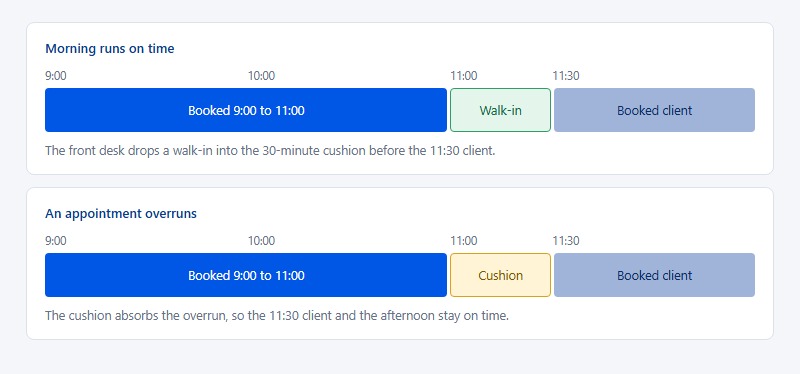
Booksy describes a cushion method. Buffer blocks sit in the backend calendar and stay hidden from public booking.
Say a stylist is booked 9:00 to 11:00, then holds a 30-minute cushion before the 11:30 client.
If the morning runs on time, the front desk drops a walk-in into the cushion. If an appointment overruns, the cushion absorbs it and the afternoon stays intact.
Assigning stylists and handling commission
American Salon's barber roundup (originally published in 2017) shows how differently barbers decide who takes the walk-in.
- Jessica Zeinstra recommends giving walk-ins to the barber with the week's best numbers, as a reward
- Garland Fox fits them between appointments, mostly around shorter services such as a shave
- Kelly Bileddo uses a software retention report to pick the barber most likely to keep the client
- For Garrison Neill, it goes to whoever has time for the service the client wants
Some salons also give walk-ins to newer stylists and keep established ones on their booked clients, a tactic Square recommends.
Commission is where disputes start. In reader comments on a Behind the Chair article, views split: one commenter's salon takes a one-time commission split on a walk-in's first visit, after which the client belongs to the stylist, while another commenter's owner took nothing.
Settle it in writing before the first walk-in arrives. A booth rental arrangement needs the clearest wording, because the renter pays for the chair, not a share of each service.
Priority and lateness rules
Booked clients go first, as long as they arrive on time.
Zeinstra runs a strict late policy. Once a booked client is 10 minutes past the start time, she takes the walk-in and the late client waits.
The exact number matters less than having one, posted and applied the same way every time.
How to set a walk-in policy and run the queue
The policy should say which services walk-ins can book, the daily cutoff, the estimated wait and what happens when the salon is full.
Writing and posting the policy
Set the cutoff at your longest walk-in service plus the buffer, so a late arrival never runs past closing.
Then put it where walk-ins decide whether to come in.
- Window or door sign
- Online booking page and Google Business Profile hours
Google's Business Profile help describes special hours as temporary changes to your regular hours, such as for holidays or events, and says closures of up to six days in a row fit special hours.
Here is plain wording to adapt. Fill in the hours and the cutoff for your own salon.
Walk-ins are welcome from [start time] to [end time]. Haircuts, trims, blowouts and beard trims can be booked on the spot. Color, highlights, perms and chemical treatments need an appointment. Booked clients are seen first, and a booked client who is 10 minutes late waits for the next opening. The last walk-in is taken at [cutoff time]. When the salon is full, we offer the next open slot or a place on the waitlist.
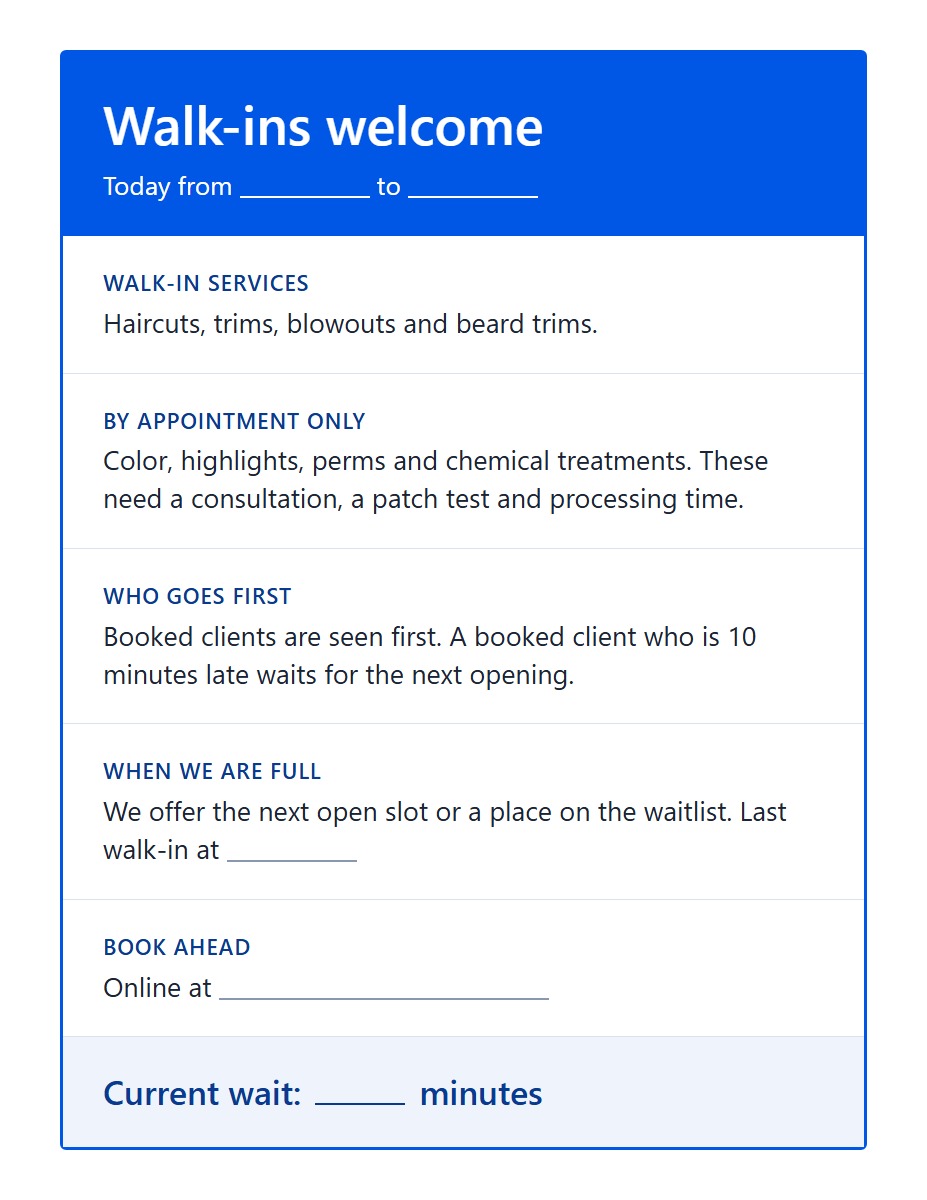
The same wording works as a sign for the door. Print it, fill in the blanks and update the current wait as the day shifts.
Keeping walk-ins from leaving during a wait
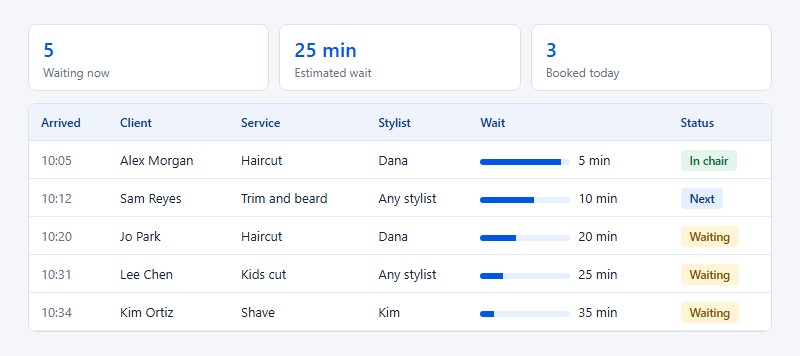
Zenoti's 2024 consumer survey names waiting for an appointment as the biggest frustration for 45% of clients.
The most direct fix is showing the wait. Meevo's Walk-In Manager Display lists the queue order and current wait on a screen in the salon.
- Waitwhile and Booksy both offer waitlists that clients can join remotely, so they can wait somewhere else
- At Aura Salonware's kiosk, a walk-in enters a phone number, picks a service and checks in, and providers choose their next client when ready
A posted wait is a promise, so update it as the day shifts.
Software for walk-in queues
Each tool below documents walk-in support differently, and the gaps matter more than the feature lists.
Whichever you pick, it should sit inside your salon scheduling software calendar, so walk-ins and bookings share one view.
| Tool | Walk-in support | Limit |
|---|---|---|
| Meevo | Walk-In Manager, kiosk, online wait list, wait estimates | Walk-in check-in is separate from appointment book check-in |
| Fresha | Appointments can be left as "Walk-in"; waitlist view in the calendar | Waitlist entries need an existing or new client |
| Square Appointments | Waitlist documented for Plus and Premium subscribers | Described for cancellation gaps; needs an online booking site |
| Vagaro | Four waitlist fill modes plus a Check-In app | Waitlist is built around filling openings, not a live line |
| Mindbody | Waitlist automations: Auto-add, or First to Claim by text | Documented for late-canceled class spots, not walk-in queues |
Feature notes reflect each vendor's documentation as of November 2026.
Of the five, only Meevo's documentation describes a live walk-in line with wait estimates. Cancellation-driven waitlists fill gaps after the fact, and they cannot tell a client standing at the door how long the wait is.
Trafft for walk-ins and booked clients
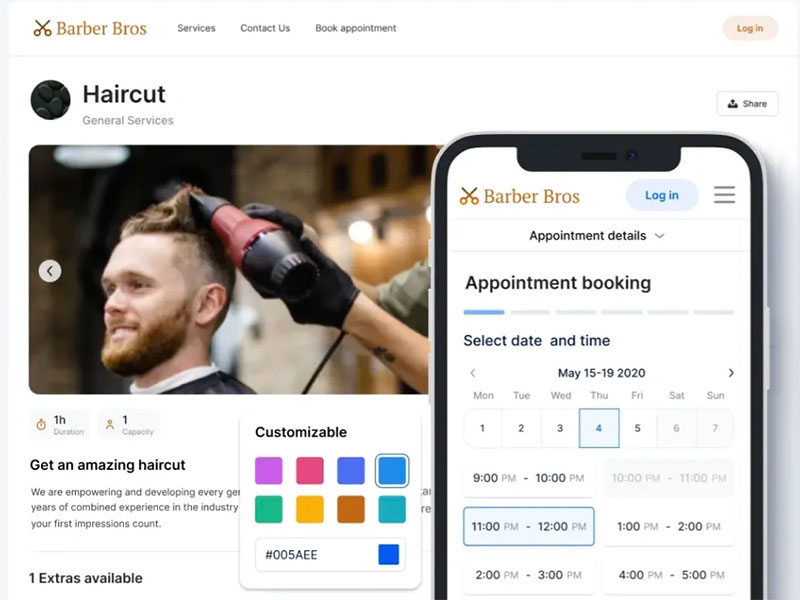
Trafft is hosted booking software from the same team that built Amelia. Its mobile app for iOS and Android lets barbers check today's list, add a walk-in to the calendar manually and reschedule from their phone, so walk-ins and online bookings share one calendar.
Working schedules are set per staff member, and special days override a person's usual hours, which helps when only some stylists take walk-ins on a given day.
When walk-ins do not work
Walk-ins fail when the salon cannot absorb a delay. Thin foot traffic is one cause, and a color-led book or a floor with no spare chair are others.
- This Ugly Beauty Business describes appointment-based salons as those outside high-traffic areas, where a walk-in is unlikely to make up a time loss
- The author of a Pure Spa Direct blog post, who runs a color business, moved to color by appointment only and argues that appointments bring more profitable clients
- Simply Business notes that salons often turn walk-ins away because of tight schedules, and that late clients already leave a salon scrambling to catch up
- Qminder calls walk-ins tricky to manage, especially at peak times when customer volume rises
Dropping walk-ins is a legitimate answer.
Turning someone away does not have to lose them. Square suggests having staff book the walk-in for a later date.
Walk-in appointments FAQ
Do salons take walk-ins?
Many do, but the policy differs by salon. Hair salons often seat trims and styling without a booking, while color-led and appointment-only salons turn walk-ins away.
Check the salon's Google Business Profile listing or call before you go.
How do barbershops handle walk-ins compared with hair salons?
Barbershops run on quick cuts, which suit a rotating queue, according to Zenoti, which also says services such as color and beard sculpting need guaranteed time blocks. Hair salons with long color or chemical services lean on bookings for the same reason.
Many shops combine both: a queue for cuts and a calendar for longer work.
What should the front desk say when the book is full?
Offer the next open slot, then a waitlist spot if nothing fits today. Keep it to two options and one booking link, so the client leaves with a plan rather than a refusal.
Should walk-ins pay a deposit or a no-show fee?
No. A walk-in is served on arrival, so there is no slot to hold.
Deposits and no-show fees belong to the booked appointment you offer instead. Fresha's no-show protection and Square's saved payment card at online booking both attach to bookings, not walk-ins.
How do you turn a walk-in into a repeat client?
Take a phone number at checkout and book the next visit before the client leaves.
A follow-up text or a first-visit offer gives a reason to return. Without a contact record, a walk-in is a one-time sale.
Judging Walk-In Appointments After the First 30 Days
You'll know walk-ins are paying off when walkouts fall, booked clients start on time and first-time walk-ins book a second visit.
- Walkouts and average wait
- Delay to booked clients
- Second-visit bookings
Waits and delays show within days. Rebooking needs return visits, so it reads last.
Gaps alone cap how many walk-ins you can seat. At Zenoti's 8% cancellation and 3% no-show rates, a salon with 40 booked slots a day loses about 4 slots to the two combined (11% of 40 is 4.4), so seating more walk-ins takes reserved windows.
Those windows trade booked-revenue certainty for walk-in volume. Compare hair salon scheduling software on live wait estimates and waitlist alerts, which vendor documentation as of November 2026 covers unevenly.