






The choice between a service business vs product business is one of the most consequential decisions a founder can make.
Both models generate real revenue. Both can scale. But they do it through completely different mechanics, with different costs, risk profiles, and growth ceilings.
Get this decision wrong and you'll spend years optimizing for a model that doesn't match your skills, capital, or goals.
This guide breaks down what separates these two models, where each one wins, and how to figure out which fits your situation right now.
What is a Service Business
A service business is a company that delivers value through human effort, expertise, or time rather than through a physical or digital product. The customer pays for what someone does, not for something they keep.
Services are intangible by nature. You can't warehouse them, ship them, or return them. That single characteristic shapes nearly every other aspect of how service businesses operate.
Core Characteristics of a Service Business
Intangibility: The output cannot be touched, stored, or transferred. A lawyer's advice, a designer's work, a cleaner's time all disappear once delivered.
Human dependency: Delivery relies on people. Scaling almost always means hiring more people first.
- Revenue tied directly to hours or team capacity
- Quality varies with the individual delivering the work
- Client relationships tend to be deeper and longer-term
The service sector contributes approximately 70% of U.S. GDP (Clearly Payments, 2024). Professional, scientific, and technical services alone generate around $2 trillion in annual revenue and employ over 9 million people.
Common Service Business Models
Consulting firms charge for expertise and strategic guidance. Agencies bill for ongoing creative or marketing work. Freelancers sell time directly to clients. Each variation still follows the same core mechanic: people delivering work in exchange for payment.
McKinsey and Deloitte are the clearest examples at the enterprise level. Both generate billions annually without manufacturing a single physical product. The management consulting industry globally reached roughly $1 trillion in value in 2023, according to Statista.
Revenue Model
Service businesses typically bill in one of three ways:
- Hourly billing - direct time-for-money exchange
- Project-based - fixed fee for a defined deliverable
- Retainer model - recurring monthly fee for ongoing access or work
Of these, retainer-based arrangements come closest to the predictable recurring revenue that product businesses naturally generate through subscriptions. Most service businesses mix all three depending on client type and engagement scope.
What is a Product Business
A product business is a company that creates a physical or digital good and sells it repeatedly without the owner or team having to deliver it each time. Once the product exists, it can be distributed, licensed, or downloaded at scale.
That separation between creation effort and delivery effort is what makes product businesses structurally different.
Core Characteristics of a Product Business
| Feature | Physical Product | Digital Product (SaaS) |
|---|---|---|
| Inventory | Required | Not applicable |
| Distribution | Logistics-dependent | Instant, global |
| Scaling costs | Increase with volume | Near-zero marginal cost |
| Capital upfront | High (manufacturing) | High (development) |
The global SaaS market was valued at nearly $274 billion in 2023 and projected to exceed $317 billion in 2024 (Stripe). That growth reflects just how dominant digital product businesses have become as an ownership model.
Revenue Model
Product businesses generate revenue through several structures. Each one separates income from direct labor in a way no service business truly can.
- One-time purchase - customer pays once, owns the product
- Subscription or SaaS model - recurring monthly or annual billing
- Freemium - free core product, paid upgrades
- Licensing - third parties pay to use or distribute the product
Shopify is a useful reference point here. It started as a product built out of frustration with existing e-commerce tools. The founders needed something for themselves, built it, and then sold access to others. Classic product-led growth.
Core Differences Between Service and Product Businesses
The structural gap between these two models runs deeper than most people expect when they first compare them. It affects cash flow, hiring, pricing power, and how the business grows.
Scalability
Service businesses scale with headcount. Add more clients, you need more people. There's no way around it.
Product businesses scale with distribution. One more customer costs almost nothing to serve once the product exists. That asymmetry is everything.
- Consulting firms hit revenue ceilings tied to billable hours
- SaaS companies can add thousands of users without proportional cost increases
- Digital products can reach global markets without additional delivery teams
Profit Margins
This is where the difference becomes very concrete.
Professional services firms (agencies, law firms, consultancies) typically see net margins of 15-25% when well-managed (Bennett Financials, 2024). Top consulting firms operate at operating margins of 15-30%, according to Mosaic benchmarks.
SaaS businesses, by contrast, target gross margins of 75% or higher. Some cloud-native SaaS companies reach 85-90% gross margins (G-Squared CFO, 2025). Salesforce operates at a gross margin of around 75%. Dropbox reported 80.7% in 2023.
The gap at scale is significant. A well-run agency and a well-run SaaS company might both generate $5 million in revenue, but the SaaS company keeps a much larger share of every dollar.
Customer Relationships
Service businesses tend to build deeper, longer relationships with individual clients. You know their goals, their internal politics, their preferences. That relationship depth creates loyalty and referrals. Tools like CRMs are central to managing this at scale.
Everything you should know about CRMs comes down to one thing: they exist to make sure no client relationship falls through the cracks as the business grows.
Product businesses typically have wider but shallower relationships. Thousands of users, each interacting with the product rather than a person. Churn is tracked by cohort, not by individual conversation.
Neither is better. They're just different levers for generating and retaining revenue.
Your success story starts with a scheduling app to streamline your calendar
Staying organized has never been easier.
You can now manage your business and grow your brand with a single, powerful software that keeps all of your appointments in line, your clients organized and your business booming.
Trafft is perfect for business owners who need to streamline their booking experience both for their staff and their clients.
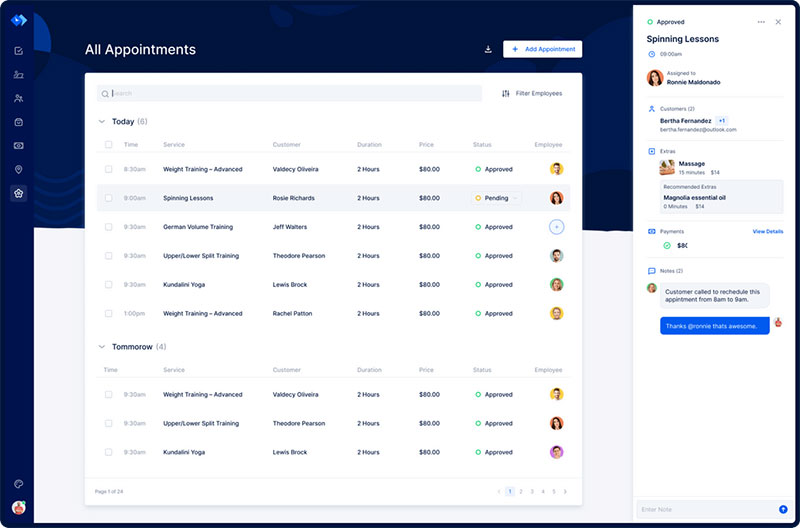
Trafft handles everything for you, even sending automated email or SMS reminders to your clients. No-shows? Not anymore!
The Trafft booking software adapts to different industries for a blissful online booking experience and employee management.
Want to know more? Check out Trafft's awesome features to see what you are missing.
Revenue Models and Pricing Structures
How a business charges for its work shapes everything downstream: cash flow predictability, customer acquisition cost, retention mechanics, and valuation multiples.
Service Pricing Structures
Most service businesses use one or more of these:
- Hourly rate - transparent but unpredictable for both sides
- Project-based fee - fixed scope, fixed price, all risk on the service provider
- Retainer - monthly recurring revenue, closest thing a service business gets to predictable income
- Value-based pricing - charge relative to outcome delivered, not time spent
Value-based pricing is where most agencies and consultants undercharge. Took me a while to see this pattern clearly, but firms that shift from hourly to value-based billing almost always see margin improvements without needing more clients. It's one of the fastest ways to increase sales revenue without adding a single new client.
Product Pricing Structures
SaaS and digital products typically follow one of these models:
| Pricing Model | Example | Best For |
|---|---|---|
| Flat subscription | Netflix, Basecamp | Simple, predictable MRR |
| Tiered subscription | HubSpot, Salesforce | Upsell path, enterprise moves |
| Freemium | Spotify, Dropbox | High-volume B2C acquisition |
| Usage-based | Stripe, Twilio | Product grows with customer |
Recurring Revenue in Both Models
Recurring revenue is the most discussed metric in product businesses. Monthly recurring revenue (MRR) and annual recurring revenue (ARR) drive valuation multiples and investor interest.
Service businesses can build recurring revenue too, mostly through retainer agreements. But the mechanics differ. A SaaS subscription renews automatically unless cancelled. A service retainer renews through relationship maintenance, scope reviews, and active client management.
Basecamp is worth noting here. It started as a project management tool built for an agency's internal use, and that origin shaped its philosophy: charge a flat fee, keep the product simple, avoid the complexity that enterprise pricing tiers create.
Startup Costs and Capital Requirements
The difference in what it costs to get started is one of the most practical factors in choosing between these models. It also shapes how much risk you're taking on before you earn a dollar.
Service Business Entry Costs
Service businesses have the lowest barriers to entry of any business type. The SBA estimates that most home-based service businesses need only $2,000-$5,000 to get started.
Your main asset is expertise. Your overhead is largely time.
- No inventory to purchase
- No manufacturing process to set up
- No product development cycle before first revenue
A freelance designer can start billing within days of deciding to go independent. A consultant who leaves a firm can often bring clients with them and generate revenue in the first month.
Product Business Entry Costs
Product businesses front-load costs significantly. Before the first sale, you need the product to exist.
Physical products require raw materials, manufacturing, inventory, and logistics infrastructure. Brick-and-mortar retail typically needs $10,000 to $300,000 to launch, according to Shopify's startup cost data (2024).
Digital products require development time, infrastructure, and often months of build before anything is shippable. That capital has to come from somewhere, either from savings, investors, or revenue from another source.
Product costs (raw materials and inventory) represent the largest share of small business funds at 31.6% of total budget allocation, according to FluentCart analysis of SBA data.
Break-Even Timelines
Service businesses can reach break-even quickly. Sometimes within the first few client engagements.
Product businesses often operate at a loss for months or years before the product generates enough revenue to cover development costs and ongoing overhead. A typical high-growth SaaS company takes 7 years from its Series B to reach a positive operating margin, according to Sapphire Ventures modeling.
That timeline is often accepted because the potential upside at scale is much higher. But it requires either patient capital or a founder willing to run lean for a long time.
Scalability and Growth Ceilings
This is the question most founders are really asking when they compare these two models: how big can this actually get?
The Service Business Ceiling
Service businesses hit a ceiling tied to people. Every hour of work has to be performed by a human. Every new client requires attention, communication, and delivery capacity.
Professional services firms saw billable utilization fall to just 68.9% in 2024, below the 75% optimal threshold, and revenue per consultant dropped to $199,000 annually (SPI Research, 2025). That's the ceiling problem made visible: your growth potential is literally capped by how many billable hours your team can produce.
Even the best-run agencies struggle to grow beyond a certain multiple of their headcount without either hiring aggressively or raising prices significantly.
The Product Business Advantage at Scale
Product businesses, especially software ones, can add customers without proportional cost increases. One more user of a SaaS platform costs almost nothing to serve once the infrastructure exists.
SaaS companies often post 70-90% gross margins on revenue (Rule of 40, Orb, 2024). As revenue scales, the margin on each incremental dollar stays high. That's the model's structural advantage.
Compare Salesforce and McKinsey. Both are massive, both are well-run. But Salesforce can double its customer base without doubling its staff. McKinsey cannot.
Hybrid Models That Bridge the Gap
Some of the most interesting businesses sit between these two categories. Agencies building internal tools and spinning them out as products. Consultants packaging frameworks into courses or software. Developers scratching their own itch and accidentally building a product-based company.
| Company | Started As | Became |
|---|---|---|
| Basecamp | Web design agency | Project management SaaS |
| HubSpot | Inbound marketing consultancy | Marketing and CRM software platform |
| Atlassian | Consulting and IT services | Software tools (Jira, Confluence) |
The pattern is consistent. Service businesses develop deep domain expertise, identify a repeatable problem, and productize the solution. That's not a shortcut. It takes years. But it's a legitimate path from service revenue to product-led scalability.
The catch: most service businesses that try this underestimate how different product development and marketing is from client services. Running both in parallel is genuinely hard. Most people who've done it will tell you that.
Risk Profiles and Business Stability
Both models carry real risk. The types just look very different.
Service businesses feel stable early on because revenue flows quickly. Product businesses look risky upfront but can build more defensible positions over time.
| Risk Type | Service Business | Product Business |
|---|---|---|
| Cash flow | Faster, tied to invoicing cycles | Slower early, predictable at scale |
| Market fit | Lower (client tells you what they want) | Higher (you have to find demand) |
| Revenue concentration | Often 2-3 clients = 60%+ of revenue | Spread across many customers |
| Failure trigger | Key client leaves or key person exits | Poor product-market fit or capital running out |
Service Business Risk Patterns
Client concentration is the quiet killer. Lose one anchor client and revenue can drop by 30-40% overnight with no warning.
Revenue concentration risk is measurable. Census Bureau data shows firms in the bottom quartile of their industry's revenue range exit at two to three times the rate of median firms (BLS Business Dynamics Statistics, 2023). For agencies and consultancies, that bottom quartile is often defined by dependence on too few clients.
Key-person dependency is the other pressure point:
- If the founder is the rainmaker, the business stalls when they step back
- If one senior person leaves, entire client relationships can walk out with them
Product Business Risk Patterns
Poor product-market fit is the leading cause of startup failure at 43%, according to CB Insights analysis of 431 VC-backed companies that shut down since 2023.
Capital burn is the other major risk. The median time from last fundraise to shutdown is just 22 months (CB Insights, 2024). Running out of money before revenue stabilizes is not a planning failure, it's a structural reality of building products.
Supplier risk management is another pressure point that physical product businesses often underestimate early. One supply chain disruption can delay launch by months, which compresses runway fast.
Blockbuster spent years watching Netflix grow and chose not to respond. That decision to protect existing revenue over adapting the product model cost them everything by 2010.
Cash Flow Patterns Compared
Service businesses invoice as work is done. Cash arrives in weeks.
Product businesses often spend for months before the first dollar comes in.
Key difference: a service business can fund itself from its first clients. A product business almost always needs capital that exists before revenue does.
Only 20.4% of businesses fail in their first year (BLS, 2024), but that number rises steeply. By year five, fewer than half of all new firms are still operating (Census Bureau Business Dynamics Statistics, 2023). Product businesses are disproportionately represented in those later-year exits because the financial runway runs out before the model matures.
Which Business Model Fits Which Founder
There is no universally better choice. The right model depends on what you have, what you want, and what you're willing to trade.
Most people who ask this question are really asking: how do I get started with the least amount of risk while building toward the kind of business I actually want?
Skills-First Founders: The Service Path
If your main asset is expertise, start with services. No product development cycle. No inventory risk. No capital raise before first revenue.
The full-time independent workforce in the U.S. doubled to 27.6 million between 2020 and 2024, with a 19% year-over-year increase in solopreneurs earning $100K+ annually (Lovable, 2024). Skills-first founders are clearly finding viable paths.
- Consultants, designers, developers, writers, coaches
- Anyone who can start billing immediately using existing expertise
- Founders who want early cash flow before committing to a long product build
Systems-First Founders: The Product Path
Product-led founders think in systems, distribution, and repeatable scale. They often tolerate longer time-to-revenue in exchange for asymmetric upside. Getting the positioning right matters too.
Podcast advertising companies have become a go-to channel for product-led startups trying to reach niche B2B audiences without the cost structure of paid search.
47% of global venture capital was invested in SaaS startups (Dealroom, 2023). That investment concentration reflects investor preference for product models with defensible recurring revenue over service models where growth requires proportional headcount.
Dropbox is the reference point for this path. The founders built a Minimum Viable Product (MVP) before committing to full development, validated demand through a simple video, and scaled to $2.5 billion in annual revenue (2023). That's the systems-first approach in full form.
Capital Access Changes the Equation
Founders with access to capital (savings, investors, revenue from another source) can take the product path from the start.
Founders without it almost always need a service bridge first.
There is nothing wrong with using service revenue to fund product development. A lot of successful product businesses started exactly that way. The risk is staying comfortable in the service model and never actually building the product.
Lifestyle and Operating Preference
| Factor | Service Business | Product Business |
|---|---|---|
| Day-to-day focus | Client relationships, delivery | Product, marketing, distribution |
| Income timing | Faster, project-driven | Slower to start, recurring at scale |
| Control over time | Client-dependent schedules | More flexibility once stable |
| Team size needed | Grows with clients | Can stay lean longer |
If managing client relationships drains you, the service model will grind you down fast regardless of how profitable it is. That's not a strategic insight, it's a practical one. Your mileage may vary.
Transitioning from a Service Business to a Product Business
The productization path is real. It's also harder than most service business owners expect.
Companies that productize their services typically achieve gross profit margins of 60-90%, compared to approximately 40% for customized professional services (Vecteris, 2024). The financial case is clear. The execution challenge is what trips people up.
Why Service Businesses Consider Productizing
The feast-or-famine revenue cycle pushes most service founders toward this decision eventually.
One month there are more projects than hours. Next month the pipeline is empty and the team is billing 30% utilization. Productized services and eventually full software products offer a path to more predictable recurring revenue that doesn't depend entirely on client timing.
For teams handling sensitive client data during this transition, switching to a secure messaging app for internal communication is a small but worthwhile operational upgrade.
Subscription businesses are growing revenues 5x faster than S&P 500 counterparts, and B2B subscription services reached an estimated $344.3 billion by 2024 (Vecteris, citing Gartner research). That's the market service businesses are trying to reach when they productize.
Steps to Transition
Start by identifying the repeatable problem. Look at the last 10 client engagements. What kept coming up? What did you solve the same way every time?
That repeatable solution is your product candidate.
- Package it with fixed scope and fixed pricing
- Test it with existing clients before building anything new
- Document the delivery process before automating or scaling it
- Only invest in software or tooling after the packaged version sells
VideoHusky is a useful small-scale example. The company productized a video editing service into a fixed subscription model and reached $1.2 million per year in annual recurring revenue (Assembly, 2024). No software. Just a service packaged and priced like a product.
Risks of the Transition
The biggest mistake: diverting attention from the service revenue before the product revenue stabilizes.
Most firms that try this successfully run both for at least 12-24 months before the product side generates enough to make the service side optional. Cutting service clients too early is the fastest way to run out of cash mid-transition.
McKinsey research found that 9 out of 10 companies across all industries are creating digital business lines to stay viable. The direction is clear. But the timing and sequencing of that transition is where most service businesses make expensive mistakes.
Basecamp did it right. Jason Fried and team ran a profitable web design agency, built project management tooling for internal use, and only launched it as a product after it was already proven. They never took outside funding and the product eventually made the agency entirely optional.
FAQ on Service Business vs Product Business
What is the main difference between a service business and a product business?
A service business delivers value through human effort and expertise. A product business sells a physical or digital good that exists independently of the person who made it. One scales with people, the other scales with distribution.
Which business model is more profitable?
Product businesses, especially SaaS, typically reach higher margins at scale. SaaS gross margins average 70-90%, while professional services firms run at 15-25% net margins. Service businesses can be profitable early.
Product businesses become more profitable over time, especially when they compete on the best quality products rather than price. Commoditized product markets compress margins fast. Differentiation on quality is what sustains pricing power long-term.
Which is easier to start with limited capital?
Service businesses. The SBA estimates most home-based service businesses need only $2,000-$5,000 to launch. Product businesses require capital before generating revenue. If your budget is tight, services give you the fastest path to cash flow.
Can a service business become a product business?
Yes, and many do. Basecamp started as a web design agency before building its project management software. The path is called productizing a service. It takes 12-24 months to transition without disrupting existing service revenue.
What is a hybrid business model?
A hybrid combines service delivery with a product offering. HubSpot sells software but also provides onboarding services. It's common in B2B. The tradeoff is operational complexity. Running both models simultaneously requires clear resource separation.
Which model is better for recurring revenue?
Product businesses generate recurring revenue more naturally through subscriptions. Service businesses can build recurring revenue through retainers, but renewals require active client management. Subscription-based product models renew automatically. Service retainers rarely do.
What are the biggest risks in each model?
Service businesses face client concentration risk and key-person dependency. Losing one anchor client can drop revenue by 30-40% overnight. Product businesses face poor product-market fit, which CB Insights identifies as the top cause of startup failure at 43%.
Which model scales faster?
Product businesses scale faster because adding customers doesn't require proportional headcount growth. Service businesses hit a ceiling tied to billable hours. SPI Research found billable utilization in professional services fell to just 68.9% in 2024, reflecting that ceiling clearly.
Is a freelance business a service business?
Yes. Freelancing is the most direct form of a service business. You sell time and expertise. Revenue is tied to your available hours. It's a low-cost starting point, but the time-for-money ceiling applies unless you productize or hire.
How do investors view service businesses vs product businesses?
Investors strongly prefer product businesses. Product and SaaS companies typically achieve valuations of 8x revenue. Traditional service firms often receive just 1x revenue. Recurring revenue, scalability, and margin structure all make product businesses significantly more attractive to outside capital.
Conclusion
Choosing between a service business vs product business comes down to where you are right now, not where you want to end up.
Services offer faster cash flow, lower startup costs, and a direct path to revenue using existing expertise. Products offer higher margins, scalable distribution, and better valuation multiples at scale.
Neither model wins outright. A bootstrapped consultancy and a SaaS company can both generate serious income. The difference is in how they get there and what the ceiling looks like.
If capital is tight, start with services. Build the domain knowledge. Then productize when the repeatable problem becomes obvious.
The best founders treat the service-to-product transition as a strategy, not an accident.



 English
  Deutsch
  Español
  Français